
Exhibition · P·P·O·W
Hew Locke
The Wanderers
Sep 9 – Oct 24
3 images · swipe
About the show
P·P·O·W is pleased to present The Wanderers, Hew Locke's third solo exhibition with the gallery. Featuring new sculptures, watercolors, and altered share certificates, the exhibition is shaped by Locke’s longstanding engagement with the restless movement of people, objects, capital, and ideas across oceans and time. For more than three decades, Locke has created works of extraordinary visual richness – layering beads, medals, trophies, jewelry, financial instruments, and heraldic devices into exuberant assemblages that reward sustained looking. Across these works, acts of gathering, adornment, and accumulation trace the afterlives of empire.
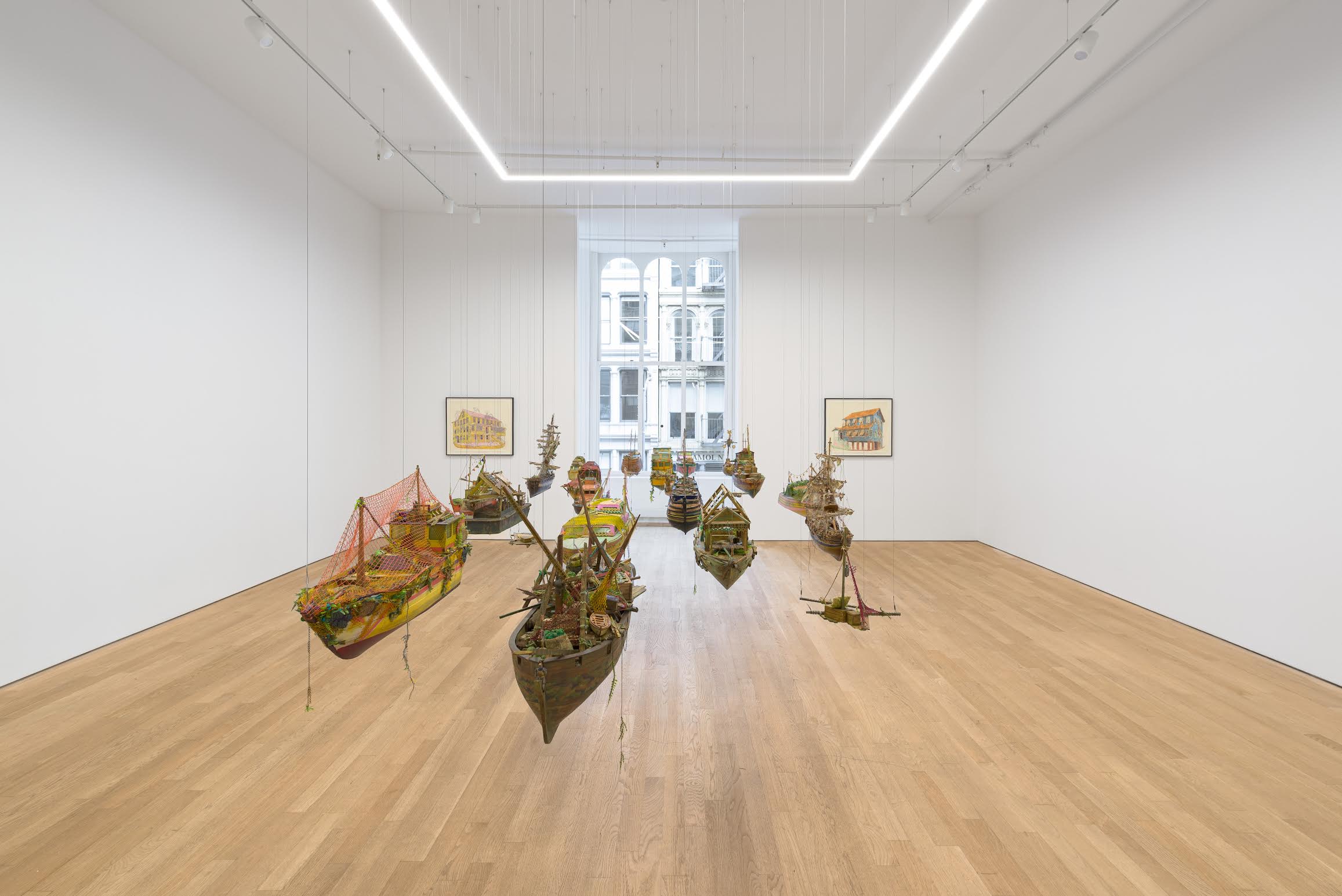
Continuing his series, Odyssey, a new fleet of intricately embellished votive boats draws on the tradition of devotional model ships once suspended in churches and cathedrals as offerings for safe passage at sea. Ranging from seventeenth-century galleons and schooners to twentieth-century tankers and fishing boats, Locke's fleet unites disparate places and moments in time. Laden with beads, flags, reproduction medals, cowrie shells, coins, painted camouflage, and imagery derived from the artist’s own altered share certificates, each vessel carries a cargo of histories shaped by migration, trade, and conquest. Locke's boat installations echo his own journeys within and between Guyana and Britain, placing them within a much longer history of ocean crossings that have shaped the sea as a space of encounter and cultural transmission, where histories of displacement are inseparable from those of survival and hope.
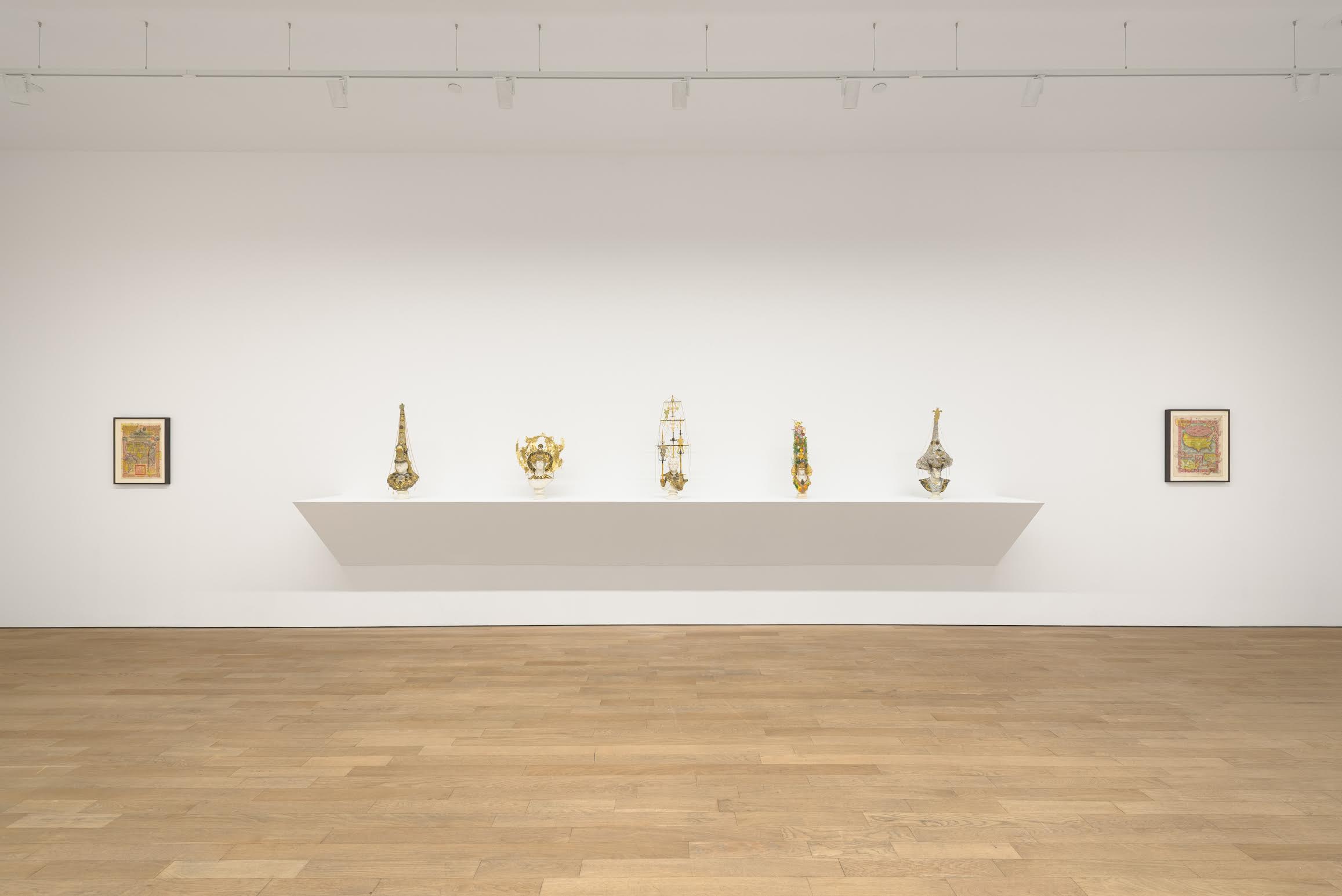
Drawing on the visual language of ornament and excess, Locke’s Souvenirs investigate how splendor has long served as a language of wealth and power. Through acts of elaborate adornment, Locke transforms nineteenth-century Parian ware busts of figures including Queen Victoria, Princess Alexandra, Horatio Nelson, and George Washington into sites of carnival and masquerade. Originally produced for Victorian homes as commemorative souvenirs, Locke dresses these familiar historical figures with found objects imitating precious metals and ceremonial regalia, inviting viewers to reconsider how beauty, spectacle, and dominance have long been intertwined. In the artist’s words, the figures become "weighed down by the literal burden of history," revealing how icons of authority continue to acquire new meanings even as the worlds that produced them recede into the past.
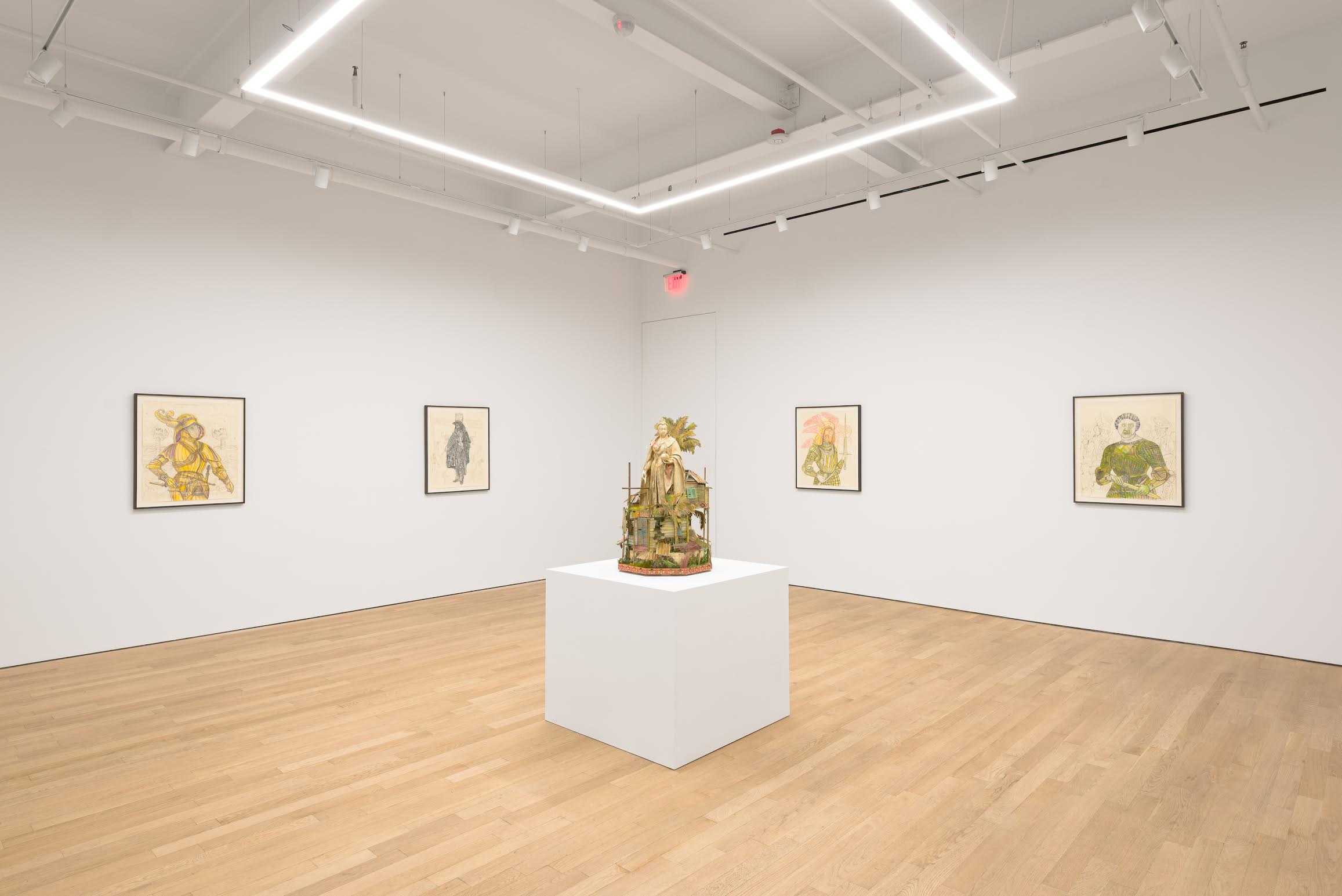
Furthering Locke’s longstanding engagement with public monuments, a new sculpture, Foreign Exchange 3, 2026, reimagines a statue of Queen Victoria set within a landscape of Caribbean vernacular architecture and tropical vegetation. The sculpture is animated by painterly passages of color inspired by Post-Impressionist painting and the ongoing history of the defacement of monuments. Through these diverse visual languages, Locke reimagines public monuments as mutable objects continually reshaped through encounter and movement.
Locke’s sculptures are flanked by portraits of medieval knights, altered share certificates, and watercolors of Guyanese colonial timber houses. In the first showing of two new series of works, inspired by the romantic imagery of Edward Burne-Jones and the Pre-Raphaelites, Knight Errant returns to the Arthurian legends that formed part of Locke's colonial education in Guyana, reimagining the wandering knight through a distinctly Caribbean lens. Spirit House likewise transforms vernacular stilt houses into repositories of memory, their façades inhabited by memento mori figures, monkeys, and vestiges of British colonial rule. A new group of altered share certificates convert instruments of colonial commerce into meditations on finance, extraction, and empire. Locke’s explorations of varied geographies and inherited imagery present a body of work that transforms the historical lexicon, accessing new potential in the continual exchange between cultures and generations.
Hew Locke OBE RA (b. 1959) received an MA in sculpture at the Royal College of Art in 1994. His work is in the permanent collections of the Tate, London, UK; Metropolitan Museum of Art, New York, NY; Pérez Art Museum, Miami, FL; and British Museum, London, UK, among many others. His work has been the subject of numerous solo exhibitions including Here’s the Thing which opened at Ikon Gallery, Birmingham, UK, in 2019 before traveling to the Kemper Museum of Contemporary Art, Kansas City, MO, and the Colby College Museum of Art, Waterville, ME. In March 2022, Locke presented The Procession, The Duveen Hall Commission for Tate Britain, London, UK, which later travelled to The Baltic Centre for Contemporary Art, Newcastle and the Institute of Contemporary Art, Boston. Locke unveiled Gilt, the Façade Commission at The Metropolitan Museum of Art, New York, in September 2022. His groundbreaking show, Hew Locke: what have we here?, opened at the British Museum, London, UK, in Fall 2024.
About P·P·O·W
P·P·O·W was founded by Wendy Olsoff and Penny Pilkington in the first wave of the East Village art galleries in New York City in 1983. In 1988 the gallery moved to Soho, in 2002 moved to Chelsea, and opened in Tribeca in 2021. Since its inception, the gallery has remained true to its early vision, showing contemporary work in all media.
More about P·P·O·W →