Ended Apr 23
Paul Rusconi
Portraits of Trees, St. James’s Park, and 21 Florals
Mar 27 – Apr 23, 2025
More from Paul Rusconi on Gallop
Robilant+Voena is pleased to present an exhibition of new works by Paul Rusconi in New York. This is the first showing of two bodies of work that the artist has developed in recent years, his Portraits of Trees and his Expansions Florals, consisting of 11 paintings and 21 works on paper. The former are a reflection of Rusconi’s exploration of the connection between individual trees, and between trees and mankind; while the latter offer a distillation of portraits of people pared to their core essence, emerging as looping lines on a colour field. The exhibition is fittingly timed with the onset of spring in New York, and just minutes from the city’s green oasis of Central Park.
Best known for his portraits of people, including those of notable figures such as Barack Obama and Kate Moss, in this exhibition Rusconi turns his attention to trees, using his signature medium of nail varnish on plexiglass. The large-scale paintings are not simple representations of these great beings, but also speak to the connectedness of single trees into a network, joined by unseen underground forces and processes. To create these ethereal, emphatically coloured paintings – which the artist also considers to be portraits – Rusconi applies thousands of individual dots of nail varnish, building contemporary pointillist visions that are evocative of blurred photographic snapshots, glimpsed through blue- or pink- or green-tinted lenses. These composite paintings might resemble the works of Roy Liechtenstein or Chuck Close; yet unlike Lichtenstein’s uniform dots, Rusconi’s vary in size and weight, in order to convey the subtleties of light and form.
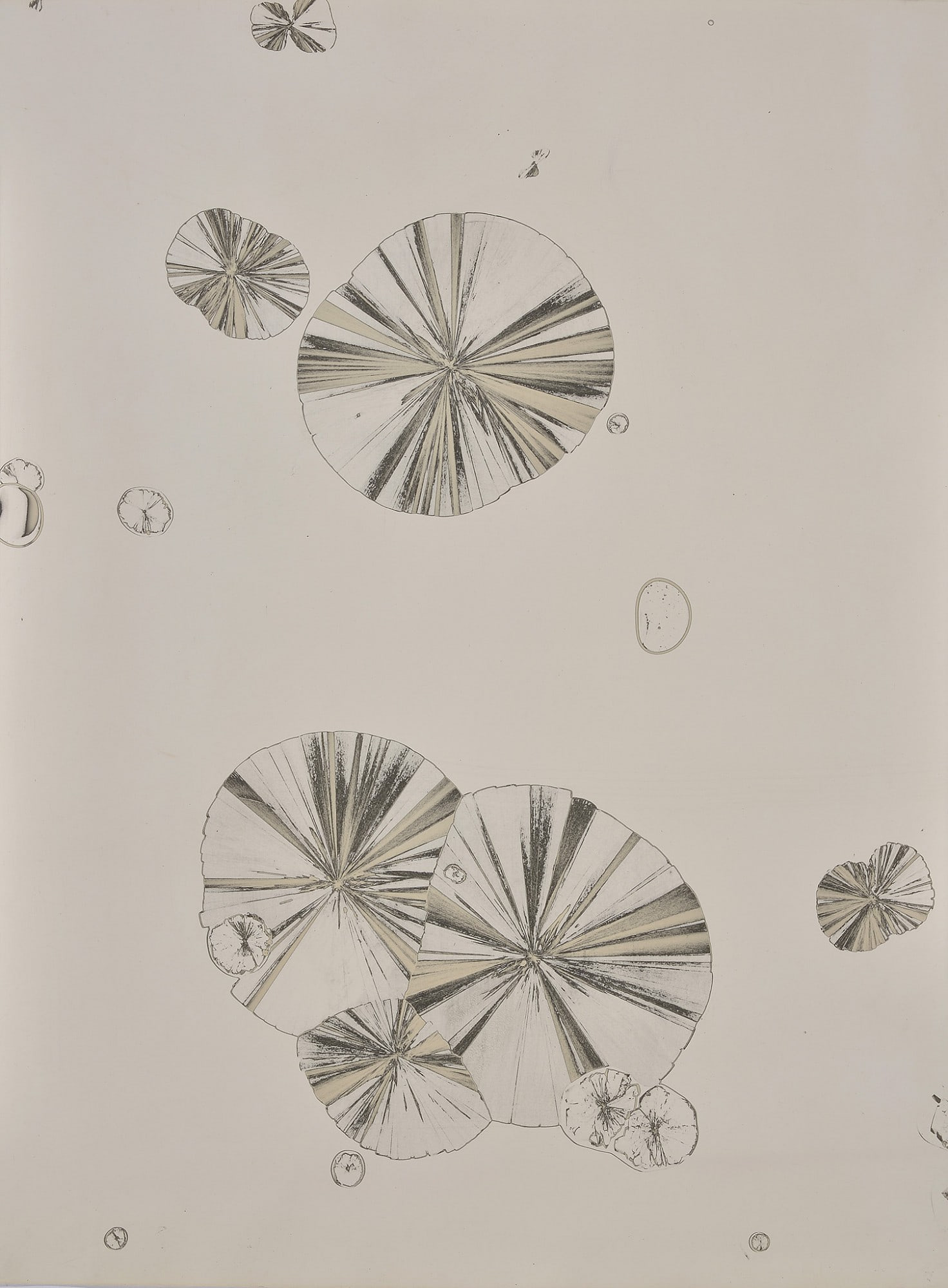
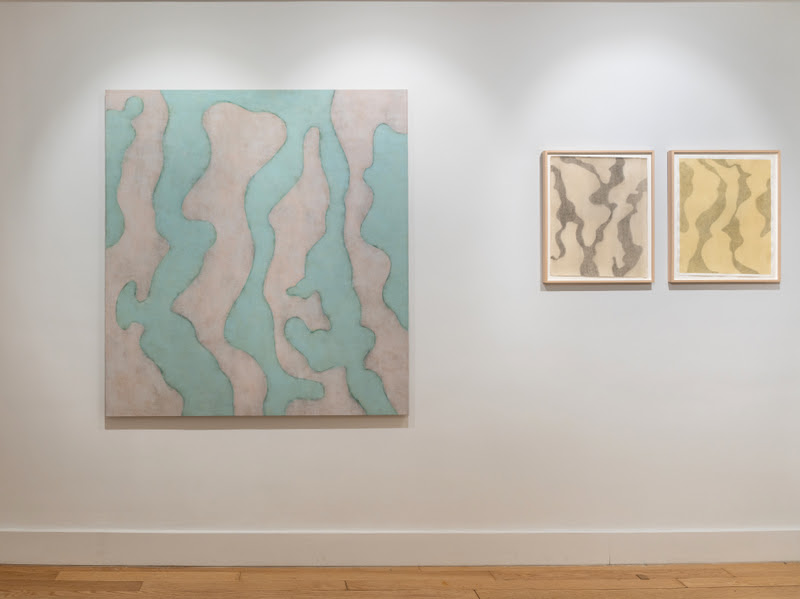
Alongside this series of paintings, the exhibition also includes works on paper that consist of extruding lines of colour, made using spray paint and coloured pencil. Each composed of fourteen looping lines creating seven outstretching rays, a purified representation of the human form in which the artist seeks to capture the essence of the individual. This group of works is related to a previous series, the multi-hued Expansion Paintings. The formal ambiguity of his latest works, however, led the artist to give them the title Expansion Florals, an allusion to the petal-like shapes that emerge rhythmically across the paper, suggesting an eternal cycle of rebirth and renewal, and inherent joy. The intentional openness of interpretation allows the viewer to come to the work through their own perspective, while simultaneously offering an unabridged experience of beauty.
Speaking about the Portraits of Trees, Rusconi describes how he experienced a profound compulsion to make the works: “The tree is a spiritual totem. I recognized this as a child. Somewhere along the line of adulthood my connectedness to them faded, until many years later. In 2016 I stood in the middle of St. James’s Park, London and began to recognize the relationship between each tree. They felt related, like they were in communion with one another. There was mutual respect and adoration. I knew I needed to paint their portraits, I was compelled... After 8 years - this body of work is the result.”
The creation of these Portraits through meticulously-placed single dots of nail varnish – the larger dots are created with the nail varnish applicator brush, the smaller ones with a toothpick – is integral to this idea of connectedness, to the relationship between the individual and the whole. Across his practice, Rusconi’s concern with the dot is relaying imagery as if through the lens of a computer; the computer, in his view, is for today’s artists what the invention of photography was for the Impressionists. In his handmade fields of dots, Rusconi mimics the pixels of a computer, yet imbues this process with an essentially human spirit and sense of beauty. In the Portraits of Trees, Rusconi builds upon ideas from Paul Wohlleben’s 2015 book The Hidden Life of Trees, which illuminates how a forest is like a social network. Each dot of colour is akin to an individual tree – an entity in its own right, yet connected to others around it in a pulsating, dynamic relationship that only becomes clear when you step back and take a wider view.
As the artist explains: “These trees are not only representations of connectedness between all things, but the beauty that can result from such connections. Each mark is a circle unto itself. They exist in a singular form, but combined and connected in context with others, a fuller, more complex image unfolds.”
Paul Rusconi (b. 1965) is a painter living and working in Los Angeles. His practice centres on portraiture, both in the conventional sense of the term – namely human visages – and in an expansive sense, including text-based images, and his latest body of work Portraits of Trees. His practice also includes extruding lines of colour, the Expansion Paintings. For the artist, these categories are all portraits; indeed, he considers himself a conceptualist, and the formal objects he makes are simply an expression and representation of his ideas. The aim of his portrait investigations is to convey not only a likeness of his subject, but also the subtlety of emotion and expression.
In 2016, Rusconi’s paintings were the subject of a major exhibition at the Abroms-Engel Institute for the Visual Arts, University of Alabama at Birmingham, Paul Rusconi: Emanations. The show consisted of portraits of artists are viewed as having a profound and transformative impact on their field, including Ed Ruscha, John Baldessari, Agnes Martin, and Chuck Close.
Rusconi’s works feature in collections and foundations across the United States and internationally, including; Abroms-Engel Institute for the Visual Arts, Birmingham, AL; The Batonga Foundation, Washington DC; The Frederick R. Weisman Art Foundation, Los Angeles, CA; the Carnegie Art Museum, Oxnard, CA; The International Contemporary Art Foundation, Louisville, KY; the Interface Foundation, Fairfax Station, VA; and the Castilla Foundation, Madrid.