Ended Nov 12
Ian Hamilton Finlay
Et in arcadia ego
Sep 14 – Nov 12, 2016
More from Ian Hamilton Finlay on Gallop
[Please scroll down for German version / Für Deutsch bitte scrollen Sie nach unten]
Kewenig is devoting a solo exhibition to Ian Hamilton Finlay (1925–2006) ten years after the Scottish poet and concept artist’s death. The show will feature works dating from the 1960s onward. Starting in the 1980s, within the context of close friendship and cooperation with the artist, Jule and Michael Kewenig amassed comprehensive holdings of prints, sculptures and installations by Finlay, of which many will now be on view. Introduced by the words “Philemon – Baucis” at the entrance, [1] the show will spread throughout the garden and the three floors of the gallery, all the way up to the gabled roof integrating two golden roof shingles in memory of the artist. Following exhibitions in Frechen (1988, 1990), Cologne (2006) and Palma de Mallorca (2009), ‘Et in Arcadia ego’ will be the first solo presentation of Finlay’s works in the Berlin gallery.
Born in Nassau, Bahamas in 1925, Finlay went to school in Scotland, carried out military service there and then attended the Glasgow School of Art. When he began writing short stories and poems, he was working as a shepherd. He published his first book, The Sea Bed and Other Stories, in 1958, and in 1963 his first volume of poetry, Rapel, that earned him international renown. From 1966 onward the poet lived in his Scottish refuge Stonypath in the Pentland Hills. Over the years, he developed the estate’s gardens – which he called Little Sparta – into a poetic synthesis of the arts with plants, stone reliefs, sculpture, fragments of Neoclassicist-style temples and landscape design distinguished by precision down to the smallest detail. To this day, Little Sparta is considered one of the masterpieces of modern British horticulture. Since 1972, Finlay’s sculptural works have been installed in public and private parks, gardens and buildings in many European countries. The Kewenig show will present Cubes (1987); Kapitell (1989), and A/or, Unit, Signs (1989) on the gallery’s ground floor and in its garden.
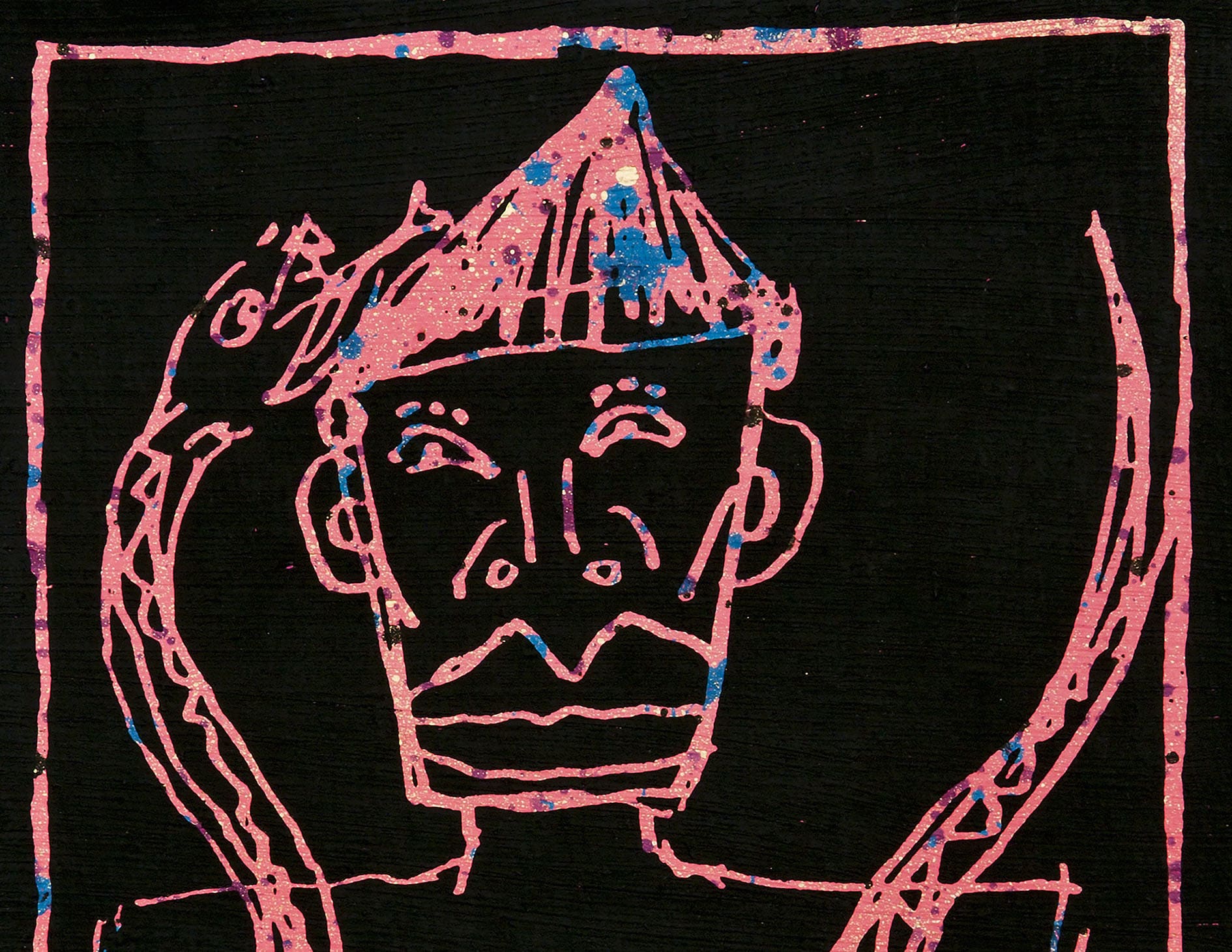
On the first exhibition floor of the gallery, the neon work Je Vous Salue Marat will greet the visitor with the colours of the French tricolour: Finlay executed it in 1989 on the occasion of the two-hundredth anniversary of the French Revolution. This large work complex invokes the bloody consequences of a series of events that began as a struggle for freedom, equality and brotherhood and ended in a dictatorship. Sentences such as “Terror is the piety of revolution” reveal Finlay’s stance on the French Revolution as historical proof of the coexistence of violence and clarity of thought. Jean Paul Marat (1743–1793), one of the French Revolution’s most infamous demagogues, turns up repeatedly in Finlay’s prints – for example the lithographs Marat Assassiné (with Gary Hincks) (1986) and Head of the Dead Marat (with Gary Hincks) (1987) – as a quotation from Jacques Louis David’s Neoclassicist masterwork The Death of Marat (1793).
Concrete poetry forms the core and beginning of Ian Hamilton Finlay’s œuvre. Images and words combine with elements from nature, art and the history of culture and manifest the interdependency between visual depiction and the meaning of the written word. Over the course of forty-five years, in the Wild Hawthorn Press publishing company he founded in 1961 and in his magazine Poor. Old. Tired. Horse, Finlay published booklets, postcards and posters in more than a thousand different forms in collaboration with well-known artists. These images and writings – graphically designed poems and so-called Poster Poems, aphorisms and neologisms, but also allegorical paintings and drawings – still distinctly characterize his early works of the 1960s as concrete poetry. His later text-image works, on the other hand, are closer to visual poetry in style. They are references to prominent protagonists and disastrous events of Occidental history. Walter Benjamin’s proposition “There is no document of culture that is not at the same time a document of barbarism” [2] demarcates the scope of the core themes of Occidental cultural history addressed by the works in the exhibition: the arcadian conceptions of the seventeenth century, the virtuous ideals and violent excesses of the French Revolution and Neoclassicism, and the appropriation of the latter by National Socialism. In a formal language all his own, Finlay anti-modernistically defied the twentieth-century avant-garde’s dictate of abstraction. His vocabulary of motifs unites depictions of wildflowers, the Greek gods and idyllic seascapes with images of battleships, guillotines and tanks, and enriches these instances of syncretism with contents of a political as well as a philosophical nature.
The exhibition title ‘Et in Arcadia ego’ – which Finlay himself used in various works – points to a motif often quoted in literature, painting and garden art since the Renaissance. The French Baroque painter Nicolas Poussin made reference to it in the two versions of his painting The Arcadian Shepherds (1630/1640), showing a group shepherds standing around a sarcophagus in a classical landscape. In 1935 and 1951, Erwin Panofsky wrote two paradigmatic essays on Poussin’s Arcadia works that had a decisive impact on Finlay’s repeated employment of the motif from the late 1970s onward. [3] Arcadia was already glorified in ancient Greece as a topos where, remote from society and its constraints, a shepherd could live in harmony with idyllic nature. Yet the omnipresence of death shatters the dream of freedom dreamt by the mythological creatures in Arcadia. Finlay made frequent allusion to the realm of the gods as described in Ovid’s Metamorphoses and Virgil’s narratives, and paid tribute to the latter author with his Virgil bricks (1987) and the painting Hanging Virgil (with Ron Costley) (1987). His reception of the mythological motif of Apollo and Daphne is manifest in various derivations from Gian Lorenzo Bernini’s Baroque sculpture of 1622–1625 in the form of wall reliefs and prints.
Turner was nominated for the Turner Prize in 1985. In 2012, the Tate Britain London devoted a comprehensive exhibition to the artist. His works are represented worldwide in the most important international and private collections.
[1] A reference to the Finlay’s stone medallions bearing the same names that lined the approach to the gallery in Frechen.
[2] Walter Benjamin, Selected Writings, vol. 4, 1938–1940, edited by Howard Eiland and Michael W. Jennings, trans. Edmund Jephcott et al. (Cambridge, 2003), p. 392.
[3] See Erwin Panofsky: “Et in Arcadia ego: Poussin and the Elegiac Tradition”, idem, Meaning in the Visual Arts (Garden City, 1955).
*****
Kewenig widmet dem schottischen Lyriker und Konzeptkünstler Ian Hamilton Finlay (1925-2006) zehn Jahre nach seinem Tod eine Einzelausstellung mit Werken ab den 1960er-Jahren. In enger Freundschaft und Zusammenarbeit von Jule und Michael Kewenig mit Ian Hamilton Finlay ist seit den 1980er Jahren ein umfassender Bestand an Grafiken, Skulpturen und Installationen Finlays entstanden, der in der Ausstellung in Teilen versammelt wird. Bespielt wird das ganze Haus: Eingeleitet von dem Schriftzug „Philemon - Baucis“ am Hauseingang [1], erstreckt sich die Ausstellung über den Garten und die drei Etagen der Galerie bis hinauf in das Satteldach, in welchem als Reminiszenz an den Künstler zwei goldene Dachschindel eingearbeitet wurden. Nach Ausstellungen in Frechen (1988, 1990), Köln (2006) und Palma de Mallorca (2009) ist ‚Et in Arcadia ego’ die erste Einzelschau von Finlays Arbeiten in der Berliner Galerie.
Finlay, 1925 in Nassau, Bahamas geboren, ging in Schottland zur Schule, absolvierte den Militärdienst, besuchte anschließend die Glasgow School of Art und arbeitete als Schäfer, als er begann Kurzgeschichten und Gedichte zu schreiben. 1958 veröffentlichte er sein erstes Buch „The Sea Bed and Other Stories“ und 1963 den ersten Gedichtband „Rapel“, mit dem er international bekannt wurde. Von 1966 an lebte und arbeitete der Poet in seinem schottischen Refugium Stonypath in den Pentland Hills, dessen Gartenreich Little Sparta er im Laufe der Jahre mit Pflanzen, Steinreliefs, Skulpturen und Tempelfragmenten in neoklassizistischem Stil und detailgenauer Landschaftsgestaltung zu einem poetischen Gesamtkunstwerk entwickelte. Little Sparta gilt bis heute als eines der Hauptwerke britischer Gartenbaukunst der Moderne. In vielen europäischen Ländern wurden seit 1972 in öffentlichen und privaten Parks, Gärten und Gebäuden Finlays plastische Werke installiert. Bei Kewenig werden die Werke "Cubes" (1987), "Kapitell" (1989) und "A/or, Unit, Signs" (1989) im Erdgeschoss und im Garten der Galerie gezeigt.
Auf der ersten Ausstellungsetage der Galerie begrüßt die Neonarbeit in den Farben der französischen Trikolore „Je Vous Salue Marat“ den Besucher, die Finlay 1989 anlässlich des 200jährigen Jubiläums der Französischen Revolution schuf. In einem großen Werkkomplex beschwört Finlay die blutigen Entgleisungen der Französischen Revolution, deren Kampf für Freiheit, Gleichheit und Brüderlichkeit zur Gewaltherrschaft wurde. Sätze wie „Terror ist die Frömmigkeit der Revolution“ legen Finlays Haltung zur Französischen Revolution als einen historischen Beleg für die Koexistenz von Gedankenschärfe und Gewalt offen. Jean Paul Marat (1743-1793), einer der berüchtigtsten Demagogen der Französischen Revolution, taucht als motivisches Zitat von Jacques Louis Davids klassizistischem Meisterwerk „Der Tod des Marat“ (1793) in Finlays Druckgrafiken wiederholt auf, so in den Lithographien „Marat Assassiné (with Gary Hincks)“ (1986), oder „Head of the Dead Marat (with Gary Hincks)“ (1987).
Im Zentrum und am Anfang des Werkes von Ian Hamilton Finlay steht die konkrete Poesie. Bilder und Worte verbinden sich mit Elementen aus Natur, Kunst und Kulturgeschichte und manifestieren die Dependenz von visueller Darstellung und Sinngehalt des geschriebenen Wortes. Während 45 Jahren hat Finlay in seinem 1961 gegründeten Verlag Wild Hawthorn Press und seiner Zeitschrift Poor. Old. Tired. Horse, über 1.000 Spielformen von Booklets, Postkarten und Plakaten in Zusammenarbeit mit benannten Künstlern herausgegeben. Jene Bilder und Schriftstücke – graphisch gestaltete Gedichte und sog. Poster Poems, Aphorismen und Neologismen aber auch allegorische Bilder und Zeichnungen – charakterisieren seine frühen Arbeiten der 1960er Jahre noch deutlich als konkrete Poesie, während die späteren Text-Bild-Bezüge vor allem der visuellen Poesie nahe stehen. Es sind Verweise auf herausragende wie katastrophale Ereignisse und Protagonisten der abendländischen Geschichte. Walter Benjamins These „Es ist niemals ein Dokument der Kultur, ohne ein solches der Barbarei zu sein“ [2], eröffnet die Tragweite der in der Ausstellung fokussierten zentralen Themen der abendländischen Kulturgeschichte: Die Arkadienvorstellungen des 17.
Jahrhunderts, die tugendhaften Vorstellungen wie gewalttätigen Exzesse der Französischen Revolution und den Klassizismus und dessen spätere Aneignung durch den Nationalsozialismus. In ureigener Formensprache trotzt Finlay antimodernistisch dem Abstraktionsdiktat der Avantgarde des 20. Jahrhunderts. Er vereint in seinem motivischen Vokabular Darstellungen von Wildblumen, griechischen Götterwesen und idyllischen Meereslandschaften mit solchen von Kriegsschiffen, Guillotinen und Panzern und reichert jene Synkretismen mit politischen wie philosophischen Inhalten an.
Der Ausstellungstitel ’Et in Arcadia ego’, den Finlay selbst in diversen Werken verwendet, verweist auf ein vielzitiertes Motiv der Literatur, Malerei und Gartenkunst seit der Renaissance. Der französische Barockmaler Nicolas Poussin greift es in seinen beiden Bildfassungen „Die Hirten von Arkadien“ (1630/1640) auf, in denen Hirten in klassischer Landschaft einen Sarkophag umstehen. Erwin Panofsky hat 1935 und 1951 zwei paradigmatische Essays zu den Arkadienbildern Poussins geschrieben, welche Finlays wiederholte Rezeption des Motivs seit den späten 1970er Jahren maßgeblich prägten. [3] Arkadien, schon in der Zeit des Hellenismus als Topos fern von gesellschaftlichen Zwängen verklärt, an dem ein Hirtenleben in Einklang mit der idyllischen Natur möglich sei. Sogleich wird jener Traum von arkadischer Freiheit, in der sich die mythologischen Wesen in Arkadien wähnen, von der Allpräsenz des Todes durchbrochen. Finlay nimmt auf die Götterwesen, die in Ovids Metamorphosen wie auch in Vergils Erzählungen überliefert sind, vielfach Bezug und ehrt die Autoren in seinen geprägten Ziegelsteinen „Virgil“ (1987) wie auch in dem Gemälde „Hanging Virgil (with Ron Costley)“ (1987). Die Rezeption des mythologischen Motivs von Apollo und Daphne erfolgt im Rahmen verschiedener Ableitungen von Gian Lorenzo Berninis barocker Skulptur von 1622-1625 in Form von Wandreliefs und Druckgrafiken.
1985 wurde Finlay für den Turner-Preis nominiert. 2012 widmete die Tate Britain, London, dem Künstler eine umfassende Ausstellung. Seine Werke sind weltweit in den wichtigsten internationalen und privaten Sammlungen vertreten.
[1] Eine Referenz an die gleichnamigen Steinmedaillons Finlays, die den Zugang der Galerie in Frechen säumten.
[2] Walter Benjamin: „Über den Begriff der Geschichte“, These VII, in: Gesammelte Schriften, hrsg. v. R. Tiedemann und H. Schweppenhäuser, Bd. I.2 – Abhandlungen, Frankfurt a.M. 1978 (2), S. 696.
[3] Vgl. Erwin Panofsky: „Et in Arcadia ego. Poussin und die Tradition des Elegischen“, in ders.: Sinn und Deutung in der bildenden Kunst, hrsg. v. Volker Breidecker, Berlin 2002.