
Exhibition · Greenspon
Nancy Barton
Swan Song
Apr 26 – Jun 1
About the show
Greenspon Gallery is pleased to present the exhibition Swan Song, a series of works created in 1988, by New York-based artist Nancy Barton.
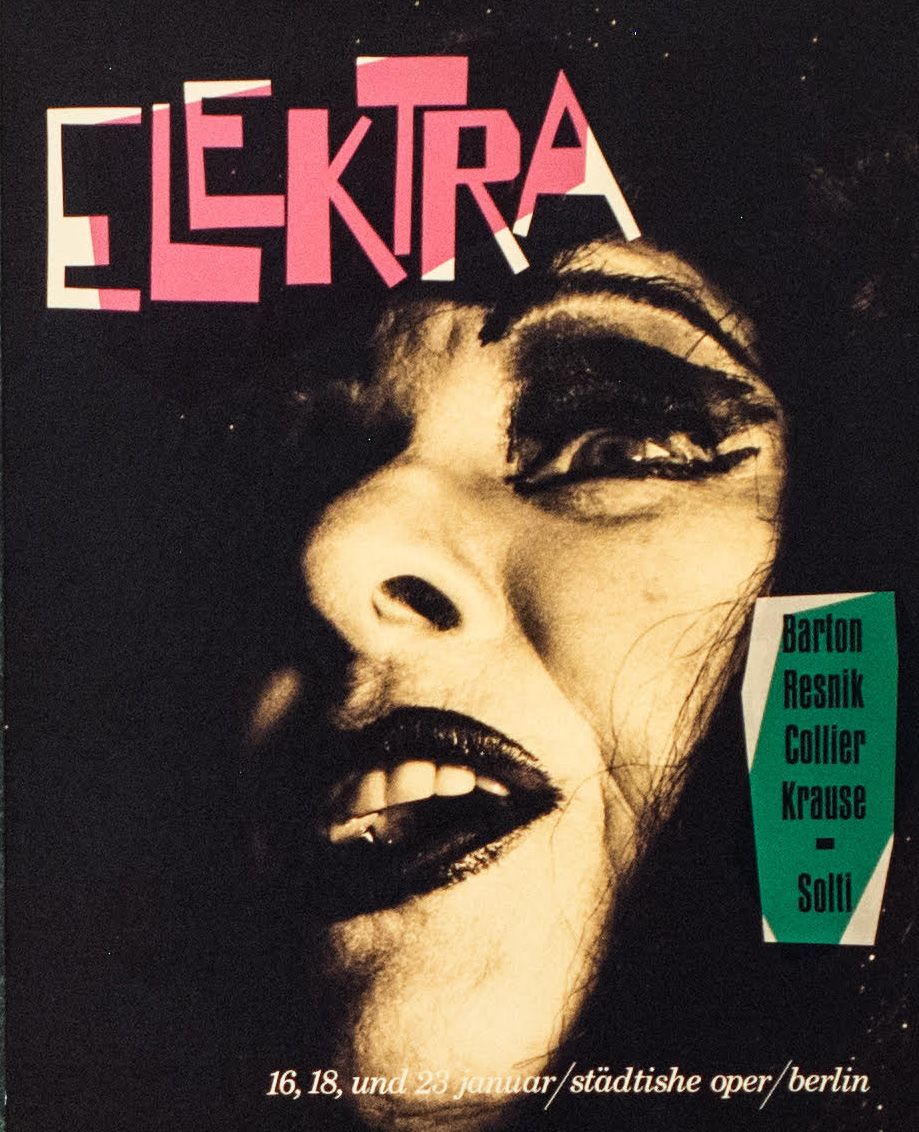
Swan Song is a series of ten photographic reliefs. Central in each is a poster-like advertisement for a well-known opera featuring a woman costumed as an iconic tragic heroine (such as Elektra, Anna Bolena, and Salome). Each piece in the series is composed in the same format, and comprises image, object, and text. The staged photographic posters echo the camp stylings of vintage opera and star the artist’s mother Marjorie Barton, who studied opera singing at the Julliard School of Music but abandoned her pursuits to raise a family. The posters are placed on top of vertical columns of marbled Formica, which are screen printed with quotations from the writings of Catherine Clément, Hélène Cixous, and Luce Irigaray, as well as texts written by the artist and her mother. As a part of the project, Barton worked closely with Marjorie to recreate her singing career through a series of performances. In the press release for Swan Song’s first showing, at American Fine Arts in 1988, the series is described as a “layered narrative which investigates the cultural function of the tragic heroine as a vessel for displaced grief and anxiety.” Barton’s juxtaposition of Formica-mounted images with the highly theoretical, oblique texts creates a disorienting collision between rigorous feminist theory and the camp sentimentality of operatic tropes.
Barton, a graduate of CalArts and a student of John Baldessari, Catherine Lord and Benjamin H.D. Buchloh, created this body of work at the tail end of the Pictures Generation and the emergence of identity politics. But Swan Song does not fully align with the strategies or aesthetics of either movement, making it an unsettling and unclassifiable project. Barton collapses the cool distance of appropriative operations with her insertion of intimate, personal narrative. The artist’s direct address of motherhood, even today a taboo subject for contemporary artists, is the series’ most unusual trait and radical gesture. Barton offered a succinct rationale for Swan Song at the time of its making in the 1980s. Informed by her insight into critical and psychoanalytic theory, the artist posited that it was a means of working through the Freudian triangulation of mother-father-child, as well as an attempt to resurrect Marjorie’s thwarted artistic evolution. This familial exploration is enveloped by a meditation on woman’s self-fulfillment and self-representation outside of—or in resistance to—the tautological notions of the feminine and femininity.
Barton is now the same age Marjorie was when she posed as her daughter’s matriarch, model, and muse. In the wake of her mother’s passing and 14 years after the series was made, she reflected back on the project’s critical matrix through the very human lens of love, loss, and mourning. While Barton once pictured and posed her mother’s body-as-image, in the end she confronted and upholds Marjorie on her own terms, as a woman of her own making.
Nancy Barton (b. Los Angeles, 1957) lives and works between New York City and upstate New York. In addition to its debut at American Fine Arts in 1988, the Swan Song series was included in California Photography: Remaking Make-Believe, curated by Susan Kismaric at The Museum of Modern Art in 1989. Her work was shown alongside John Baldessari, Jo Ann Callis, John Divola, Robert Heinecken, Larry Johnson, and Larry Sultan.
Artist, writer, and educator, Barton works across photography, performance, and mixed media installation. Between 2005 and 2011 she chaired the Department of Art at New York University, where she continues to teach. She is the Founding Director of the Prattsville Art Center & Residency in Prattsville, NY. Barton has exhibited her work at 80 WSE Gallery, New York; MIT List Visual Art Center, Cambridge; The Art Center College of Design, Pasadena; among others. She frequently publishes and her writing has appeared in Art US, Bomb, Flash Art, Lacanian Ink, and Work and The Image.