Ended Mar 2
Sylvie Fleury
Just Jacuzzi
Jan 24 – Mar 2, 2024
More from Sylvie Fleury on Gallop
Sylvie Fleury first came to recognition in the early 1990’s with her sculptures composed of shopping bags casually installed on the floor, as if dropped in the hallway after a long and totally exhausting afternoon on 5th Avenue.The pictures of these early installations are now well known, widely circulated and, naturally, re-appropriated by Fleury herself. Yet what gets lost in reproduction, is that each bag conceals an opulent garment: fine lingerie, stilettos, a silk dress, secreted away by the artist. This occult act of occlusion, or of ‘burying the dog’ as the early 20th Century mystic Gurdjieff might put it, signals a lifelong and sincere engagement with mysticism, new age philosophy and the esoteric that has informed Fleury’s work of the past three decades.
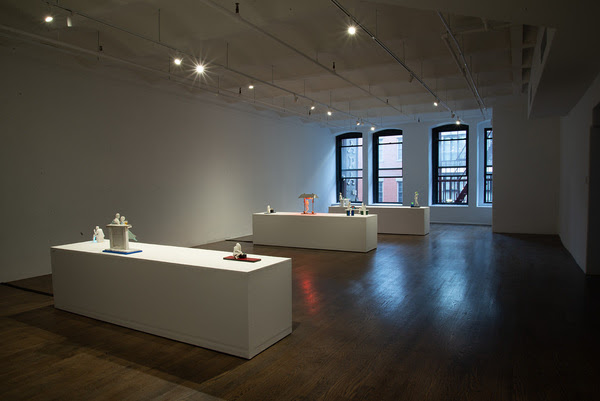
Just Jacuzzi is an exhibition of sculpture, painting and video focused around two installations. Spanning the length and width of the upstairs gallery is an architectonic catwalk, set against a mandala-like mural and encircled by twenty-three square paintings of varying size. Reenacting Jackson Pollock’s tortured explorations of the inner self, Fleury painted the canvases on the floor, interweaving sinuous filaments of gold and silver over the course of one single painting session. Each is accessorized with a braided chain handle and in a private runway show, prior to the exhibition opening to the public, carried down the runway under the arm of a model to be hung nonchalantly on a single screw. The installation is a restaging of the same performance that took place in Paris in 2008 at Thaddeus Ropac Gallery. Counter to the fashion industry’s commandments of radical evolution and individual expression, the models are all styled in the same matching outfits. The paintings are near-identical to those made 15 years ago. The one-off event of the runway show is made into a ritual.
Backstage stands a towering rocket ship primed for interdimensional travel that shifts color from pink to blue depending on the viewing angle. Behind glows a symbol comprising seven interconnected circles, traced from an online image of a crop circle; the same symbol can be found emblazoned onto robes hanging nearby. Downstairs, two neon texts installed in vitrines emit a restorative blue light. Taken from a discontinued Prada skincare line, one reads “Exfoliate” and the other “Revive”. Together they articulate the mechanisms of repetition, not as a machine-like act but as one of eternal renewal, of rebirth. In the center of the room a circular jacuzzi tub set on chromatherapy mode gurgles in chorus with a video of sputtering mud and the ultrasonic hum of essential oil diffusers. The beginning of any alchemical experiment is of course to remove all friction from life.
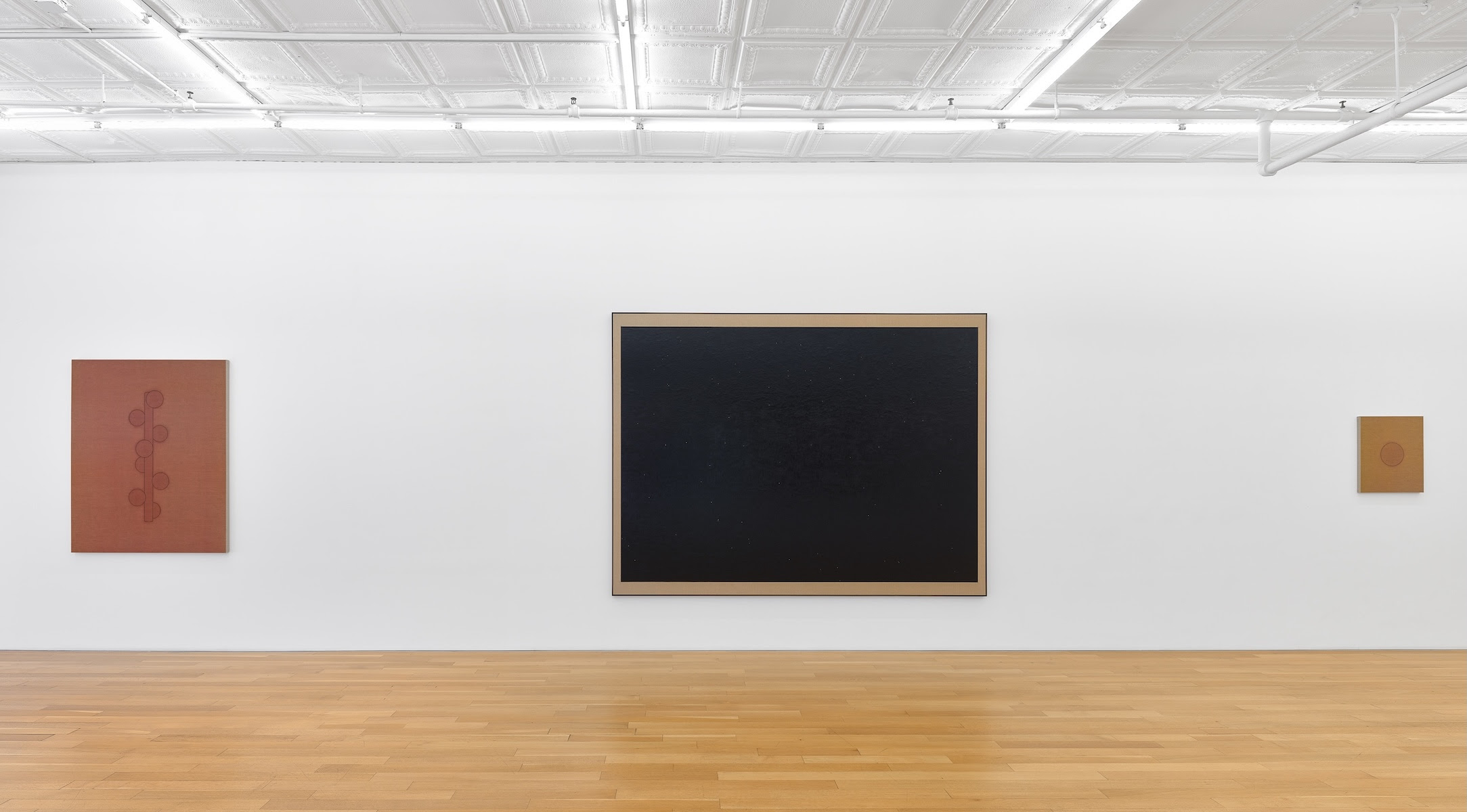
Three circular paintings “The Luminous Lifting Cushion Foundation (Pink Porcelain)”, “Skin Caviar (Porcelain Brush)” and “Essence de Teint (Golden Beige)” all 2019 are reminiscent of Kazimir Malevich’s Suprematist compositions in their reduced geometry. Informed by the philosophies of esotericist P.D.Ouspensky, Malevich sought to express the higher order of reality through form and color. Fleury’s paintings take their forms, colors and titles from popular foundations and concealers. If Sol Lewitt used repetition as a pneumatic press to expel the subject, and Sturtevant wielded repetition as an x-ray to expose the understructure, Fleury uses repetition as a mantra. She reproduces and repeats the apparatus and output of cultural production across time and space, to transcend our plane of existence and the perception of multiplicity, converting the everyday into the esoteric, where subject and object merge and there is only one.
—Tobias Czudej
Sylvie Fleury (b. 1961 in Geneva, Switzerland) is a contemporary Swiss artist whose installation, sculpture, and mixed media work deals with our sentimental and aesthetic attachments to consumerist culture. Emerging in the 1990s, Fleury’s early “shopping bag” installations laid the foundations for a body of work that became as provocative as it is playful. Fleury heralded a new artistic trend by subverting the codes of consumption, creating an interplay between fashion and art, while interrogating the relationship between desire and fetishism.
Fleury’s work exploits the ambiguity of superficiality, exploring subversions, paradoxes, truths and values via materialistic components she deems symptomatic of our epoch – particularly luxury clothing and accessories, makeup, race cars, icons of modern and contemporary art (from Marcel Duchamp to Piet Mondrian to Andy Warhol), magazines, television and media, and other objects drawn from everyday life. Employing common modern advertising strategies, including slogans, bright colors and attention-grabbing presentation, she examines the curious interchange between high-end luxury and trash culture, all the while manipulating the visuals of the modern economy. Moreover, she openly refers to the concept of fetishism in a manner that is largely ignored by modern visual culture.
Trademark bronze sculptures of high heels and handbags are cast in chrome, radiating an atmosphere of excess while focussing on the seductive superficiality of fashion, advertising and design. Re-appropriating items and slogans from high fashion and its dedicated mass media, as well as re-appropriating ideas from high art, enables Fleury’s deft critique of these subjects in challenging the viewer to re-think their views on both fashion and art. Her attention to the banal accoutrements of consumerism pokes fun at our consumption of such objects; and the items take on a cheeky double meaning as artworks, being equally banal in nature, and yet more seductive through their association with the luxury of the art market and museum or gallery space. Her oeuvre reflects and ant icipates her epoch as much as it participates within it, thus lending her work a Warholian wit and ambiguity.
If irreverence characterizes much of her work, she just as often shows her detailed knowledge of recent art history, embracing, re-appropriating, and satirizing work from key artistic movements and artists, such as Duchamp, Mondrian and Warhol, modernists Daniel Buren and Donald Judd. Intriguingly, Fleury reserves her satirical approach for male artists, probing the grandiose machismo of modern art. Her commentary on gender politics works two ways, through both the art market and the relentless consumerism of our era.