Opens tomorrow
Isabelle Brourman
You Have the Body
Nov 6 – Dec 19, 2026
More from Isabelle Brourman on Gallop
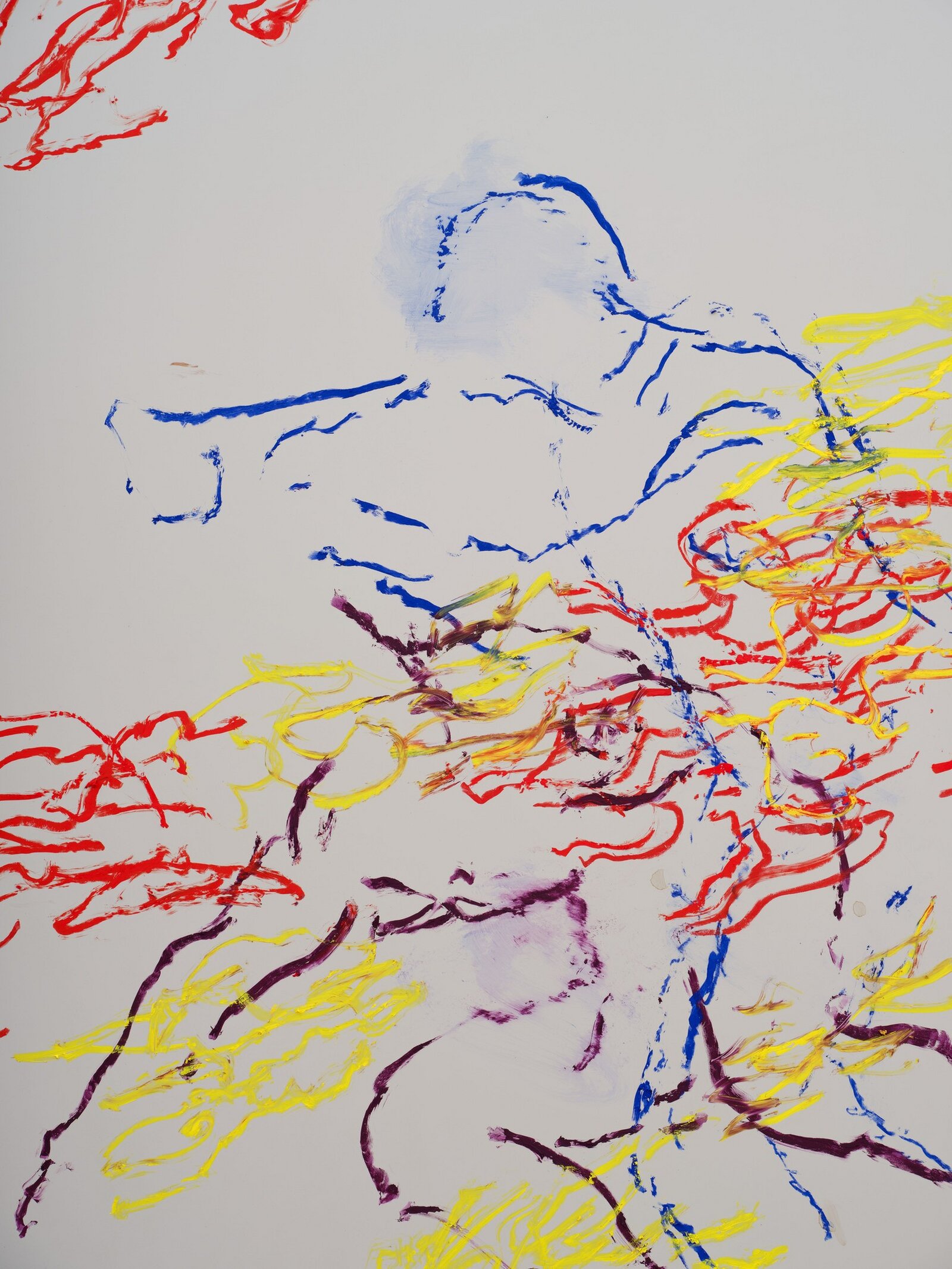
Isabelle Brourman’s You Have the Body presents 23 works on paper made during court proceedings and in the days surrounding major legal and political events of the past three years. Working within the bustle of courtrooms and the charged environments surrounding them, Brourman records the gestures and fragments of speech that compose these scenes. In settings where photography is often prohibited, her drawings offer a form of documentary evidence shaped by an autobiographical perspective. Her own associations and emotional responses enter the record, making the act of witnessing part of the work’s subject.
Over the past four years, Brourman has made the courtroom and its surrounding public spaces central to her practice. W orking alongside journalists, attorneys, and fellow sketch artists, she has documented Donald Trump’ s hush-money trial in New York, Nicolas Maduro’s arraignment, and court proceedings involving Luigi Mangione. This body of work also includes her coverage of the immigration crackdown, from the immigration court at 26 Federal Plaza in New York to events surrounding Delaney Hall, a detention facility in New Jersey. Her work extends to protests and legal confrontations in Minneapolis, South Florida, Washington, D.C., and Chicago.
Brourman’s medium extends beyond the page into the landscape of the twenty-four-hour media cycle and political theater. Legal proceedings are both mechanisms through which power is exercised and performances in which authority and truth are continually contested. Within this landscape, she follows how events are framed for public consumption, attending to the distance between their public narratives and the experiences of the people caught within them.
Access is integral to this practice. Brourman secured an official sketch artist’ s seat in the New York courts without a network affiliation, working without editorial direction. During her 2025 coverage of 26 Federal Plaza, she was the only sketch artist permitted inside the immigration courtrooms. Moving between the hearings and the hallways, she could observe both the procedures through which people sought legal protection and the arrests unfolding just outside.
The exhibition’ s title translates “habeas corpus,” the writ through which a person can challenge the lawfulness of their detention before a court. Acting as one of the oldest protections against arbitrary imprisonment, the Constitution protects the writ against suspension except in cases of rebellion or invasion when public safety requires it. Its history is inseparable from the nation’ s struggles over enslavement, liberty, and the limits of state power. The use of habeas petitions to challenge immigration detention gives these questions renewed urgency, exposing the distance between the promise of constitutional protection and its practical availability. Brourman connects the title to ICE agents ’ use of “bodies ” to describe the people they detain, a vocabulary used to distance the act of enforcement from its human consequences. Her drawings attend to the gestures, expressions, and relationships that this language obscures.
In its immediacy and compression, You Have the Body belongs to a longer history of artists who have used drawing to register political conflict and social fracture. Honoré Daumier’s courtroom caricatures exposed the absurdities and inequities of nineteenth-century French society, while Thomas Nast’s political cartoons helped shape the visual language of American satire. Philip Guston’s drawings of Richard Nixon and his circle rendered American political life in deliberately crude, unsettling terms. Brourman shares their interest in the expressive possibilities of distortion, adapting them to the demands of firsthand observation. The work resonates with the empathy and humanity of Alice Neel’s portraits, the riotous humor and restless energy of Lee Lozano’s drawings.
The dexterity of Brourman’s hand gives these observations their visual form. Her line moves rapidly between figures, spatial arrangements, and handwritten fragments of overheard conversations, translating the heightened moods and frenetic energies of these settings onto the page. She describes her approach as “structural collapse,” bird’s-eye view of a room, the details before her, and her own bodily and emotional responses occupy the same image. The technique also brings together spaces that are treated as separate, revealing how events inside and outside the courtroom continually shape one another.
As immigration enforcement moves from court buildings into American neighborhoods, the conditions of access and witnessing change. Brourman follows this movement, attending to what can be seen, recorded, and contested when the procedures meant to protect people become harder to reach. Throughout You Have the Body, the abstract language of the law meets the physical presence of those whose freedom it determines. The drawings ask what recourse remains when a person can be taken from view faster than the institutions charged with protecting them can respond.
Isabelle Brourman (b. 1993, Pennsylvania) is a New Y ork-based mixed-media artist working across painting, drawing, collage, and courtroom sketching. She holds a BA in Art History from the University of Michigan and an MFA in Painting and Drawing from Pratt Institute. Her recent courtroom work includes coverage of The People v. Donald J. Trump, People of the State of New York v. Luigi Mangione, Depp v. Heard, and The People of the State of New York v. The NRA, as well as asylum hearings at 26 Federal Plaza Immigration Court in New York.