Opens Saturday
Olivia Reavey
Fever
Nov 7, 2026 – Jan 9, 2027
More from Olivia Reavey on Gallop
Writing breaks the silence that proceeds it. Words, in taking the form of a path, walk their way into spaces that were previously wordless. The words explicitly ask for wordlessness to end, and simultaneously go about fracturing it.
Olivia Reavey’s photos feel like once-silent spaces that have undergone a similar kind of shattering. Why? The works [in this show] all include forms in tension–skin stretched, bodies angled, metal apparatuses suspended–though seemingly and precariously occupying settings that evoke an undisturbed sense of privacy. Tension and aloneness are not opposites, but there is an ease to being solo that tension contrasts, and a multiplicity to the formation of tension that seems unrelated to the singularity of what happens in private. Put differently, and more applicably, Olivia’s photographic subjects have been knowingly obscured, producing spatial discord through submission to the awkwardness of their own croppings. Heads gone, lost. Legs, present, evident, misplaced.
The spaces of the photos are filled with questions of what constitutes a whole. Is a body something that is inherently complete, and if not, can it be made so? Does it become completed with shadow skeletons, phallic extensions, and mirrored obstructions to recognizability? Or does it only get compared with that which is not also flesh? The shots bare forms waiting and wanting and craving for things to be changed. How else can it look. Can we look. What else can things be. Can I be.
Quickly, erratically, and thoughtfully, the works conceptualize these questions, while holding onto as much hiddenness and intimacy as the exposure of question-posing allows them to. Olivia Reavey’s latest photos are glimpses into the endless findings that result from being constructively alone and truly searching.
—Olivia Guarnieri on Olivia Reavey
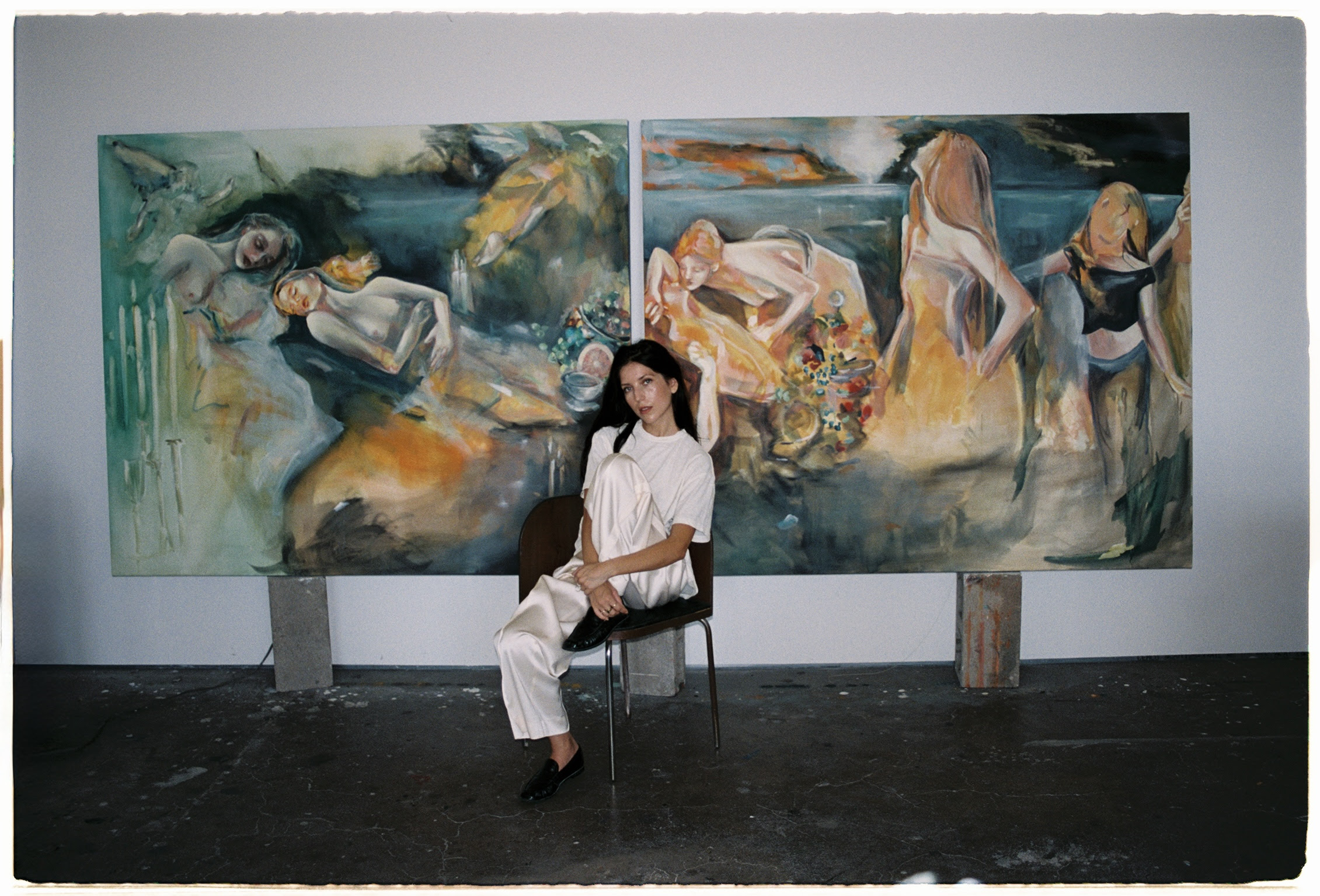
For the inaugural “Back Room Presentation,” Fernberger presents a body of work that Olivia Reavey has developed over the past few years, spanning her time completing an MFA at the Yale School of Art and her participation in the most recent Skowhegan program. Reavey describes herself as a photographer working between the studio and the darkroom, moving fluidly between analog and digital processes to produce images in which the body is subjected to acts of distortion, fragmentation, and transformation.
Found objects play a central role in this process. As Reavey describes it, they become “weapons of intervention”: objects that penetrate, distort, and mirror the body, collapsing distinctions between beauty and corrosion, intimacy and violence. A grate placed directly in front of the camera lens, for example, might physically distort a body as it is captured on film. Reavey collages the analog film negatives and then scans them as objects to produce new digital negatives. The finished photograph may be cut or otherwise physically manipulated, further collapsing the distinction between photographic image and object.
This oscillation between analog and digital, physical and illusionistic, extends to Reavey’s treatment of the figure itself. Her photographs are insistently bodily and materially handmade, yet the bodies they depict can be difficult to apprehend. Limbs and surfaces merge with objects or with one another; familiar anatomies become momentarily illegible before reorganizing themselves into recognizable parts. At times grotesque and at others unexpectedly tender, Reavey’s images present the body as simultaneously fragile and remarkably plastic—something that can be penetrated, compressed, fragmented, and reconstituted.
Through these sleights of hand, Reavey finds unfamiliar territory within one of photography and art history’s most persistent subjects: the human figure. Rather than treating the body as a fixed form to be represented, she approaches it as something whose boundaries can be continually renegotiated. As Reavey writes, “My work seeks to address the perceived limitations of the body, and in doing so, simulates a space in which those limitations are non-existent.”
Olivia Reavey (b. 1998) has recently exhibited with Thomas Erben, New York; City State, Miami; and Center of Photography Woodstock, New York. Reavey obtained her MFA in Photography from Yale in the spring and attended Skowhegan School of Painting and Sculpture this past summer.