
Ended
Beyond Ecstasy
Oct 14 – Nov 16, 2024
Arnaud Adami, Johanna Bath, Julien Boudet, Salomé Chatriot, Cathleen Clarke, Jane Dickson, Nick Doyle, Tracey Emin, Yuan Fang, John Fou, Al Freeman, Nan Goldin, Dhewadi Hadjab, Jin Jeong, Arghavan Khosravi, Melanie Loureiro, Karyn Lyons, Marguerite Piard, Aura Rosenberg, Betty Tompkins, Urara Tsuchiya, Jess Valice, Sue Williams, Chloe Wise
Visiting the exhibition Beyond Ecstasy. Is it in a white-walled gallery where you take the time to reflect on the body, on how we escape from it and how we inhabit it—is that possible? The space in which you stand is no exception to the ways in which spatial politics of gender and sex sort, distribute, and govern places, so why not. The works assembled here collect specific sites, cities, mental spaces, corporeal envelopes.
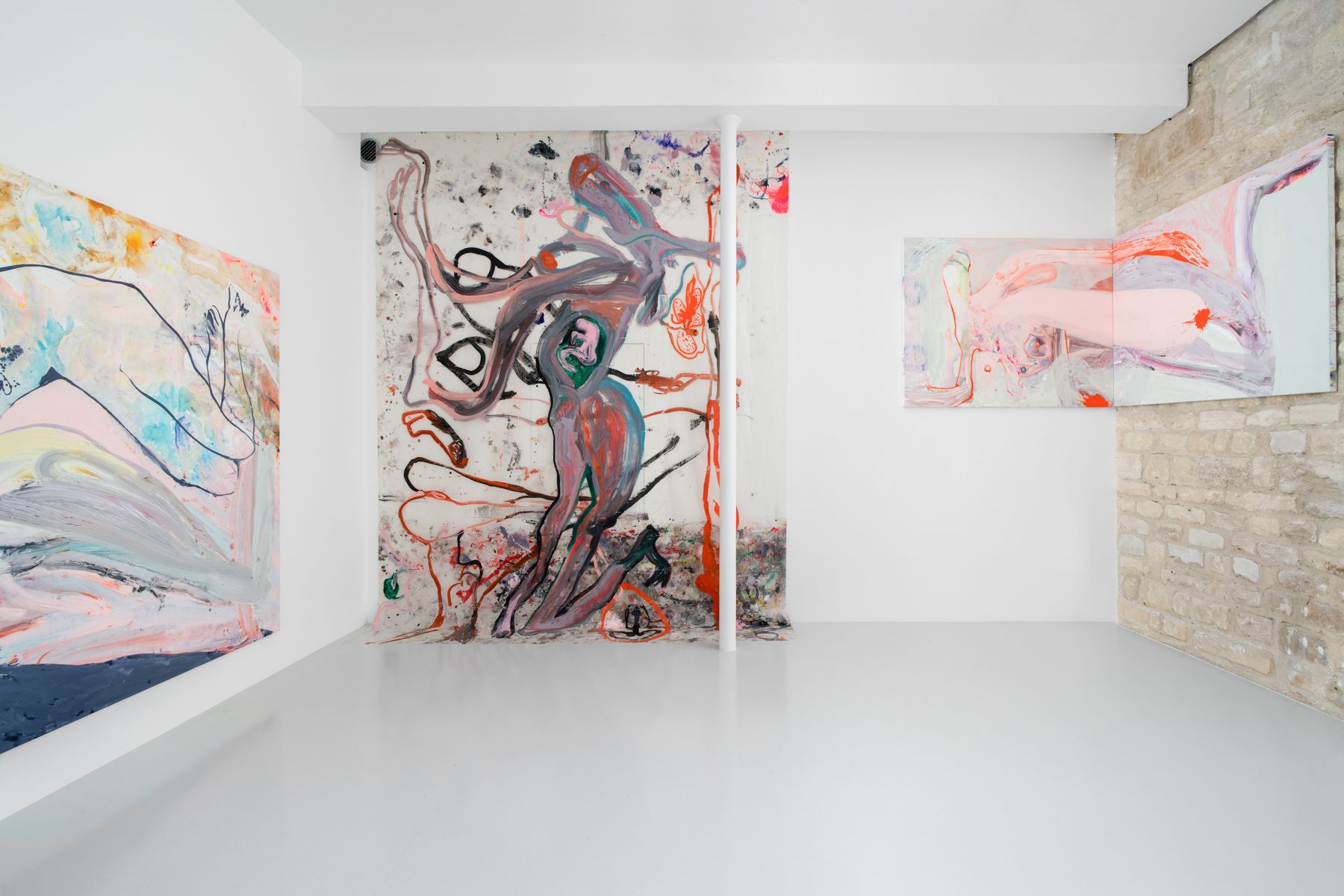
There are spaces of sex and labor that we no longer see. Here, it’s the vanished Times Square of the 1980s, Peepland, yes, neon lights lubricating the dark night, and anonymous silhouettes cut through the scene to purchase fragments of pleasure and escape. Where has that Times Square gone, along with its counterparts purged from metropolises—like all things that exceed boundaries? This question lingers in and out of the room. There are those spaces of sex and labor whose physical and tangible nature we had forgotten. Now they are pulled into political reality by a meticulous brushstroke. Intimacy becomes the vehicle; nudity is not the subject—it is at once gratuitous and transactional, intruding upon the master's chambers or the making of one’s own room. It is a compelling case of spatial power-sharing, of unassailable places, relegated spaces, defended territories. There is the pink pixelated room where digital sex is performed, a space the client’s eye typically enters only via the camera; it is the soft bed where one falls asleep, screen aglow, waiting for a viewer to subscribe to one of the possible services.
Then there are spaces where sex appears freely. It clutters the imagination, much like pornographic imagery—a picture that no longer transgresses. The constant flow has dulled its edges. It is laziness, weakly rinsing a tired eye, a return to order in the 2020s. It overflows from magazines, drips through the internet, and nestles, polished and compact, in the details of a mineral landscape, or comes, automatically, to furnish an empty room one struggles to fill.
Beyond, Above, Underneath. Several works articulate the misalignment with the norm and what struggles to incarnate itself. Eyes do not align with holes, feet spill out of shoes, interpenetrated bodies defy binary habits, floating on white or yellow backgrounds, unable to touch ground. There are unrealized fantasies, but also fragments of traumatic memories whose inaudible violence confines them to a non-place, clashing with the narrative of lightness and finding no room.
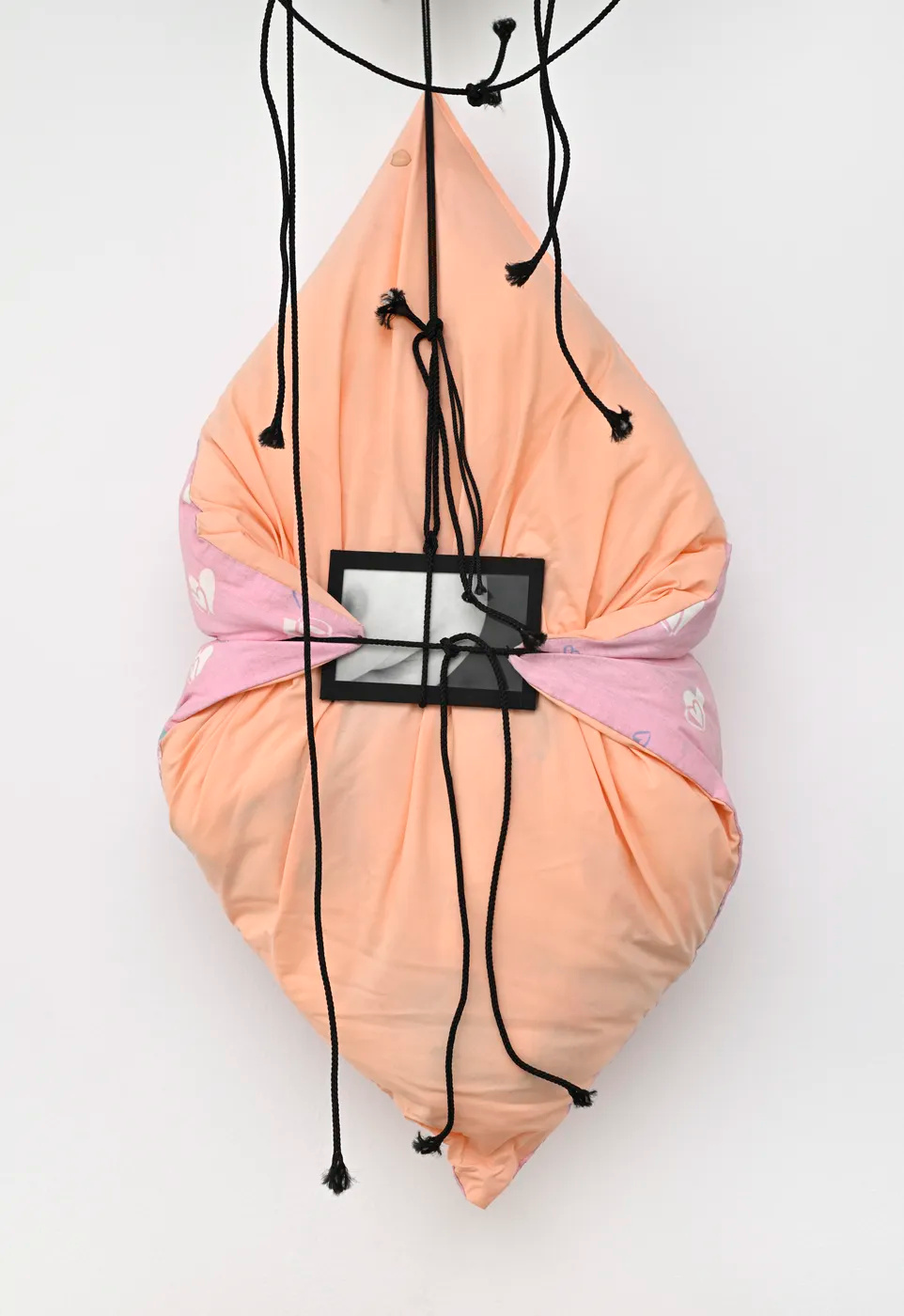
How does one escape the body: ek-stasis. Yes, it is tempting to slip free of the constraints of gender norms, whose structuring power remains unspoken. Beyond Ecstasy gathers bodies in motion, truncated, constrained by invisible bonds and weights, urgently seeking escape. It also gathers in absentia portraits of the bodies of those who have fled or disappeared, narrated silently by their material witnesses: the thorns of wildflowers lining Mexican roads, the metal jaws of a hair clip holding a clipboard, a black leather belt, and patent stilettos—belonging perhaps to an employee ordered to clear out her desk, or to a dominatrix. Perhaps the professional’s arsenal—between sexualized diktat and reappropriation—was the gendered tool of her workplace conformity, as well as the incriminating evidence of those who dismissed her?
Stasis: how we hold ourselves and why we do so; but also the revolt that arises from the imbalance of power. There are works here that re-teach us how to inhabit our bodies. Some look at us, realigning us behind our eye sockets. Others prolong and suspend moments of grounding through the simplest things: a vibration in the air between present bodies, the late afternoon sun on bare skin, fabric slipping, an embrace from which we draw the strength to live rebelliously.
—Marion Chevalier Taton