
Ended
Luis in Friendly Company
Apr 29 – Jun 20, 2026
Luis Gordillo, Philip Guston, Uwe Lausen, Julie Mehretu, Néstor Sanmiguel Diest, Thomas Scheibitz, Amy Sillman
Carlier Gebauer, Berlin, is pleased to present the group exhibition, Luis in Friendly Company, with works by Luis Gordillo, Philip Guston, Uwe Lausen, Julie Mehretu, Néstor Sanmiguel Diest, Thomas Scheibitz, and Amy Sillman.
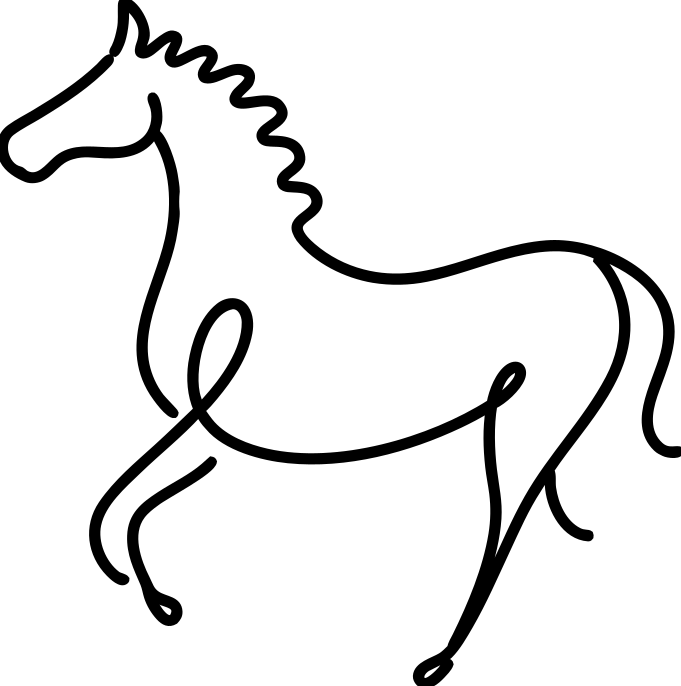
Original exhibited at Carlier Gebauer, Madrid on the occasion of Apertura 2025, the exhibition is a joyful journey through the distinct stages of life and forms of expression, filled with entertaining encounters with fictional travel companions and creative accomplices, the group exhibition is devoted entirely to drawing: its rhythms, resistances, and radical possibilities.
Gordillo's automatic drawings, humorous calligraphic diagrams, produced between the 1960s and 1990s, are displayed in playful dialogues alongside carefully selected works by each invited artist. Rather than illustrating influence in a linear way, these pairings reveal reciprocal affinities, echoing formal choices, and conceptual friction. The result is a constellation of conversations: a polyphonic arrangement that allows viewers to experience drawing as a musical structure—where repetition, variation, interruption, and syncopation shape the visual field.
Gordillo emerges here not only as a precursor to many contemporary approaches to drawing, but as an artist deeply embedded in a dense network of aesthetic exchange. Luis in Friendly Company is an invitation to look closely at how drawing functions not just as a preparatory act or an automatic, private gesture, but as a fully realized, autonomous language.
Luis Gordillo (b. 1934, Spain) established himself as a pioneer of artistic experimentation with his unique use of figuration and color. He has a deep interest in psychoanalysis and is constantly looking for new ways of expression, utilizing photography and other image reproduction methods alongside traditional painterly techniques. Over his sixty-year career Luis Gordillo has risen to become one of Spain’s most prolific painters and one of the leading figures of abstract art in the country.
For over 50 years, artist Philip Guston (b. 1913, Canada – d. 1980, USA) restlessly made paintings and drawings that captured the anxious and turbulent world he was witnessing. Born in Canada to a Jewish immigrant family, he grew up in the US and eventually became one of the most celebrated abstract painters of the 1950s and 1960s, alongside Mark Rothko and his childhood friend Jackson Pollock. His early work included murals and paintings addressing racism in America and wars abroad. During the social and political upheavals of the late 1960s, Guston grew critical of abstraction, and began producing large-scale paintings that feature comic- like figures, some in white hoods representing evil and the everyday perpetrators of racism. These paintings and those that followed established Guston as one of the most influential painters of the late 20th century. Guston was a complex artist who took inspiration from the nightmarish world around him to create new and surprising imagery.
In only nine years of art production, autodidact Uwe Lausen (b. 1941 - d. 1970, Germany) created a provocative and stylistically hybrid body of paintings that translate the tensions and contradictions inherent in postwar Germany. From 1960, in reaction to the middle-class milieu where he grew up and the socio-political context of West Germany, Lausen developed a personal vocabulary. His exploration of the human figure is haunted by the cohabitation of younger and older generations, the latter held responsible for Third Reich politics. His paintings conflate many influences, from Francis Bacon to British pop artists Peter Blake and Allen Jones. Close to the SPUR group of artists based in Munich, Lausen lived in Hans-Peter Zimmer’s studio and met the revolutionary Situationist International group in Paris in 1961, taking part in their activities until his eviction in 1965. In an effort to reflect on and extract from the socio-cultural and political establishment of his time, Lausen created a singular pictorial language marked by his resolutely rebellious character and experimentation with drugs.
Julie Mehretu (b. 1970, Ethiopia) makes large-scale, gestural paintings. Her work conveys a compression of time, space, and place and a collapse of art historical references. Known for a deep political and social engagement, Mehretu’s dynamic compositions have been lauded for their capacity to convey the energy, chaos and urgency of our globalized world. Over the years her works have made reference to architecture, traffic patterns, wind and water currents, migrations, military plans, border crossings, and travel. Her signature sharp lines and geometries have softened as she probes deeper into the visual language of abstraction.
Spanish artist Néstor Sanmiguel Diest (b. 1949, Spain)’s art practice has developed a nuanced, diosyncratic visual language shaped by a voracious interest in literature and philosophy. Sanmiguel Diest constructs his paintings and works on paper as palimpsests, alternately layering strata of found materials like magazine clippings, newspapers, industrial reports, mail, formulas, and texts atop one another in interplay with layers of ink, paint, graphite, solvents, and ballpoint pen. He wields superimposed layers of information as screens, simultaneously revealing and hiding a succession of pictorial stories or texts. Sanmiguel Diest‘s at times hermetic and highly personal conception of art has resulted in a nuanced vocabulary of methodologies and symbols. Like German artist Hanne Darboven, who employed personally derived numerical systems in the creation of her artworks, Sanmiguel Diest‘s paintings and drawings have an algorithmic quality. However, if we consider an algorithm to be a finite process with a fixed symbolic vocabulary governed by precise instructions, then Sanmiguel Diest‘s algorithms are unstable, constantly stuttering and re-aligning themselves as the repetition of one process unlocks new, unpredictable effects.
Thomas Scheibitz (b. 1968, Germany) is among the most important German painters and sculptors of his generation. Since the early 1990s, he has developed a kind of conceptual painting and sculpture that draws upon art-historical references, and at the heart of the Berlin-based artist’s work is a search for a new relationship between figuration and abstraction. The search leads him to not only pushing the limits of his media, expanding its potential, but also to question the contemporary relevance of this traditional antagonism between the two poles.
Amy Sillman (b. 1955, USA) worked at cannery in Alaska and a feminist silkscreen factory in Chicago, and trained at NYU to be a Japanese interpreter for the United Nations, before landing at Manhattan’s School of Visual Arts, from which she graduated in 1979. She found herself deeply enmeshed in the feminist and countercultural movements of downtown New York, becoming a member of the lesbian feminist journal Heresies, while also engaging with the area’s burgeoning community of artists. She cites Abstract Expressionists such as Willem de Kooning and Philip Guston as influences, but also foils: “I wanted to learn about both Abstract Expressionism and the critique of easel painting—not because I wanted to emulate them, but because I didn’t like them.”