
Ended
Hugo Capron
Zzzzzz
Nov 23 – Dec 21, 2024
[Scroll down for French version / Veuillez trouver ci-dessous la version française]
"And Suddenly, a Phrase Resurfaced…"[1]
During our conversation, a phrase suddenly resurfaced. Or rather, a title: that of an exhibition—and what an exhibition it was! And above all, what a title: “Une exposition de peinture réunissant certains peintres qui mettraient la peinture en question” [An Exhibition Bringing Together Certain Painters Who Seek to Challenge the Notion of Painting].[2] It took place in 1973, before the birth of Hugo Capron. Yet it was here that it all began.
In the early years of his practice, Hugo Capron’s painting was very different. In his own words, his painting was rather “minimalist.” He entered the world of art through printing and exchanged technical college for art school. He was obliged to make this choice, on his own, to choose this pathway that we might take for granted, if we don’t take the time to reflect a little more. We don’t all necessarily live in a world bathed in art, and, on the contrary, we might all too rapidly come to the conclusion that the impermeability of this particular world and its forms might exclude those whose practice was not preceded by an assiduous attendance of exhibitions and museums. Images however, whatever their provenance, spread more widely and rapidly than our own assumptions would lead us to believe.
When Hugo Capron was at the School of Fine Arts in Dijon, he often exchanged with Didier Marcel, who teaches there; who is a sculptor not a painter and who also developed his current work through different forms that lodged themselves in the interstitial—which we might also refer to as the inframince[3] [the infra-thin].[4] We could also mention Rémy Zaugg, who for Hugo Capron represents both the pinnacle to strive for and a starting point, even if it may not seem that way.
It was a similar circuitous route of highways and byways that led Hugo Capron to Japan, as a resident at the Kujoyama Villa. If you think carefully, it’s easy to imagine why he chose this path. Paper and printing, the exceptional preservation of ancient techniques, of which Japan, more than any other country has become the repository. And this, a posteriori explains why this voyage was a necessity.[5] Sometimes, like Bissière who went to Algiers to learn painting, or Michaux who travelled to Ecuador and then Asia to rediscover writing, you have to know when it’s time to set sail.
There is an art in knowing how to travel and discover. Coming home is also part of the learning process.
Who would have believed that at the beginning of the 21st century, in the same way as at that of the 20th century, painters would turn to Japanese prints as a novel source of inspiration? Everything is recycled, but nothing is repeated. Each supposedly mandatory rite of passage, has suddenly become an obstacle to be sidestepped, while the unforeseen, the unpredictable, can be transformed into an absolute imperative. This has been the case for Hugo Capron on several occasions, and another unexpected turn in his career came about shortly afterwards. In 2022, he joined Semiose, originally a publishing house that was reborn as a gallery, thanks to the Révélations Emerige grant.[6]
But let’s get back to the painter and his painting. Can you see the correlation between his Feux d’artifice [fireworks] series of paintings and vintage images from Japan? We should look, he tells us, at the posters by the graphic designer and visual artist Tadanori Yokoo; in particular at the one that refers to the writer Yukio Mishima[7]—another of Hugo Capron’s inspirational sources, another point of departure and culmination, who, upon Capron’s arrival in Japan led him to visit the port of Shimoda, to the hotel where Mishima stayed, but “whose room unfortunately no longer exists.”[8]
So, what can we actually see? Where is Tadanori Yokoo’s locomotive taking us? Undoubtedly to another harbor, where the waves have no choice but to encroach on the land—and then again, some of Hugo Capron’s paintings also show waves, don’t they? And if you look closely, the sun illuminating the poster, which also evokes other schematic, standardized Asian depictions of the sun, functions as a sign from which the paintings of Moustiques [Mosquitos] you are about to see, barely distance themselves.
“Mosquitos?” You say to yourselves. With a capital M, as biologists might refer to them.
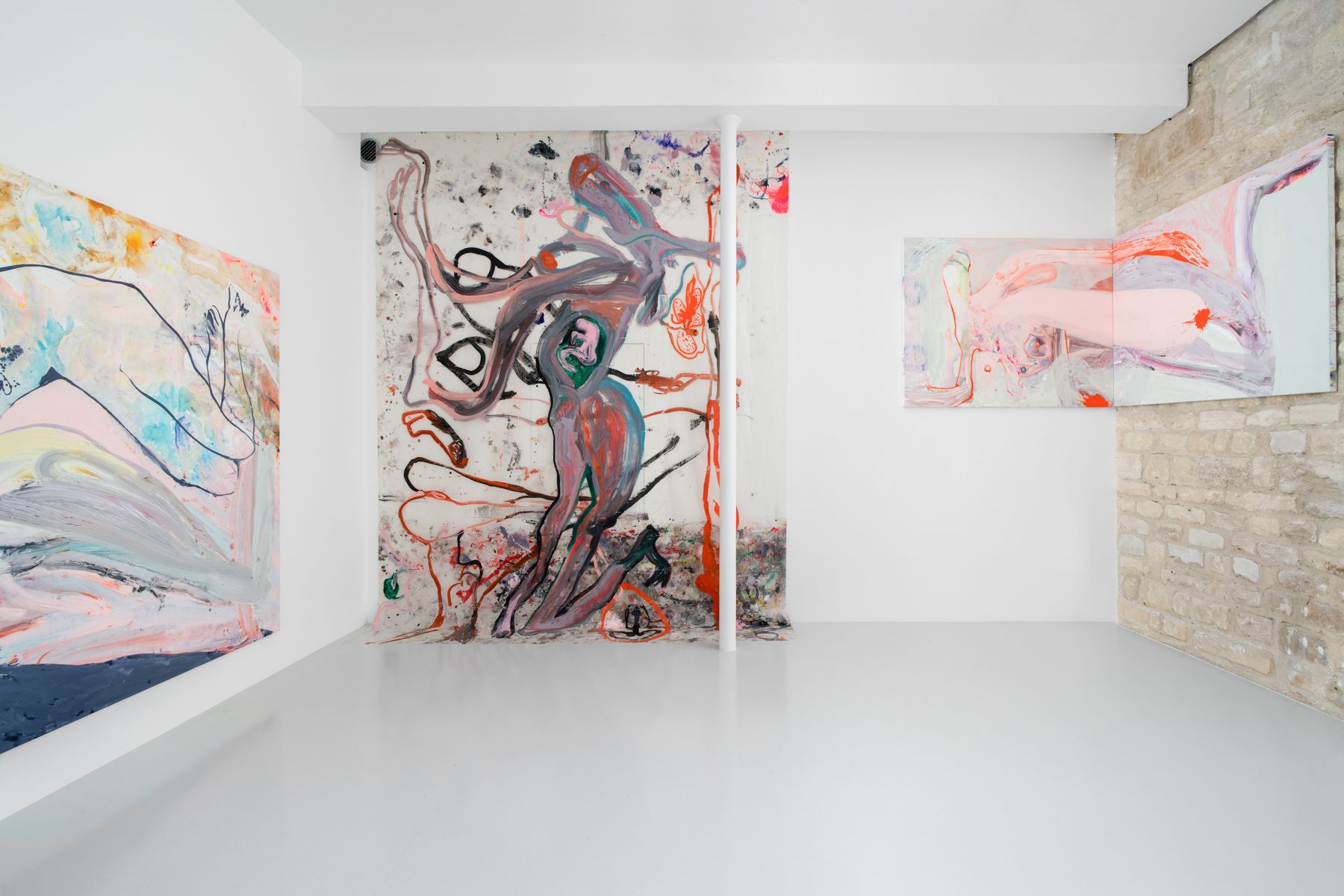
The first time we spoke of the paintings, I didn’t see the mosquitos, I only saw the brush-strokes and the colors. No doubt this was how the artist wanted us to approach them. Via the strokes. That which fills the canvas makes us forget the starting point, yet two dark circles and a larger, lighter one are there to remind us. Nevertheless, even after identifying the true subject, we are still able to simply consider the canvas from a purely pictorial, abstract point of view. In this very distance between what we see and what the artist intends, we are drawn back to the early days of his work, to that prehistory when he pursued radical abstraction. Will the temporal bridge thus formed be spanned by this second series: a basket of lemons, or a tray as Hugo Capron prefers to call it? Unlike the Mosquitos, the image is immediately readable—a bit too immediately for us not to consider it, in turn, as pure pretext. The game of illusions had to continue a little longer, with nothing put forward in a truly straightforward manner, nothing given away; the clarity of forms had once again to dissolve into a kind of ideogram, just for the sheer pleasure of the game.
—Françoise Michaud
1 - This text is the introduction to an essay for an upcoming catalog.
2 - An exhibition organised by Michel Claura and René Deniziot, at 16 Place Vendôme, Paris, from 29 May through 23 June 1973, featuring Daniel Burien, Alan Charlton, Giorgio Griffa, Bernd Lohaus, Brice Marden, Agnes Martin, Palermo, Robert Ryman and Niele Toroni.
3 - Like the reference to Malevich’s Red Cavalry (1928-1932), in the abstract lines of the carpet which the public crossed at Didier Marcel’s exhibition, which we co-organized in 2010 at the Musée d’Art Moderne in Paris.
4 - Translator’s note: a term coined by Marcel Duchamp referring to ephemeral, ultra-thin and undecidable phenomena, such as the warmth that remains on a chair when someone gets up.
5 - His residency at the Kujoyama villa followed an Erasmus exchange with Japan, which ultimately led to the jury’s decision to award the artist the place he coveted so much.
6 - The Révélations Emerige grant was inaugurated in 2014 at the instigation of Laurent Dumas, Chairman of the Emerige Group. It is a program dedicated to supporting talented young artists of the French scene.
7 - Silkscreen created by Tadanori Yokoo for Yukio Mishima’s essay The Aesthetics of End (1966). It shows a young blonde woman riding a locomotive bedecked with flowers, ploughing through the waves, its plume of smoke rising into a sky lit by a golden sun.
8 - Correspondence by e-mail with Hugo Capron, 28 October 2024.
*****
"Une phrase, soudain, est revenue…"[1]
Au cours de la conversation, une phrase, soudain, est revenue. Un titre plutôt : celui d’une exposition – et quelle exposition ! Quel titre surtout : « Une exposition de peinture réunissant certains peintres qui mettraient la peinture en question ».[2] C’était en 1973 ; Hugo Capron n’était pas né. C’est pourtant là que tout a commencé.
La peinture d’Hugo Capron, au début, était très différente. Il pratiquait une peinture « minimaliste », suivant ses propres mots. Venu à l’art par l’imprimerie et à l’école d’art par le lycée technique, il lui fallut faire, à sa manière, ce chemin qu’on croit donné, quand on y réfléchit trop rapidement. Non, on ne vit pas nécessairement dans un monde baigné par l’art et, à l’inverse, on peut penser un peu vite que l’étanchéité des mondes et des formes tient à distance ceux dont la pratique n’est pas précédée par une fréquentation assidue des expositions et des musées. Les images, quelle qu’en soit l’origine, circulent plus rapidement et davantage que nos propres habitudes nous incitent à le croire.
Ainsi, lorsque Hugo Capron est à l’École des beaux-arts de Dijon, c’est souvent avec Didier Marcel, qui y enseigne, qu’il a l’occasion de discuter : avec un sculpteur donc, et non un peintre, mais un sculpteur lui aussi venu à son travail actuel par des formes différentes, des sources qui viennent se loger dans l’interstitiel – on aimerait dire : dans l’inframince.[3] Nous aurions pu aussi parler de Rémy Zaugg qui constitue pour Hugo Capron autant ce sommet à atteindre que le point de départ, même quand rien n’y paraît.
C’est une même voie détournée, un chemin de traverse, qui a conduit Hugo Capron jusqu’au Japon, comme pensionnaire de la villa Kujoyama. En cherchant bien, on trouve aisément l’origine de ce destin. Le papier toujours, l’imprimerie, cette permanence exceptionnelle de techniques anciennes dont le Japon, plus qu’aucune autre contrée, s’est fait le conservatoire. C’est cela qui explique a posteriori la nécessité du voyage.[4] Parfois, tel Bissière parti à Alger pour y apprendre la peinture, tel Michaux en Équateur puis en Asie où il retrouve l’écriture, il faut savoir embarquer.
Il y a un art du voyage et de la découverte. Revenir aussi est un apprentissage.
Qui aurait dit qu’au début du XXIe siècle, comme au début du XXe siècle, des peintres iraient puiser dans ce Japon de l’estampe une nouvelle source de création ? Tout se recycle, mais rien ne se répète. Tout passage, soi-disant obligé, devient soudain un obstacle qu’on contourne ; tandis que l’imprévu, l’imprévisible, peut se transformer en impérieuse nécessité. Il en a été ainsi pour Hugo Capron plusieurs fois, car un autre hasard objectif devait intervenir peu après. En 2022, il a rejoint la galerie Semiose – une galerie née aussi du livre… – à la faveur de la Bourse Révélations Emerige.[5]
Mais revenons au peintre et à sa peinture. Voyez-vous la correspondance qui se joue entre ses feux d’artifice et des images anciennes originaires du Japon ? Il faut la chercher, nous dit-il, dans les affiches du graphiste et plasticien Tadanori Yokoo ; celle, en particulier, qui concerne l’écrivain Yukio Mishima [6] – autre source d’inspiration pour Hugo Capron, autre point de départ et d’arrivée, qui le pousse à aller, à peine arrivé au Japon, jusqu’au port de Shimoda, dans l’hôtel où Mishima a séjourné et où « malheureusement la chambre n’existe plus ».[7]
Alors, désormais, que voit-on ? Où nous mène la locomotive de Tadanori Yokoo ? Dans une autre rade sûrement, où les vagues n’ont pas d’autre choix que d’envahir la terre. N’y a-t-il pas également des vagues dans certains tableaux de Capron ?
À bien y regarder, ce soleil qui irradie l’affiche, et qui en évoque d’autres en Asie, schématiques et normés, fonctionne comme un signe dont les peintures de Moustiques que vous allez voir s’éloignent à peine.
« Des Moustiques ? », dites-vous, en ajoutant une majuscule comme le font les biologistes.
La première fois que nous en avons parlé, je n’ai pas vu les moustiques, je ne voyais que les traits – les traits et la couleur. Sans doute était-ce bien ainsi que l’artiste souhaitait qu’on les aborde. Par la ligne. Ce qui couvre la toile fait oublier le point de départ, bien que deux ronds sombres et un autre plus gros et plus clair soient là pour nous le rappeler. Cependant, même après avoir reconnu le sujet, nous pouvons continuer à considérer la toile sous son pur angle pictural et abstrait. Dans cette distance même, entre ce que nous voyons et ce dont se sert l’artiste, nous sommes rappelés vers les origines de son travail, vers cette préhistoire où il recherche l’abstraction radicale. Le pont temporel ainsi formé sera-t-il comblé par cette autre série : une corbeille de citrons ou plutôt un plateau, tel que le nomme Hugo Capron ? Contrairement aux Moustiques, l’image se lit immédiatement – trop immédiatement pour que nous ne la prenions, à son tour, comme pur prétexte. Il fallait bien que se prolonge un peu ce jeu des faux-semblants. Il fallait que rien ne soit vraiment dit, rien vraiment donné, que la lisibilité des formes se perde à nouveau dans une sorte d’idéogramme, pour l’entier plaisir du jeu.
—François Michaud
1 - Ce texte est l’introduction d’un essai pour un catalogue à venir.
2 - Exposition organisée par Michel Claura et René Denizot, au 16, place Vendôme à Paris, du 29 mai au 23 juin 1973, avec Daniel Buren, Alan Charlton, Giorgio Griffa, Bernd Lohaus, Brice Marden, Agnes Martin, Palermo, Robert Ryman, Niele Toroni.
3 - À l’instar de la citation de La Charge de la cavalerie rouge (1928-1932) de Malevitch, à travers les lignes abstraites de la moquette que foulait le public de l’exposition de Didier Marcel, que nous avions montée ensemble en 2010 au musée d’art moderne de Paris.
4 - La résidence à la villa Kujoyama fut précédée par un Erasmus au Japon, lequel, en fin de compte, emporta la décision du jury d’attribuer à l’artiste cette résidence qu’il convoitait.
5 - Créée en 2014, sous l’impulsion de Laurent Dumas, président du Groupe Emerige, la Bourse Révélations Emerige est un programme destiné à soutenir la jeune scène française.
6 - Sérigraphie créée par Tadanori Yokoo pour l’essai de Yukio Mishima, The Aesthetics of End (1966), non traduit en français. On y voit une jeune femme blonde qui se tient sur une locomotive ornée de fleurs, avançant sur des vagues, son panache de fumée s’élevant sur un ciel où rayonne un soleil d’or.
7 - Propos de Hugo Capron, par e-mail, le 28 octobre 2024.