Ended Aug 11
Dilexi: Seeking the Unknown
Jun 15 – Aug 11, 2019
Artists: Jeremy Anderson, Wallace Berman, Roy De Forest, Wally Hedrick, Alfred Jensen, Kurt Schwitters, H.C. Westermann, Franklin Williams
Jeremy Anderson, Wallace Berman, Roy De Forest, Wally Hedrick, Alfred Jensen, Jess, Kurt Schwitters, H.C. Westermann, Franklin Williams
Parker Gallery is proud to present Dilexi: Seeking the Unknown, one of six exhibitions in a multi-venue retrospective honoring the pioneering San Francisco-based gallery led by Jim Newman. The Dilexi Gallery (1958-1969) was renowned for championing a diverse stable of artists, many of whom—through autonomous strains—presented their own cosmologies replete with systems of individuation. These strategies provided a modern allegory for ancient forms of magic. Revitalizing the notion that the artist has a proto-shamanic role, their work culled the latent powers of alchemy, Kabbalah, totemic thought, and hermetic diagrams, often convening with the unknown.
Alfred Jensen (1903-1981) explored native, ancient, and indigenous traditions that harbored numerological systems as the foundation for their metaphysical laws, which served as the primary influences for his striking paintings emphasizing color and geometric forms. Wallace Berman’s (1926-1976) Verifax collages feature handheld radios, a motif the artist explored in various formats throughout the series, which function as receiving apparatuses; their surfaces further display images culled from popular culture and esoteric tradition. As a sonar man during the war and a consummate gambler, transmission and numbers were central to Berman’s oeuvre. These communiques from the ether recalled the numerical system of Kabbalah, which viewed Hebraic letters as the numerical building blocks for cosmic design and portals to transmutation. Focusing on Hebrew letters and Pythagorean sigils (symbols used in magic), Berman invoked the essential tenets of Abulafian Kabbalah, which emphasized that meaning is understood through form.
The artist Jess (1923-2004) engaged hermetic scholarship with his partner Robert Duncan, exploring both Kabbalistic tradition and alchemical thought. Jess’s “paste-ups” anointed the pop culture canon and its images, spanning erotica to religiosity, as poetic instruments to parlay a spirit kingdom. Alchemical thought was also enlisted by Kurt Schwitters (1887-1948), the harbinger of California’s Neo-Dada movement, who viewed his work as a modern allegory to magical tradition. His Merz series is informed by a logic wherein, as the artist states, “everything had to be broken down and new things had to be made out of the fragments.” This kind of dissolution was required before transmutation could take place, which was commensurate with Dada’s anti-art objectives.
Wally Hedrick (1928-2003) was fascinated with hermetic tradition, notably painting fifteenth-century diagrams by poet and alchemist Thomas Norton. Hedrick—whose work was included in the first and last shows at Dilexi—was forcibly drafted into the Korean War (1950-1953). He later protested the Vietnam War by “cancelling” out earlier works, painting them over in black. Hedrick’s work revitalized the ancient practice of political dissent through negation while enacting the alchemical nigredo and the Heraclitean concept that the beginning and end are one.
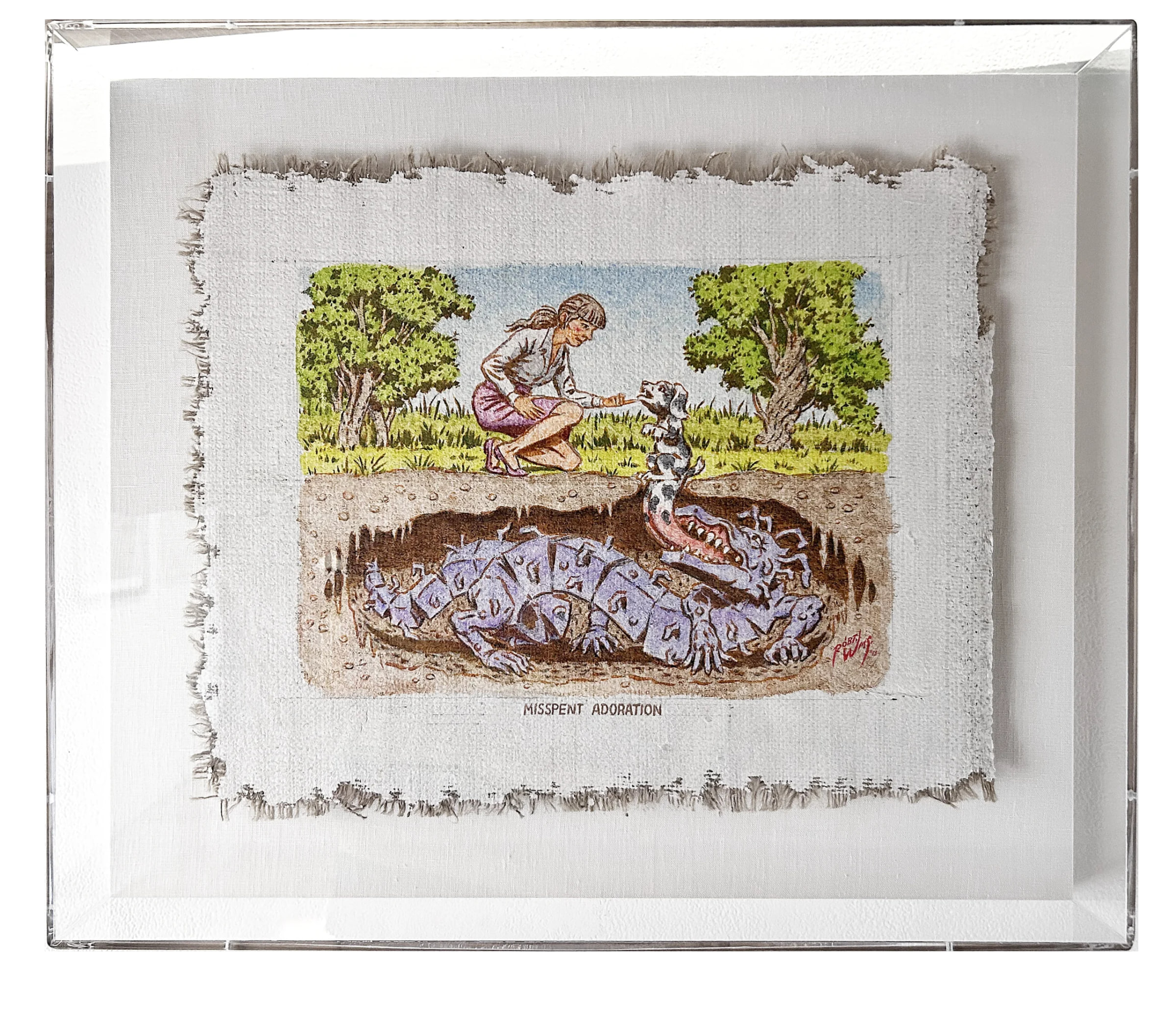
Roy De Forest (1930-2007) and Franklin Williams (b. 1940) invoked the grid to create various cosmologies and a series of sculptural fetishes which focus on the paradigm of American folklore and its attendant materials. De Forest created paintings that present a poetic framework that anoints each fragment, object, and animal to a supernatural force. His constructions are reminiscent of composite altars recalling ritual effigies with purpose and benediction. Williams, by contrast, creates works that recall amulets through a process of sewing and gluing fabric tufts, beads, and found detritus. His work engages his Welsh lineage and the tradition of making votives for underworld spirits, the Tywyth Teg.
Jeremy Anderson (1921-1982) explored the cosmological systems of the Neolithic and Celtic age, as well as their sun and moon cycles, offering an anthropomorphic treatise of incantation through sculpture and suggesting that everything abides to the same cosmic laws. H.C. Westermann (1922-1981) who, like Anderson, saw heavy combat in World War II, created his own deeply personal cosmogony from the psychic disruptions experienced as a result of his participation in the South Pacific. Regarded by Peter Selz as a “modern shaman,” Westermann turned the sinister imperative of the Industrial War Complex into sculptural totems that engaged a Neo-Dada reverence for humor. Westermann, along with many of the Dilexi artists, presented work that offered both a spiritual redemption to America’s ideological failures and a porthole to return a world back to balance.
- Laura Whitcomb
The retrospective will be accompanied by a forthcoming catalogue from Label Curatorial, Dilexi: Gallery and Beyond, and will feature a focused chapter derived from Laura Whitcomb’s scholarship for her upcoming book, The Passing of the Torch: Occult Roots and Post-War California Art, which has been influential to the conception of the exhibition at Parker Gallery.