

Exhibition · Argentinian Pavilion
Luciana Lamothe
Ojala se derrumben las puertas
Apr 1 – Nov 24
About the show
Ojalá se derrumben las puertas [Hope the Doors Collapse], the exhibition and book forming Argentina’s participation in the 60 Mostra Internazionale d’Arte - La Biennale di Venezia and presenting the work of Luciana Lamothe, inhabits the (visible and invisible) borders that separate the human from the non-human, the natural from the constructed, the known from the unknown. In this new work, Lamothe interlaces pieces of wood and pipes, bodies and structures, mutability and permanence, to create spaces within spaces that modulate forms of violence and hospitality in a tense equilibrium of interdependent forms.
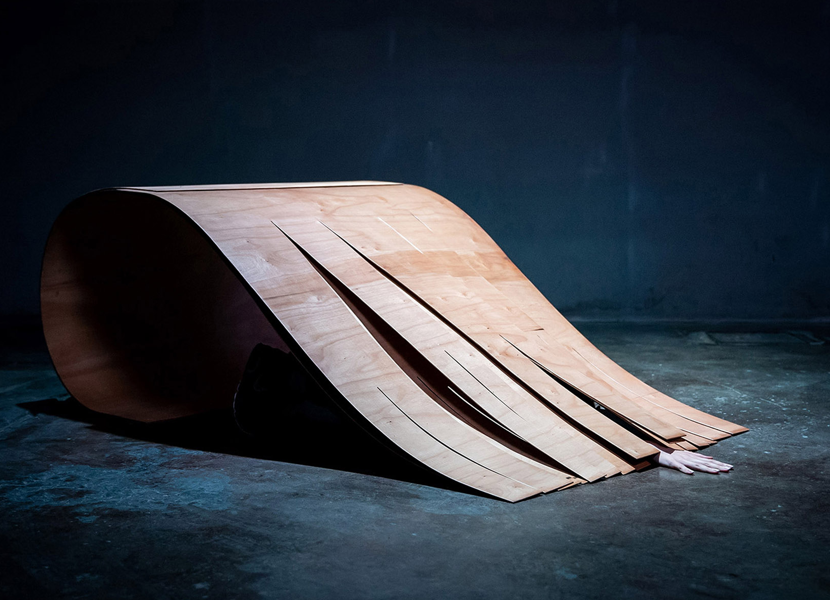
The four sculptures that make up the work address objects (human, infrastructural, industrial and ‘natural’), their latent potentials and the spatial field in which they exist in order to test alternatives to their familiar forms of interaction. To do this, she offers us a specific set of tools and perspectives that allow us to observe, represent and analyse our constructed environment and the structures humans have designed or occupied over time. Her systems of scaffolding and phenolic plywood infiltrate architecture and infrastructural forms to reveal the layers of techno-textures, information, history and relations that make up their quasi-industrial, quasi-natural bodies. By displaying the dismantled innards of our constructions and recomposing them in new, unexpected spatial formulations, Ojalá se derrumben las puertas insists on the possibility of effecting changes to our constructed environment and so also to the webs of relations and interactions that shape the world.
Lamothe’s meticulous manipulation of the material world combines elements and sequences of reactions, weights and counterweights, invoking more-than-human alliances and a spatial alchemy that generate new formal, aesthetic and affective possibilities for the bodies and objects they contain. She creates undisciplined spaces opposed not only to the constructive forms of modernity but also rebelling against what Malcom Ferdinand calls ‘l’habiter colonial’ (colonial inhabitation), the violence of which subjects territories and human and non-human bodies to a system of extractivist exploitation. Each sculpture functions as an enveloping, inhabitable space that suggests other ways of conceiving our relationship with the material world. At the same time, they contain forms of care and violence– that are manifested in the slashes, joints, assemblages and torsions essential for the work to keep its form: a series of wounds and sutures that acknowledge the burden of centuries of social, spatial and material conditioning on human and non-human bodies.
Constructed entirely in the pavilion, the structures manipulate iron scaffolding and plywood boards into curves and counter-curves and, in their interstices, house a series of objects embodying different stages in the life of wood: from its origin, through its extraction as a commodified resource and its industrialization, to its disposal as organic or industrial waste. It brings together industrial materials and others collected from nearby areas, such as local workshops and a small forest in Slovenia. It also reutilizes materials gathered during the dismantling of the last Architecture Biennial, from the Argentina Pavilion itself, but also from others such as the Nordic and German pavilions, the latter reutilized materials from previous pavilions as well. As a consequence, the work nests within it a series of production, disposal and reproduction processes in constant motion. This approach to materials, which Lamothe calls ‘monomateriality’, forces us to pay unusual attention both to the structures and the materials and to experience them as part of a supportive system of interconnected subsistences and to to establish a sensual, affective relationship with materials.
In a context of extreme violence that seeks to flatten out differences and sweep away dissent, Ojalá se derrumben las puertas offers a form of resistance grounded in indeterminacy and divergence to break through the dominant cultural parameters. It enunciates an ecology in which bodies, objects and structures fracture the boundaries that separate culture from nature, the human from the non-human, in order to imagine material alliances for other possible symbiotic, queer and solidary forms of life.
Luciana Lamothe is a visual artist who works in sculpture, performance, activation, drawing, photography and video. In 2023 she held the exhibition Cien caminos en un solo día at the Museo de Arte Moderno de Buenos Aires. In 2022 she was a resident at Factory Lyon and held a solo show Galleria Alberta Pane Paris and at the festival Arts Ephémères – Itinérance en Baux-de-Provence, France. She also presented the work Invocar el acto during the Bienal de Performance, Buenos Aires. During 2021 she was part of the Artist-in-Residence Program at Atelier NI, Marseille. In 2019, Lamothe was the recipient of the Pollock-Krasner Grant for Artists by the Pollock-Krasner Foundation, New York. Previously, Lamothe’s work took part in the 11th Lyon Biennial, Lyon; the 5th Berlin Biennial, Berlin; and the 3rd Montevideo Biennial. She has been exhibited in numerous shows worldwide including Art Basel Miami Beach Meridians; Kunstraum Kreuzberg/ Bethanien, Berlin; CGAC, Santiago de Compostela; La Maison Rouge- Fondation Antoine de Galbert, Paris; Palais de Tokyo, Paris; Da Maré Museum, Rio de Janeiro; Museo del Barrio, New York; Museo de Arte Moderno de Buenos Aires, Buenos Aires; Fundación PROA, Buenos Aires; MNBA, Buenos Aires. She was Artist-in-Residence at MANA Wynwood; Art Dubai, UAE; Air Antwerp, Antwerp; Skowhegan, Maine, and was awarded the First Prize of the Lichter Art Award, Frankfurt; the First Prize of the Itaú Cultural Award, Buenos Aires and was a 2011 fellow at the Universidad Torcuato Di Tella Artists Program, Buenos Aires.
Commissioner: Mtro. Alejandra Pecoraro
Curator: Sofia Dourron