
Ended
Gilberto Zorio, Carlito Carvalhosa, Robert Feintuch
Zorio, Carvalhosa, Feintuch
May 3 – Jul 26, 2014
GILBERTO ZORIO
Throughout Zorio’s body of work, the five pointed star has been a recurring and important image. In this show, a series of large metal stars are exhibited – each in a state of flux introduced by either sparks of electricity or the hissing movement of compressed air. Another work,“Stella di giavellotti,” is a star formed by crossed copper javelins, tools that represent an extension of both arm and thought, allowing one to touch distances not accessible by the body alone. Also on view is “Giunchi con arco voltaico,” consisting of a bunched cluster of reeds extending from the wall and activated by timed bursts of electrical energy.
Gilberto Zorio rose to prominence in the 1960s as part of the influential Arte Povera movement, which was characterized by the use of unremarkable materials such as concrete blocks, copper pipes, rubber tubes, wires and animal hides. His work often incorporates alchemical themes and is engaged with ideas of matter in a state of transformation – sometimes represented by sparks of electricity or phosporescent liquids and inks.
CARLITO CARVALHOSA
In these rooms, the space is interrupted and criss-crossed from floor to ceiling by dozens of large wooden shafts, disrupting the usual flow of movement through the gallery rooms and thus altering perception of the interior. The heavy poles, the kind usually used to support telephone lines, puncture the walls and descend from the ceiling to rest upon transparent drinking glasses, creating a flow of light and gravity. For Carvalhosa, material is not a barrier to the enactment of an idea, the material is the fulfillment of the idea.
Carvalhosa’s work is an ongoing exploration of the reconfiguration of architectural spaces, often via unexpected juxtapositions of interior/exterior objects and everyday materials.
ROBERT FEINTUCH
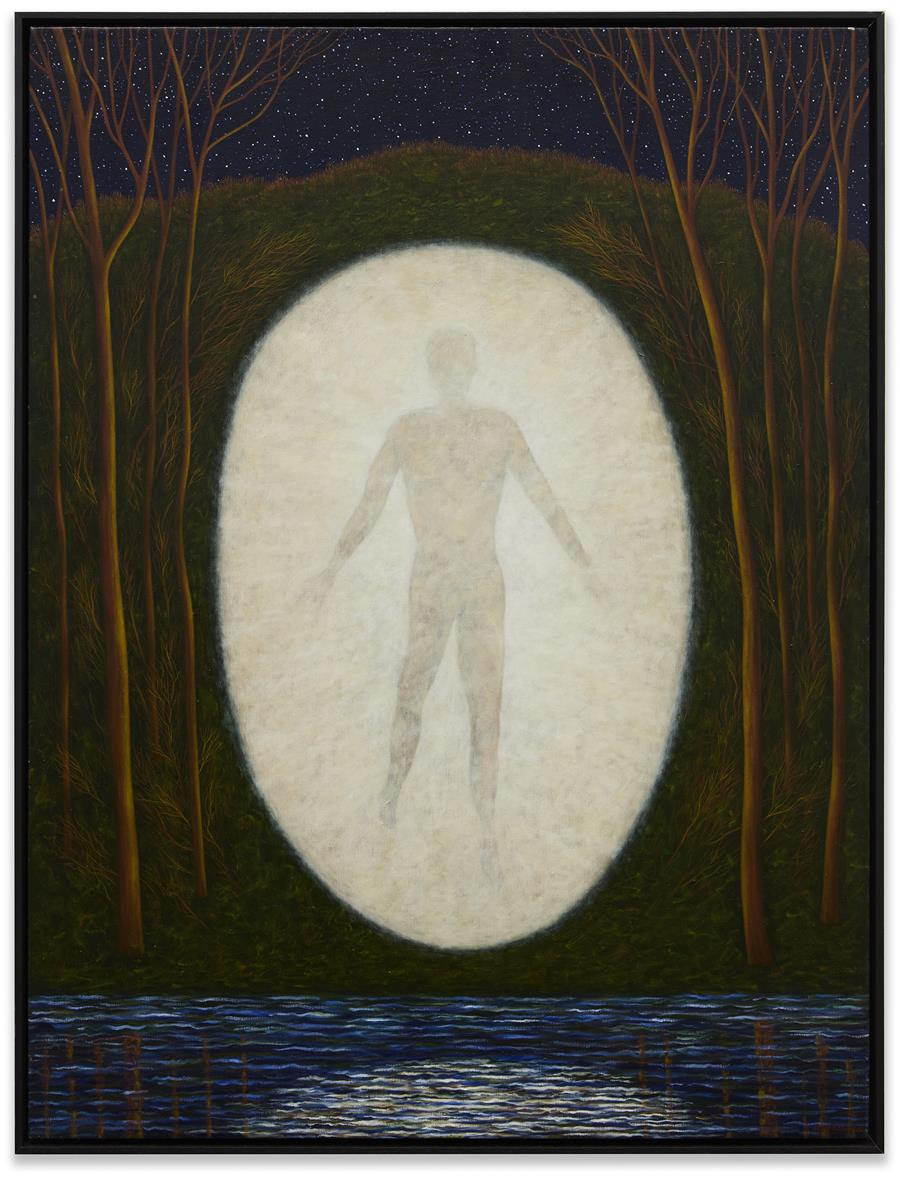
These paintings are inspired by historic images of the Assumption, the Ascension, and of heaven. Influenced by both Gothic paintings and cartoons from his childhood, the artist inserts parts or all of his own body into each image. In several of the paintings the figure is shown with his legs up, in a position that may be both sexual and infantile, like a character that has been knocked out in a cartoon. Also included is an image of Hercules, a motif the artist has worked with across years. Long associated with protective power, in this painting Hercules is fat and propped up from behind with a crutch.
Filled with desire, simultaneously ecstatic and comic, the grandiosity of the subjects is undercut by Feintuch’s fidelity to naturalistic, unidealized form that veers towards caricature.