Ended Oct 16
Mary Ramsden
Blunt Instrument
Sep 15 – Oct 16, 2021
More from Mary Ramsden on Gallop
[Please scroll down for German version / Für Deutsch bitte scrollen Sie nach unten]
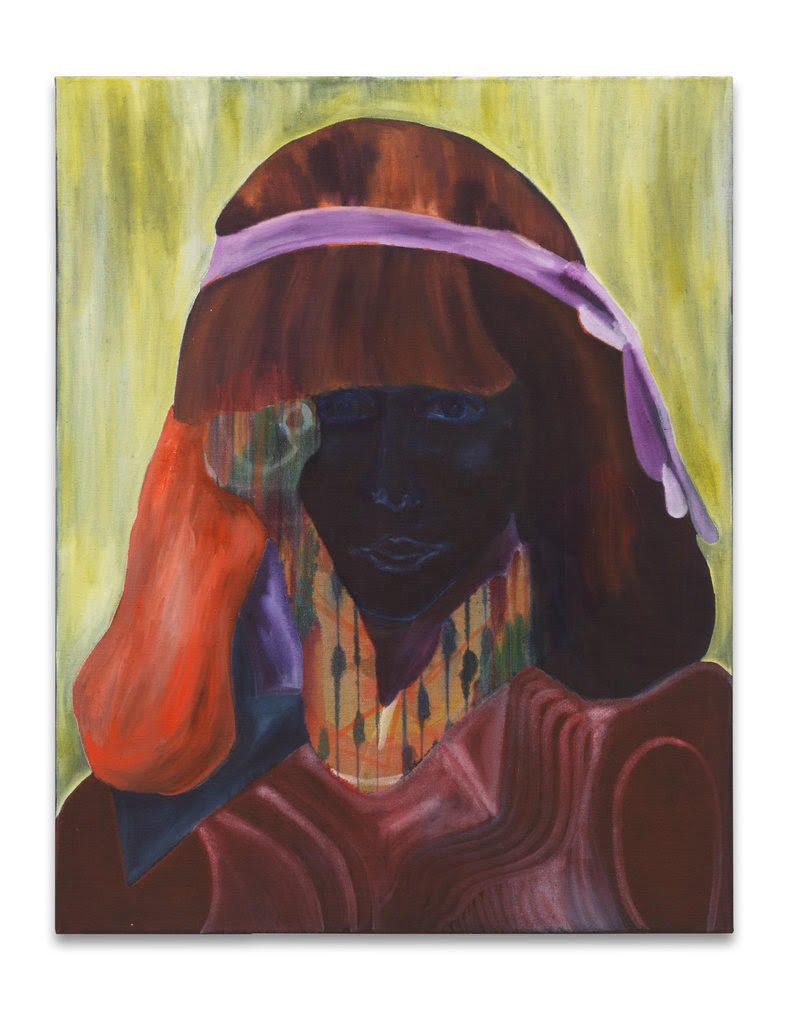
In March 2020, Mary Ramsden (b. 1984, based in London) began a new series of abstract portraits. These were motivated by the impressions of the first lockdown in the context of the Corona Pandemic. The lack of proximity to the people around her and the only ‘fragmentary’ communication via video calls made her want to ‘spend time’ with them, if not in person, then in a figurative sense.
Ramsden took inspiration from the icon-painting of those cult and holy images that played an essential role in worshiping saints in Byzantine art. The artist is primarily interested in the concept of ‘visualization’ as it has characterized the cultural history of humankind since its beginnings. Here, the lack of reality, for example through the absence (of a person) is understood as a detachment, which is attempted to compensate with the help of (pictorial) visualization.
Mary Ramsden now takes up this idea to counteract the Corona-imposed sense of being alone or thrown back on oneself. The unusual thing about it is that the portraits are not — as one might think hearing the term portrait — figurative, pictorial representations of people, but small-format, abstract compositions, amalgams of painting, material collages, and portraits in the metaphorical sense.
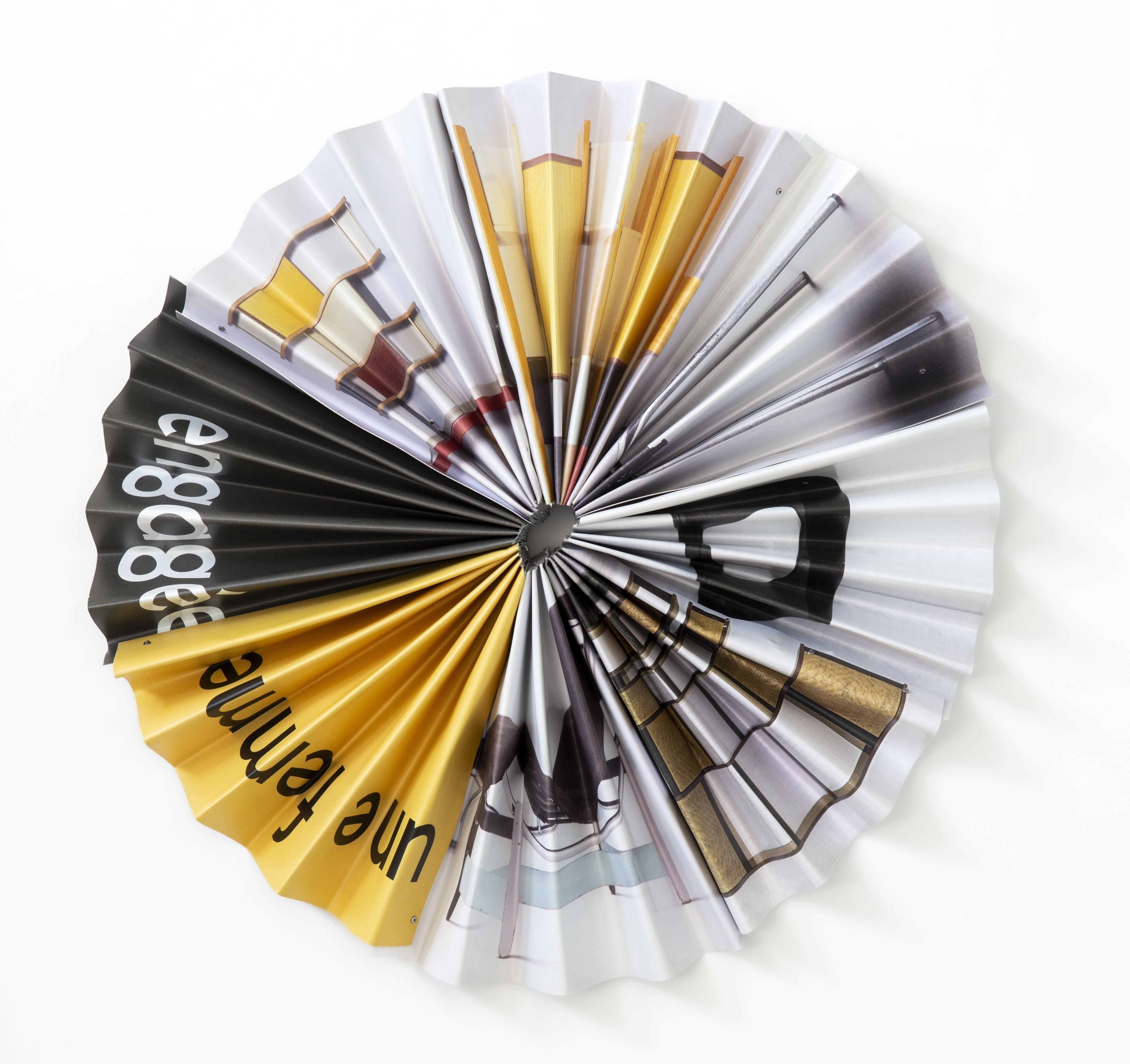
Almost all of the works shown in the exhibition Blunt Instrument consist of several overlapping material layers. These are mostly wooden panels painted, sawn, broken with dots of color, painted over the entire surface, or partially. She combines these with other common household materials such as plastic, corrugated cardboard, mirrors, pieces of metal, leather and more.
The painterly accents here are very manifold. Sometimes Ramsden paints the material entirely, occasionally only in parts, sometimes before the materials are joined together, sometimes afterward. The entire range of painterly techniques can be found, from thick, pasty, almost dry application of paint to full-area overpainting to thin, glazed ductus. The layers of material prepared in this way are then given other painterly accents. Gestural markings, graphic lines, pictographic forms, or brushstrokes that seem frozen in time are added. Not infrequently, the wood is additionally splintered, drilled, or has irregular edges.
For all the variety of different formal and material choices, what they all have in common is a somnambulistic certainty in the painterly settings and the tactile presence of the materiality and surfaces.
Although she sees this series as portraits, Mary Ramsden does not see herself as a portrait painter. “I wanted to play about with notions of traditional portraiture and employ assembled wall-based constructions as a means to locate a sense of how a person I know or have known is, to me.” (Ramsden)
In a time characterized by glossy screen surfaces on which we constantly tap, swipe, and pinch, the sometimes crude materiality of Mary Ramsden’s works, their haptic sensoriality, and the bold gestures of her painterly settings are soothing oases that invite contemplation about color, form, material, and painting.
In October, the book Blunt Instrument (Book works) will be published with works from the series of the same name and texts by authors with whom the artist was in lively exchange during the creation of the series of works.
Mary Ramsden had solo exhibitions at Pilar Corrias, London; The Aspen Art Museum, Aspen; Atticsalt Gallery, Edinburgh. She was part of group exhibitions at Tate Britain, London; Sid Motion Gallery, London; The Drawing Biennial 2019, London; The Drawing Room, London; Victoria Miro; London; Saatchi Gallery, London.
*****
Im März 2020 begann Mary Ramsden (*1984, lebt in London) eine neue Werkreihe von abstrakten Porträts. Diese waren motiviert durch die Eindrücke des ersten Lockdown vor dem Hintergrund der Corona-Pandemie. Die fehlende Nähe zu den Menschen aus ihrem Umfeld sowie die lediglich ‘fragmentarische’ Kommunikation über Video-Calls ließen in ihr den Wunsch aufkommen, mit diesen, wenn schon nicht in persona, so doch in übertragener Form ‘Zeit zu verbringen’.
Inspiriert hat Ramsden dabei die Ikonenmalerei jener Kult- und Heiligenbildern, die in der byzantinischen Kunst bei der Verehrung von Heiligen eine wichtige Rolle spielten. Dabei gilt das Interesse der Künstlerin in erster Linie dem Konzept der ‘Vergegenwärtigung’, wie sie die Kulturgeschichte der Menschheit seit ihren Anfängen prägt. Hierbei wird der Mangel an Wirklichkeit bspw. durch die Abwesenheit (einer Person o.ä.) als eine Entwirklichung begriffen, die mit Hilfe der (bildlichen) Vergegenwärtigung zu kompensieren versucht wird.
Mary Ramsden nimmt sich nun dieser Idee an, um dem Corona-bedingten Alleine- bzw. Auf-sich-selbst-Zurückgeworfen-Sein etwas entgegenzusetzen. Das Ungewöhnliche daran ist, dass es sich bei den Porträts nicht um die figurativ-bildliche Darstellung von Personen handelt, sondern um kleinformatige, abstrakte Kompositionen, Amalgame aus Malerei, Material-Collagen und eben auch Porträts im erweiterten Sinn.
Fast alle der in der Ausstellung Blunt Instrument gezeigten Arbeiten bestehen aus mehreren sich überlagernden Materialebenen. In der Regel sind das Holzplatten, die bemalt, gesägt, gebrochen mit Farbtupfern versehen, vollflächig oder partiell bemalt sind. Diese kombiniert sie mit anderen haushaltsüblichen Materialien wie Plastik, Wellpappe, Spiegeln, Metallstücke, Leder und anderen mehr.
Die malerischen Akzente sind hierbei ganz unterschiedlicher Natur. Manchmal bemalt sie das Material vollständig, gelegentlich nur in Teilen, ab und zu bevor die Materialien miteinander verbunden werden, manchmal auch hinterher. Es findet sich die gesamte Breite malerischer Techniken vom dicken, pastosen, fast trockenen Farbauftrag über vollflächigen Übermalungen bis hin zu dünnem, lasierendem Duktus. Die derart vorbereiteten Materialschichtungen werden anschließend mit weiteren malerischen Akzenten versehen. Es kommen gestische Markierungen, zeichenhafte Linien, bildliche Formen oder wie eingefroren wirkende Pinselstriche hinzu. Nicht selten ist das Holz zusätzlich gesplittert, gebohrt und mit unregelmäßigen Kanten versehen.
Bei aller Vielfalt der unterschiedlichen formalen wie materiellen Entscheidungen, allen gemeinsam ist eine traumwandlerische Sicherheit der malerischen Setzungen, sowie die taktile Präsenz der Materialität und Oberflächen.
Obgleich sie diese Serie als Porträts versteht, sieht sich Mary Ramsden nicht als Porträtmalerin. “I wanted to play about with notions of traditional portraiture and employ assembled wall-based constructions as a means to locate a sense of how a person I know or have known is, to me.” (Ramsden)
In einer Zeit, die geprägt ist von glatten Bildschirmoberflächen, auf denen wir ständig tippen, wischen und pinchen sind die bisweilen krude Materialität von Mary Ramsdens Werken, ihre haptische Sensorik sowie die kühne Gestik ihrer malerischen Setzungen wohltuende Oasen die zur Kontemplation über Farbe, Form, Material und Malerei einladen.
Im Oktober erscheint das Buch Blunt Instrument (Book Works) mit Werken aus der gleichnamigen Serie sowie Texten von Autoren, mit denen die Künstlerin während der Entstehung der Werkreihe im regen Austausch stand.
Mary Ramsden hatte Einzelausstellungen bei Pilar Corrias, London; The Aspen Art Museum; Atticsalt Gallery, Edinburgh. Sie war u.a. in Gruppenausstellungen zu sehen in der Tate Britain, London; Sid Motion Gallery, London; The Drawing Biennial 2019, London; The Drawing Room, London; Victoria Miro, London; Saatchi Gallery, London.