Ended Dec 15
Liang Fu
Corps Célestes
Oct 27 – Dec 15, 2022
Grasping at Ghosts: The Portraiture of Liang Fu
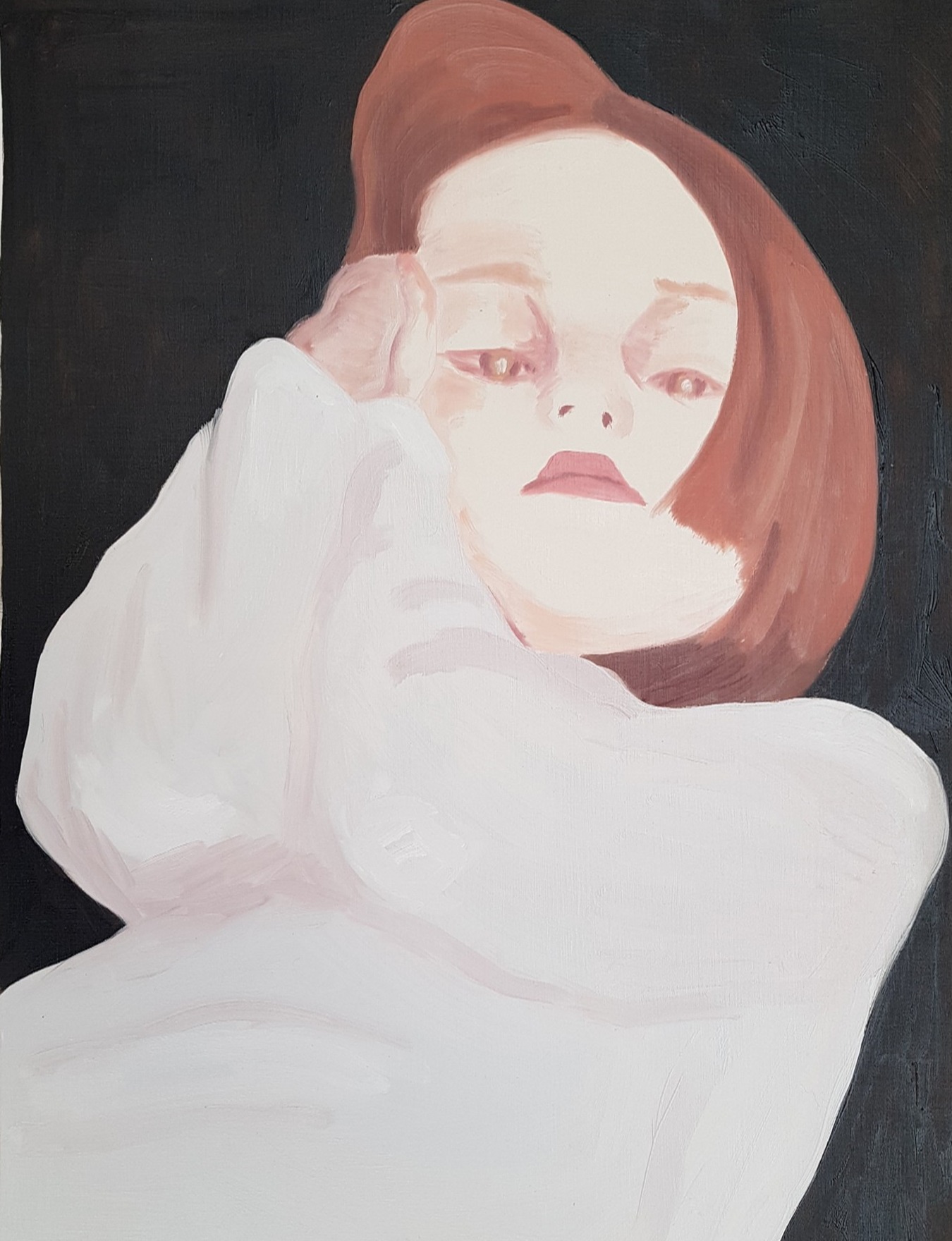
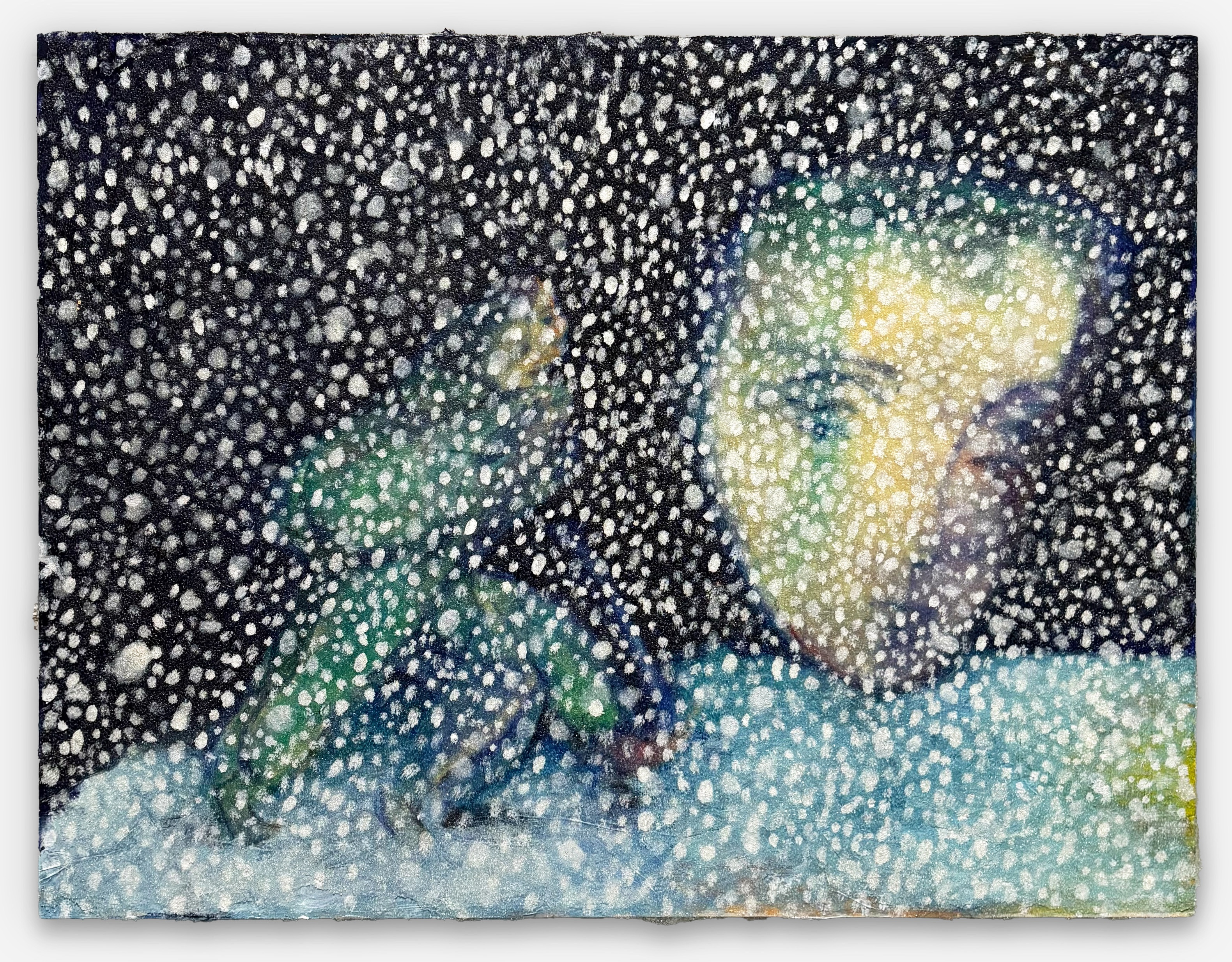
In contrast to photographic portraits, the subjects of Liang Fu’s figurative works are fluid beings—they emerge from nothing and disappear again. The paintings within corps célestes are not the expressions of captured moments, but rather allegories of transition. The bodies appear to function as if unobserved, left to their own devices, and completely alone. They are introvertedly engrossed and lost in thought as they fade in and out.
Fu’s human figures are presented without gender-defining signifiers or characteristics. Faces are veiled in translucent fabrics so that the viewer can only guess at their features: eyes, ears, mouths, and noses are obscured, fragmented, and riddled with gaps. Deep blues contrasted with lighter hues betray density and tease a transparent weightlessness, like the negatives of a photograph. Fu’s execution challenges us to fill-in the missing pieces, to pin-down an apparition, but ultimately we are grasping at ghosts. Occasionally the figures are headless torsos frozen in flux, suspended in movement but propelling forward (or backward) in time and space. His subtle interplay of colors and shapes, light and darkness, opacity and transparency, allows the strength of the spiritual to reveal itself within the aura of the incarnate. These works are intentionally and uniquely anonymous humans-as-portraits, not the other way around. Identity is unnecessary. These celestial bodies are specific in their individuality, yet anyone and everyone all at once.
The works of corps célestes oscillate between absence and presence, abstraction and figuration, the real and ethereal. A contemplative atmosphere asserts itself in the in-between as in both traditional Chinese painting and western modernism—there is a great tension when a void is defined as much by its subject as the subject by its surrounding void. Fu recalls the painting Angler on a Wintry Lake, 1195, by Mǎ Yuǎn of the Song Dynasty. Within the composition, a lonely, bearded man crouches on a little wooden boat with a fishing rod, gazing at the wave-tossed water, full of expectation. Rendered with a few strokes, the monochrome emptiness of water and sky spreading out around the man is as essential as the figure himself. The two exist in opposition, yet perfect balance. To Fu, Yuǎn’s piece is not dissimilar from the still lifes of Giorgio Morandi. His vases, bottles, bowls, and flowers are delineated by their isolation, their existence articulated by the lack which envelopes them. Fu expounds on these traditions within his practice, his paintings are defined by absence and emptiness and the transitory nature of each.
When every object, every figure is in a state of articulating and undoing itself, the idea of permanence is just a construct draped over reality. In contextualizing corps célestes, Fu cites a passage from the work “Water and Dreams” by the Frenchman Gaston Bachelard. For the poet and the philosopher, a drop of water is a second in time, and the flowing of a river is eternal death. Fu’s celestial bodies encapsulate the constant back and forth between existence and death, earth and stars, time and space. They are a drop of water in the river of the cosmos.
Liang Fu (b. 1993, Sichuan, China) lives and works in Paris, France. He received his BFA and MFA from National Fine Arts School of Nantes in Nantes, France. Recent exhibitions include Disembodied, Galeria Nicodim, Bucharest (2022); Intangible, Nicodim Upstairs, Los Angeles (2022, solo); Peripheries, Newchild Gallery, Antwerp (2022); Moonstruck Noon, Linseed, Shanghai (2022); petit beurre, Maia Muller Gallery, Paris (2021); Emergence, Riseart Gallery, London (2021).
—Heinz-Norbert Jocks
Translated from the German by Alexandra Skwara with Ben Lee Ritchie Handler