
Exhibition · Gillmeier Rech
Lisa Holzer
I Come In You - The Party Sequel (Berlin)
Sep 2 – Oct 21
3 images · swipe
About the show
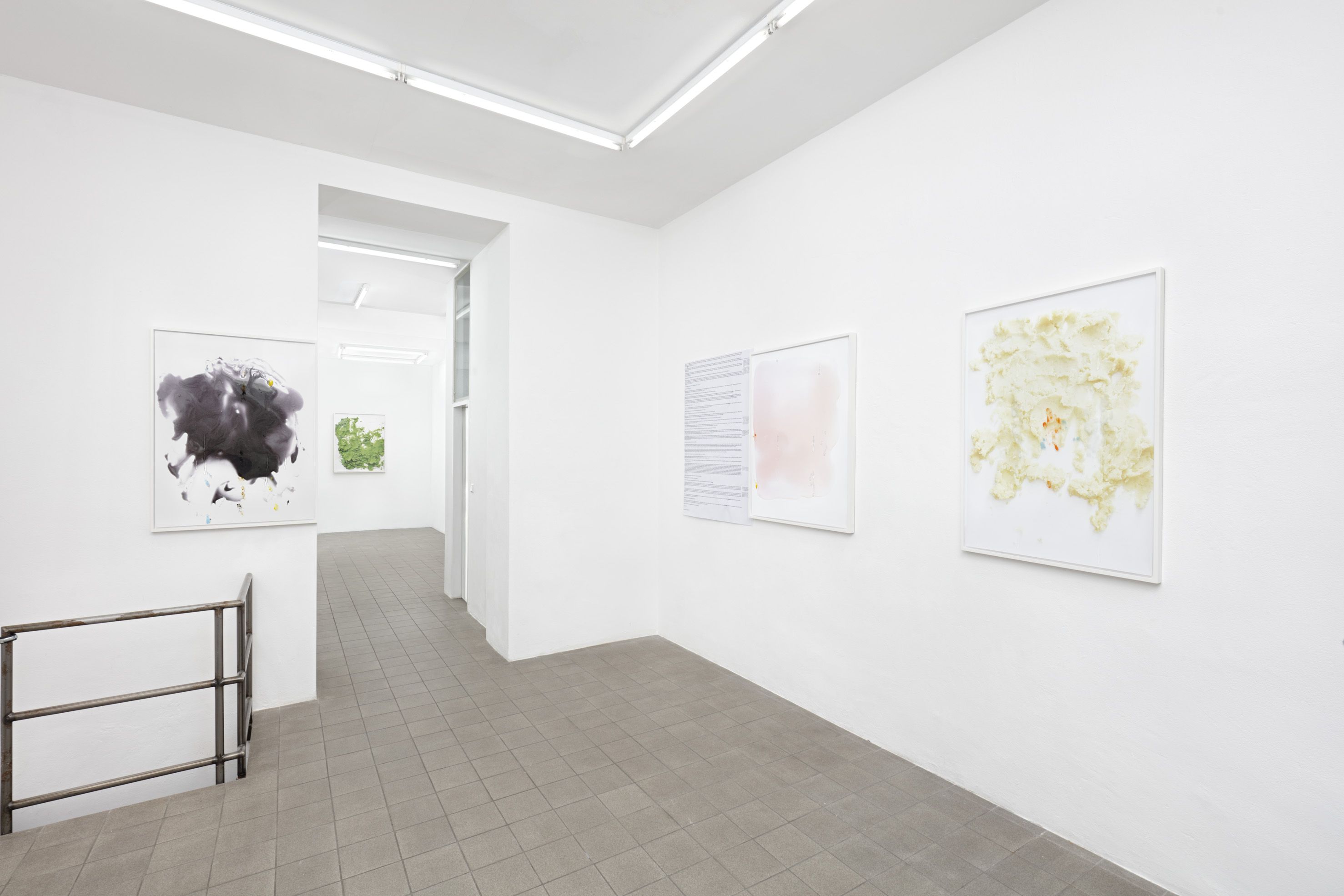
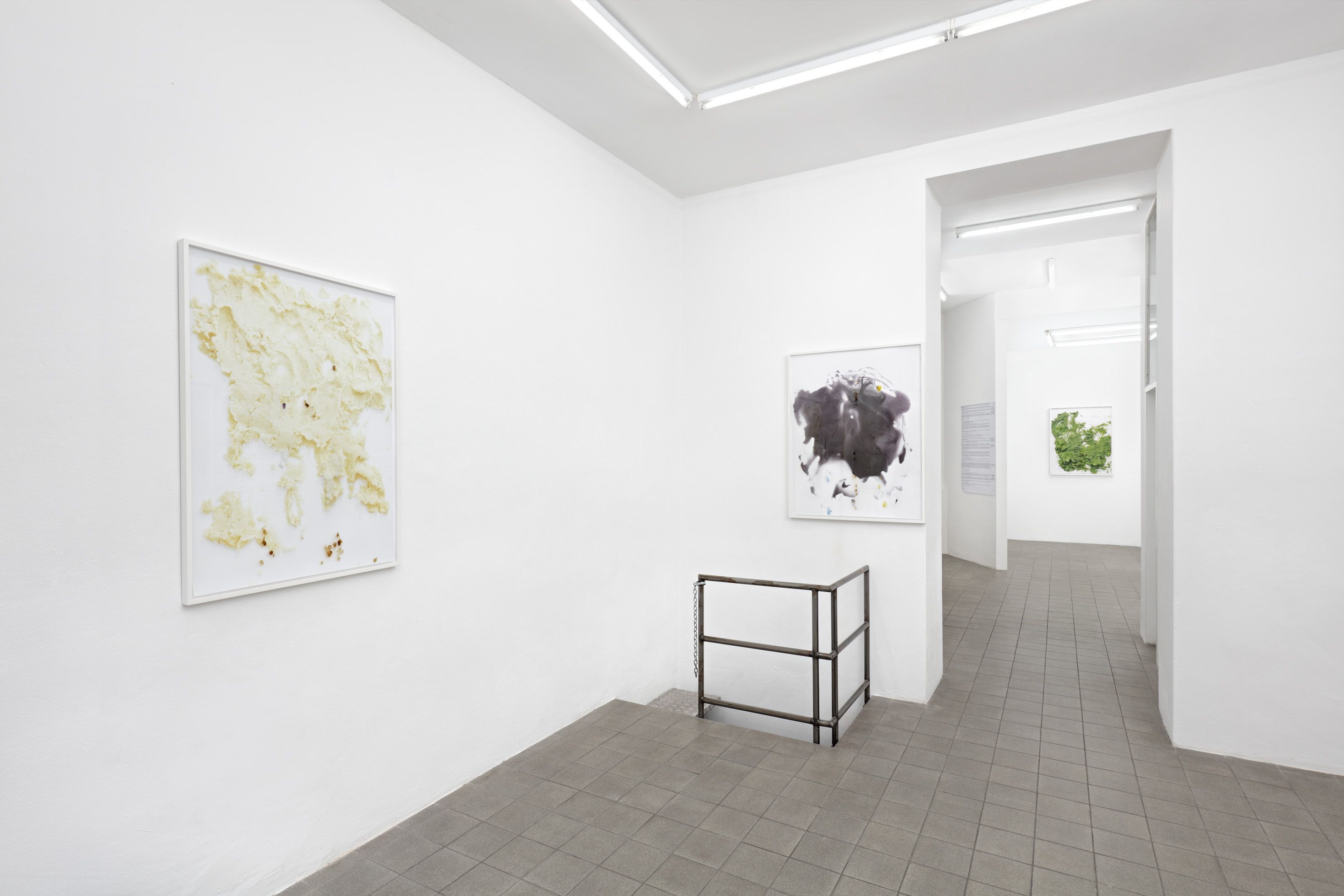
For her first solo exhibition in Berlin [1] I Come In You - The Party Sequel (Berlin) [2] Lisa Holzer shows The Party Sequel (Berlin). The Party Sequel (Berlin) follows a series of pictures of smeared puréed lentils evoking shit and concrete in shapes inspired by Morris Louis’ 1950s Veils series, merely transformed to portrait format, and pictures of sticky white sugar icing in similar shapes. Kari Rittenbach referred to them as paintings.
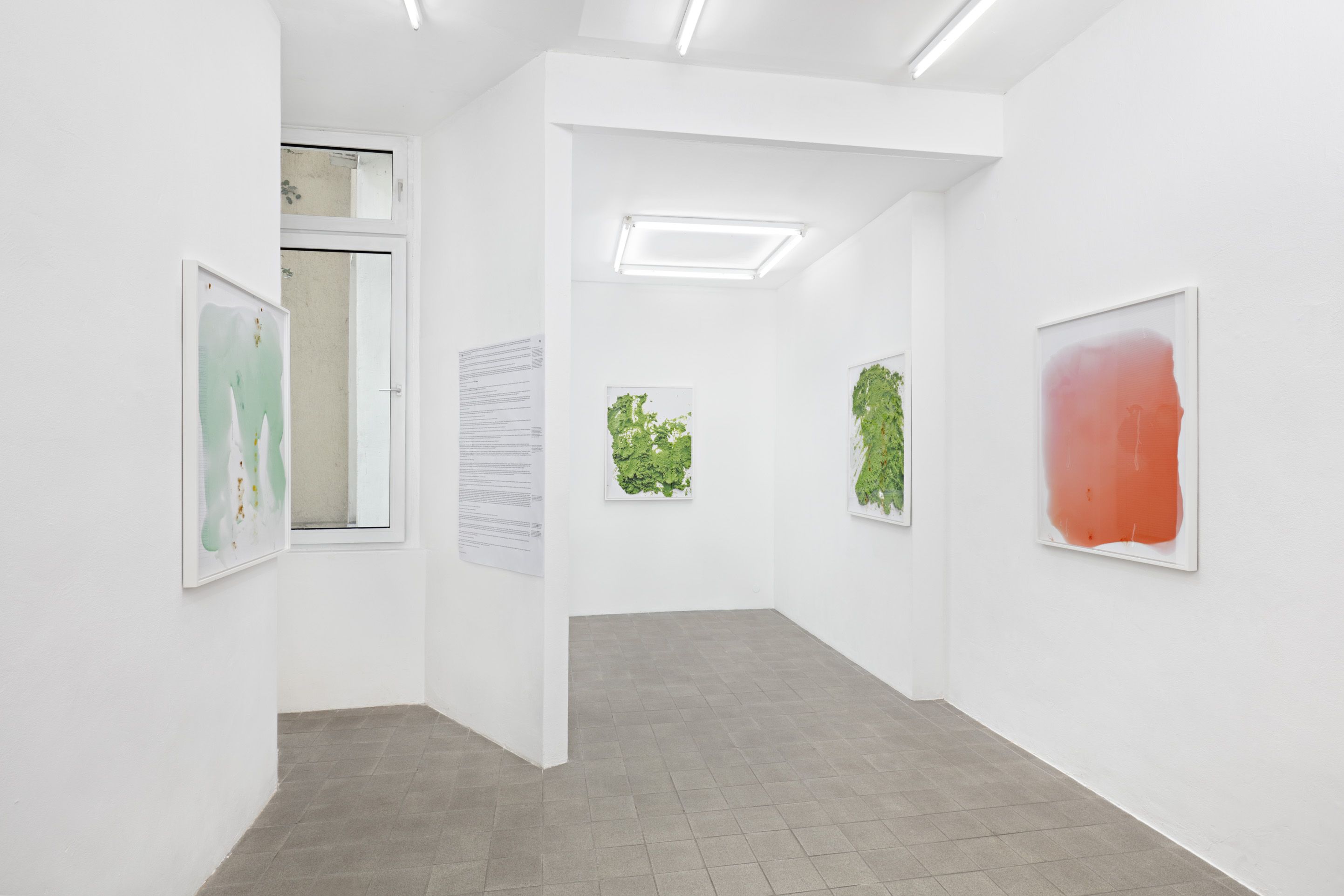
The Party Sequel (Berlin) are pictures of puréed potatoes and peas and pictures of differently coloured sugar icing in whose sticky, soggy surfaces I am sometimes mirrored. You. I am in the middle of your picture [3]. A somehow crooked narcissus-idea plays here as well. The pictures are pigment prints on cotton paper framed in exclusive white varnished frames in the size of torsos-plus-aura. Both mashed potatoes pictures are a little too pale.
The shapes of the puréed potatoes, peas, and the coloured sugar icing are freer interpretations of the Veils shapes and/or inspired by two watercolours by my little son.
That process, sounds and all, of puréeing, spreading and smearing and photographing these carefully overcooked lumpy potatoes and peas, which - instead of shit and concrete - evoke or should evoke only shitty-sweet regression, is very satisfying. As is the whisking of icing, coloured or not.
Food has to do with body, and desire, and destruction, and painting as well.
What do I tell, the pictures me? Are they weak enough? Vulgar? And how frustrated, resentful, aggressive, how passive-aggressive is I come in you, if at all? Would these pictures fail as abstract expressive or be taken up in the contradictions of Abstract Expressionism respectively its hangovers? Are these pictures paintings or how much paintings? Are they beautiful?
What kind of echo is this? What a party!? Does this second part answer the first?
Apparently Louis was a loner, they say he had few friends and rarely discussed his art with anyone, not even his wife.
And the other bodies? Do the pictures transport my dark or at least rather ambivalent view on parties? I have difficulties with/at parties. I have difficulties with a certain way of happiness or lightness. What is the common ground thing? What do parties have to do with regression? It still seems wrong to me to work at parties. As teenager I cried a lot at parties.
Emily Sundblad said: “But I think also people drink too much to really cause a revolution. They get too drunk, and they cannot do anything.” [4]
And who gets invited? Together with Trevor Lee Larson I am invited to do a performance for the Special Program of this years' Art Berlin for VIPs, at least they got invited first. This is a VIP dream. And another border/edge/verge (Rand) of this exhibition, of me.
Morris Louis is dead. Others die too. Photography as painting has a connection to death. Language anyway.
Édouard Louis writes: “Years later, while reading the biography of Marie-Antoinette by Stefan Zweig, I will remember the people who lived in the village where I grew up, my mother in particular, when Zweig speaks of all the furious women, worn out by hunger and poverty, who, in 1789, descended upon Versailles to protest and who, at the sight of the monarch, spontaneously cried out Long live the King!: their bodies - which had spoken for them - torn between absolute submission to power and an enduring sense of revolt.” [5]
I am still interested in surfaces and the question what a picture is, a picture constitutes. Its instability, elasticity or permeability and silence. Its borders/edges/verges (Ränder) and mine. The pictures cry. Sometimes colour passes, permeates the glass, comes out of the picture. Do they puke a little? I don't know (exactly) why they puke, or cry. All is leaky and leaks through. Crying as readymade and puking as well. And the not coated glass of the frames mirrors everything. You?
My mascara is smeared or theirs. Runs, literally.
The gallery's toilet's body sweats/cries in a permanent installation. Look what I did!
Intensities visualise in more or less amounts of rather different liquids. What is it with tears? How transformative is crying? I am interested in crying as bodily expression, action, as means of transition, communication, as one border/edge/verge (Rand) of me, my face, my work, as leakage or readymade, crutch, ..
We'll cry, maybe. As crying, as one border/edge/verge (Rand) of my work, my face/of me or as some kind of door, is, what I am currently thinking about. I want to touch something. My pictures cry, after they sweated for some time now. How do they, I act on the world?
Sometimes there is no border/edge/verge (Rand).
I feel cheesy, moody, needy, ashamed as an artist. Porous like a door. A hustler. How regressive are things? How porous am I? How involved? What comes with tears, matters? And what do I not say/see, avoid, again, in order to go on, forward? as artist?? What recurs? Hesitation? I used to cry a lot at parties.
Anger and sadness live in suspended relation. And do get mixed up.
I come in you.
The Party Sequel (Berlin) is accompanied by I cry., an even chattier version of this press release in the form of a poster.
An edition of crying champagne glasses are available via the gallery.
̶ Lisa Holzer, Summer 2017
1 - I live here since 9 years.
2 - The Party Sequel (Paris) featuring pictures of puréed black beans and carrots alongside other pictures of coloured icing will be on view at Galerie Emanuel Layr at Fiac 2017 in Paris this October.
3 - »I am in the middle of your picture« is a line from All I need by Radiohead, first cited in Vier Pressetexte (2009), and then again in I am not there (2011). I am in the middle of your picture was the title of my first solo show at Galerie Emanuel Layr in 2011.
4 - But I think also people drink too much to really cause a revolution. They get too drunk, and they cannot do anything. Emily Sundblad in WELCOME TO THE TATE CAFÉ a conversation between Merlin Carpenter, Emily Sundblad and John Kelsey. Paris, March 2012.
5 - Édouard Louis, The End of Eddy, Harvill Secker, Vintage, 2017. penguin.co.uk/vintage. The original edition was published in 2014, entitled En finir avec Eddy Bellegeule, Editions du Seuil, Paris.
*****
Lisa Holzer zeigt in ihrer ersten Einzelausstellung in Berlin [1], I Come In You - The Party Sequel (Berlin) [2], The Party Sequel (Berlin). The Party Sequel (Berlin) folgt einer Serie von Bildern verschmierter pürierter Linsen, die Scheisse und Beton evozieren und in ihren Formen von Morris Louis 1950er Veils Serie inspiriert sind, nur verschoben ins Hochformat, und Bildern von klebrigem weissem Zuckerguss, in ähnlichen Formen. Kari Rittenbach hat sie als Malereien bezeichnet.
The Party Sequel (Berlin) sind Bilder von pürierten Kartoffeln und Erbsen und Bilder von verschieden farbigem Zuckerguss, in deren klebrigen, feuchten Oberflächen ich mich manchmal spiegle. Du. Ich bin in der Mitte deines Bildes. [3] Eine irgendwie schräge (crooked) Narziss-Idee spielt hier auch mit rein. Die Bilder sind Pigmentprints auf Baumwollpapier, gerahmt in exklusiven, weiß lackierten Rahmen, in der Größe von Torsos plus Aura. Beide Kartoffelpüreebilder sind etwas zu blass.
Die Formen der pürierten verschmierten Kartoffeln, Erbsen und dem farbigen Zuckerguss sind freiere Interpretationen der Veils Formen und/oder von zwei Aquarellen meines kleinen Sohnes inspiriert.
Dieser Prozess, Geräusche und alles, des Pürierens, Verteilens und Schmierens und Fotografierens dieser vorsichtig zerkochten, klumpigen Kartoffeln und Erbsen, die statt Scheiße und Beton nur beschissen-süße Regression evozieren bzw. evozieren sollen, ist sehr befriedigend. So wie das Quirlen von Zuckerguss, egal ob farbig oder nicht.
Essen hat mit Körper und Begehren zu tun und Zerstörung und auch mit Malerei.
Was erzähle ich, die Bilder mir? Sind sie schwach genug? Vulgär? Und wie frustriert, nachtragend, aggressiv, wie passiv-aggressiv ist I come in you, wenn überhaupt? Würden diese Bilder scheitern als abstrakt expressive, oder Aufgehen in den Widersprüchen eines abstrakten Expressionismus bzw. seiner Nachwirkungen? Sind diese Bilder Malerei oder wieviel Malerei? Sind sie schön?
Was ist das für ein Echo? Was für eine Party!? Antwortet dieser zweite Teil dem ersten?
Anscheinend war Louis ein Einzelgänger, es heißt, er hatte wenige Freunde und hat selten mit jemandem über seine Kunst gesprochen, nicht einmal mit seiner Frau.
Und die anderen Körper? Transportieren die Bilder meine dunkle oder zumindest ziemlich ambivalente Sicht auf Parties? Ich habe Schwierigkeiten mit/auf Parties. Ich habe Schwierigkeiten mit einer bestimmten Art von Glück oder Leichtigkeit. Was ist das Gemeinsame? Was haben Parties mit Regression zu tun? Es kommt mir immer noch falsch vor, auf Parties zu arbeiten. Als Teenager habe ich viel auf Parties geweint.
Emily Sundblad hat gesagt: „Aber ich denke auch, dass die Leute trinken zu viel trinken, um wirklich eine Revolution zu bewirken. Sie werden zu betrunken und können gar nichts tun.“ [4]
Und wer wird eingeladen? Gemeinsam mit Trevor Lee Larson bin ich eingeladen, eine Performance im Special Program der diesjährigen Art Berlin zu machen, für VIPs, zumindest wurden die zuerst eingeladen. This is a VIP dream. Und ein anderer Rand dieser Ausstellung, von mir.
Morris Louis ist tot. Andere sterben auch. Fotografie wie Malerei haben eine Verbindung zu Tod. Sprache sowieso.
Édouard Louis schreibt: „Viele Jahre später, bei der Lektüre von Stefan Zweigs Marie Antoinette, musste ich an die Bewohner des Dorfes denken, aus dem ich stamme, und besonders an meine Mutter, wenn Zweig die von Hunger und Elend gepeinigten aufständischen Frauen schildert, die 1789 gen Versailles ziehen, und die, als sie des Königs ansichtig werden, spontan Es lebe der König! ausrufen - ihre Körper sprechen selbständig, an ihrer Statt, zerrissen zwischen restloser Unterwerfung und fortwährendem Aufstand.“ [5]
Mich interessieren immer noch Oberflächen und die Frage, was ein Bild ist, ein Bild ausmacht. Seine Instabilität, Elastizität bzw. Durchlässigkeit und Stille. Seine Ränder und meine. Die Bilder weinen. Manchmal kommt Farbe durch, dringt durchs Glas, kommt aus dem Bild. Kotzen sie ein bisschen? Ich weiß nicht (genau), wieso sie kotzen oder weinen. Alles leckt und sickert durch. Weinen als Readymade und Kotzen auch. Und das nicht entspiegelte Glas der Rahmen spiegelt alles. Dich?
Meine Wimperntusche ist verschmiert oder ihre. Rinnt, literally.
Der Toilettenkörper der Galerietoilette schwitzt/weint in einer bleibenden Installation. Look what I did!
Intensitäten werden in mehr oder weniger großen Mengen ziemlich verschiedener Flüssigkeiten sichtbar. Was ist mit Tränen? Wie transformativ ist Weinen? Mich interessiert Weinen als körperlicher Ausdruck, Handlung, als Mittel des Übergangs, der Kommunikation, als ein Rand von mir, meines Gesichts, meiner Arbeit, als Leckwerden/Auslaufen/Verlust oder Readymade, Krücke,…
Wir werden weinen, vielleicht. Weil Weinen, als ein Rand meiner Arbeit, meines Gesichts/von mir oder als eine Art Tür, das ist, worüber ich gerade nachdenke. Ich will etwas berühren. Meine Bilder weinen, nachdem sie jetzt seit einiger Zeit geschwitzt haben. Wie wirken sie, ich auf die Welt?
Manchmal ist da kein Rand.
Ich fühl mich cheesy, launisch, bedürftig, beschämt als Künstlerin. Porös wie eine Tür. A hustler. Wie regressiv sind die Dinge? Wie porös bin ich? Wie involviert? Was unter Tränen gesagt wird, bedeutet etwas? Und was sag/seh ich nicht, vermeide ich, schon wieder, um nach vorne?, weiter? zu gehen als Künstlerin?? Was wiederholt sich? Ein Zögern? Ich habe viel auf Parties geweint.
Wut und Traurigkeit leben in suspendierter Beziehung. Und werden verwechselt.
I come in you.
The Party Sequel (Berlin) wird von I cry., einer noch gesprächigeren Version dieses Pressetexts in Form eines Posters begleitet.
Eine Edition weinender Sektgläser ist über die Galerie erhältlich.
̶ Lisa Holzer, Sommer 2017
1 - Ich lebe hier seit 9 Jahren.
2 - The Party Sequel (Paris) mit Bildern von pürierten, schwarzen Bohnen und Karotten, neben anderen Bildern von farbigem Zuckerguss, werden bei Galerie Emanuel Layr auf der Fiac 2017, diesen Oktober in Paris zu sehen sein.
3 - »I am in the middle of your picture« ist eine Zeile aus All I need von Radiohead, zuerst zitiert in Vier Pressetexte (2009), und dann nochmal in I am not there (2011). I am in the middle of your picture war der Titel meiner ersten Einzelausstellung bei Galerie Emanuel Layr in 2011.
4 - But I think also people drink too much to really cause a revolution. They get too drunk, and they cannot do anything. Emily Sundblad in WELCOME TO THE TATE CAFÉ ein Gespräch zwischen Merlin Carpenter, Emily Sundblad und John Kelsey. Paris, März 2012.
5 - Édouard Louis, Das Ende von Eddy, Roman, 2016, Fischer Taschenbuch. Die Originalausgabe erschien 2014 unter dem Titel En finir avec Eddy Bellegeule bei Editions du Seuil, Paris.