
Ended
Kaari Upson
House to Body Shift
Sep 16 – Nov 1, 2025
Throughout the work of Kaari Upson, the home and the body are persistent themes, from her earliest works from "The Larry Project” to her later series drawn from the contents of her childhood home in San Bernardino, California. Monika Sprüth and Philomene Magers are pleased to present House to Body Shift, an exhibition at the London gallery that explores how the late artist delved into the rich connections between our selves and our domestic surroundings, both physically and psychologically and across familial generations. In latex, silicone, charcoal, paper, sound and video, the body and its traces dissolve into the objects and architecture of the home, only to reappear again as fragments and uncanny presences that reverberate across Upson's charged forms.
Any account of Upson's practice begins with "Larry," a pseudonym for her parents' neighbor in the early 2000s whose ostentatious house, loud parties and Hugh Hefner– styled character were the subject of many stories and complaints. Amused at first, she became engrossed by the idea of him after finding a trove of his personal affairs left abandoned in his partially burned home—a casualty of San Bernardino's periodic urban wildfires. Furniture, clothing, photographs, letters, journals and other private items became the source of years worth of art-making for Upson, who developed an intricate, evolving picture of this largely imagined character and the home-space he had designed and inhabited, as well as her equally imagined relationship with him as the blonde "girl next door."
Upson's early Kiss Paintings, such as Untitled (Kiss) (2008), exemplify this romantic bonding of self and other. The artist painted a self-portrait on one panel, and a portrait of Larry on the other; while still wet, she pressed them together, so that each face became partly imprinted on the other. Larry's specter, and artifacts from his home, also filtered into early examples of her cast sculptures on view in House to Body Shift. Speaking about Larry's house in a 2014 interview, Upson remarked: "I always knew that I was going to get to the endpoint where I would have to deal with the house as a subject." In 2011, she produced a series of latex sculptures, all pigmented in tones reminiscent of white skin and modeled after fences, chandeliers, and staircases reminiscent or recreated from what she had witnessed there.
Internal Pocket #2 (2011) reproduces the carpeted area at the top of his extravagant double staircase and includes the ghostly cast of Larry's tennis racket and athletic shoe. Draped across the wall, the work has the effect of a flesh-toned portal or mouth —the body is subsumed into the house, then redefined as a body. This became a recurring image in Upson's drawings, including in the four-part House to Body Shift (2012) that gives this exhibition its title. There, the staircase is now on its side, mirrored and doubled, creating an ocular presence alongside notations of "fold" and "unfold," referring perhaps to the folds of paper or skin.
The notion of the double, a common compositional and theoretical tool for the artist, is also apparent in the two latex works Chandelier and Double Chandelier (both 2011), as it is in Barrier (2011), in which two repeating fence segments stretch toe-to-toe from floor to ceiling. These works demonstrate Upson's inventive use of the gallery architecture to upend our expectations of how objects function and where they belong, as well as the continued influence of the Larry narrative on her practice.
In 2012, Upson turned to working with soft furniture, including mattresses, sofas and other objects found discarded near her studio in Los Angeles. The artist cast these forms out of silicone and urethane, fascinated with the possibility of lifting and replicating not only their surfaces and "skins," but also the emotional, psychological and physical traces of those who had used them (she had also earlier encountered an unusual number of mattresses in the rooms of Larry's house). "Body and stain are always in my work," she noted in 2015. Upson's dynamic application of pigment features in two works from 2013, 68 and 98, twin mattresses rendered in ultra-bright tones of green, blue, yellow and pink that illustrate her vivid exploration of both beauty and the grotesque.
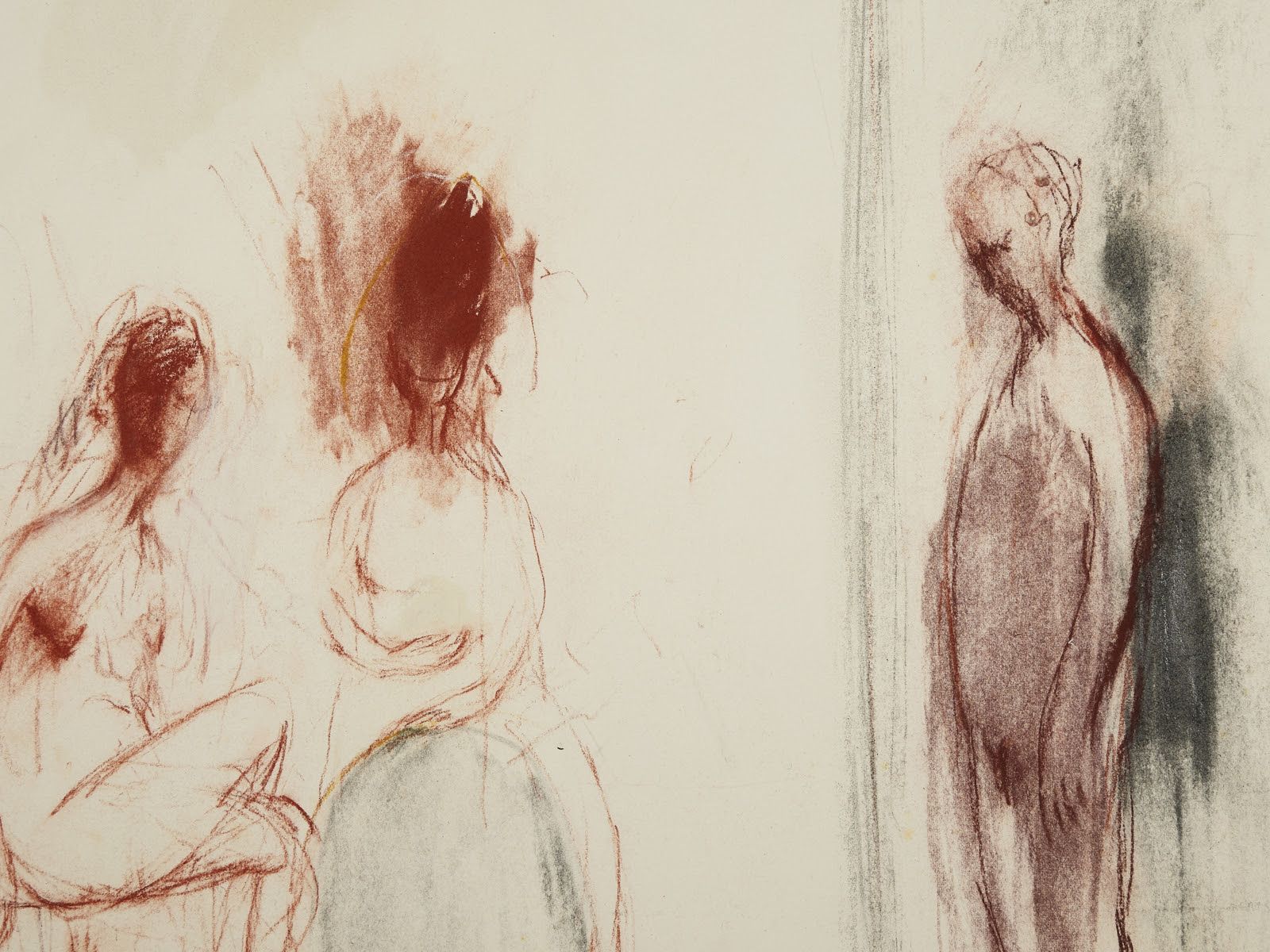
Because of the fire that consumed Larry's house (first partially in 2003, and then completely in 2007), Upson frequently employed charcoal—the residue of fire— attracted by its deep, black tones and its metaphorical links to destruction, transformation and rebirth. A series of text-based drawings from 2009 feature phrases and commands filtered from past relationships, both real and dramatized ("I Am More Him Than He Is," "Go Inside", "Not Here Not Now,") and are made from charcoal and cutouts to echo burnt paper. Opposite these works are examples of Upson's Grotto Drawings (2008–10), large-format pastel and charcoal works on paper that begin with porn imagery—some appropriated, at times from Larry's belongings, others featuring Upson herself wearing prosthetic breasts and vulvas. Using various reproduction and layering techniques, the artist dissolved and diffused the original images, nearly subsuming them into abstraction. Their lush pastel surfaces echo the softcore nature of the images, and Upson's charcoal dustings add a dusky edge to each scene.
The grotto in Upson's works refers to the notorious structure at Hugh Hefner's Playboy Mansion, the site of countless parties and orgies; but also to the cheap imitations that Larry designed and installed on his own properties. Videos that the artist shot within her installation entitled The Grotto (2008–09) depict the artist wearing her sexual prostheses, mimicking the drawl and affected sexiness of playboy bunnies. Caves and grottos represent private, secluded spaces; homes for creatures of the night. Upson brings the dark underbelly of this hyper-masculine world to the fore, but also revels in her fascination with it, rendering the home as a surreal site of trauma, memory and intrigue.
Kaari Upson (1970–2021) lived and worked in Los Angeles and New York. A major retrospective of her work, Dollhouse – A Retrospective, is currently on view at the Louisiana Museum of Modern Art, Humlebæk, Denmark, and will travel to Kunsthalle Mannheim and MASI Lugano in 2026–27. Other solo exhibitions include Hammer Museum, Los Angeles (2023, 2007), Deste Foundation, Athens (2022), Kunsthalle Basel (2019), Kunstverein Hannover (2019), and New Museum, New York (2017). Group exhibitions include Kunstmuseum Basel (2025), Hessel Museum of Art, Annandale-On-Hudson, NY (2024), Centre d'Art Contemporain Genève (2023), Notthingham Contemporary (2022), San Francisco Museum of Modern Art (2022), Cleveland Museum of Art (2021), Louisiana Museum of Modern Art (2021), Walker Art Center, Minneapolis (2020), Aspen Art Museum (2019), Marta Herford Museum, Herford, Germany (2018), 15th Istanbul Biennial (2017), 2017 Whitney Biennial, Aïshti Foundation, Beirut, Lebanon (2015-16), The High Line, New York (2015), Rubell Family Collection, Miami (2015), Ullens Center for Contemporary Art, Beijing (2014), CAPC Musée d’art contemporain, Bordeaux, France (2014) and Museum of Contemporary Art, Los Angeles, CA (2013). In 2019 and 2022, her work was featured in the 58th and 59th Biennale di Venezia.