
Ended
Vikky Alexander
Dream Palace
Sep 7 – Oct 5, 2024
[Scroll down for French version / Veuillez trouver ci-dessous la version française]
Do you remember the 1980s? The time of Margaret Thatcher’s England and Ronald Reagan’s United States allying along the lines of an unchecked liberalism, marking the dawn of a new era whose watchwords would be commerce, performance and efficiency. In order to stimulate consumption, advertisers distributed images that would shine and sparkle ever more spectacularly, the pursuit of immediate pleasure was their moral core. Images of desirable objects, people and places multiplied, appeared on television screens, among the pages of magazines, were plastered across advertising billboards. The public space grew covered with fictions and injunctions, the domestic environment crowded with parasitic information, publicity and entertainment. Faced with this deluge of fabricated representations, constructed, misleading and ill-intentioned, a population could easily lose its grip on reality. Jean Baudrillard prophesised then the disappearance of lived experience, to be replaced by simulations[1]. And during this moment, Vikky Alexander created works that not only recall the decade, but encapsulate its spirit and its representations, and the violence and domination that they express.
In the late 1970s, Vikky Alexander was a student at the Nova Scotia College of Art and Design in Halifax, Nova Scotia, Canada. She practiced photography, but not of people or places she encountered; rather, she turned her lens on television and billboard advertisements, on their characters and locations, their perfection only matched by their irreality. Moving to New York in 1979, she discovered the work of artists there, many barely older than herself. Some had participated in Douglas Crimp’s group exhibition Pictures in 1977; others gathered around the Metro Pictures gallery, opened in 1980 by Helene Winer and Janelle Reiring. This group would come to be known as the Pictures Generation, and included Sarah Charlesworth, Jack Goldstein, Louise Lawler, Robert Longo, Sherrie Levine and Cindy Sherman. The artists invented a new mode of expression: the copy. Their works reproduce advertising and cinematic images, made to entertain, impress, or ignite desire, and through their manipulation, probe the intentions behind such representations, and the psychological impacts they are designed to effect. Many artists of the Pictures Generation are women, who often bring a critical regard to mass media representations that are intended for their consumption, concerning their idealised appearance, their availability, their submission. This objectification, Laura Mulvey’s Male Gaze, is painstakingly dissected by feminist theory[2].
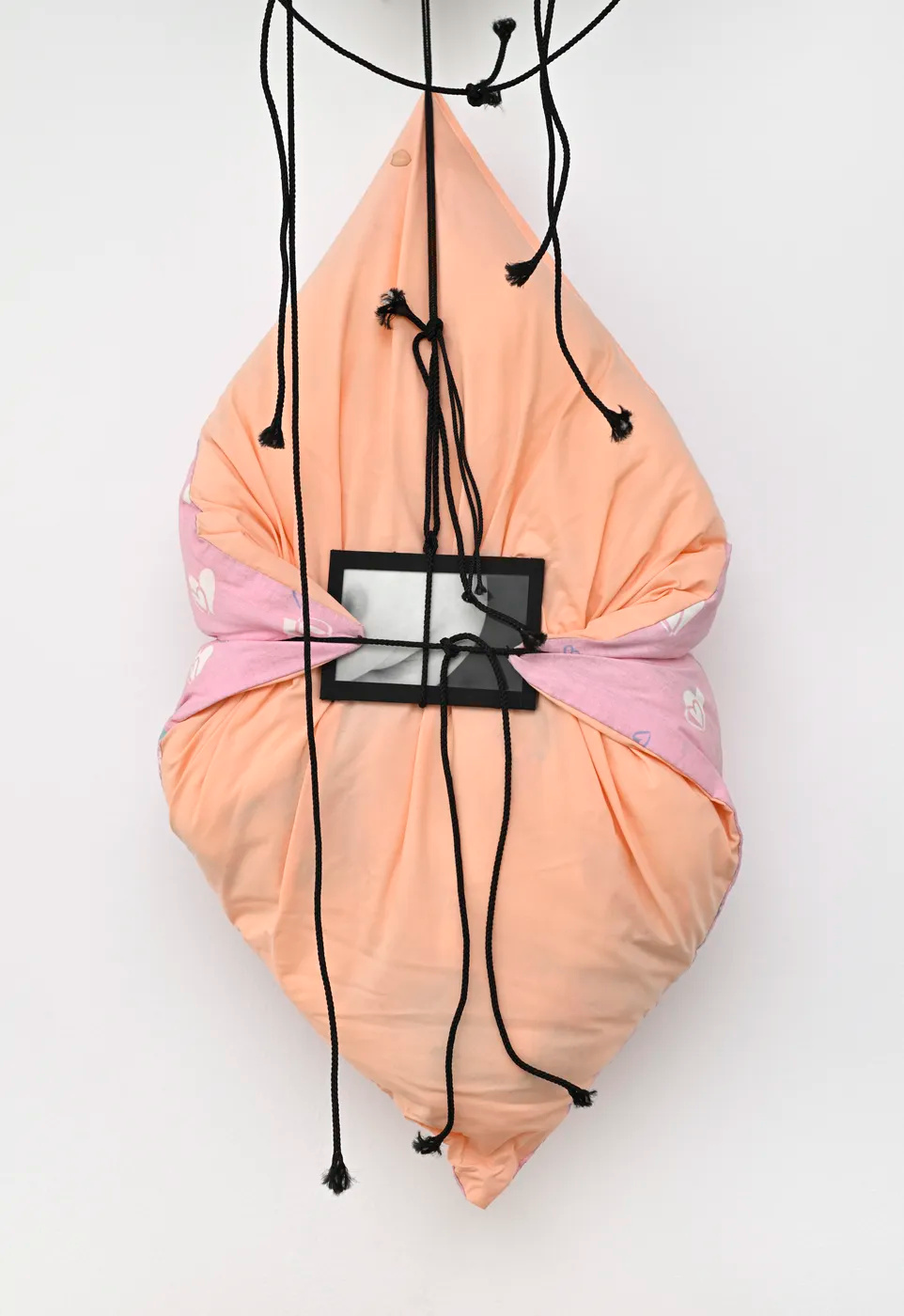
Vikky Alexander began, then, to photograph images from adverts, in magazines and calendars. These images that penetrate the domestic space are manipulated by her: moved, rotated, associated, presented behind coloured plexiglass. When photographing them, the artist frames the models and landscapes in such a way as to exclude their accompanying text. Like this, the image’s justification disappears, and we are left with that which would give her 2020 retrospective at the Vancouver Art Gallery its title: Extreme Beauty[3]. Stripped of its commercial or decorative explanation, its legitimisation, such beauty reveals itself to be chillingly objectified.
Vikky Alexander explains it simply: in some of her works “there is an image of a super-beautiful model surrounded by images of super-beautiful landscapes[4].” It is the prosaic description of works like Portage Glacier, 1982, in which the images used are the result of a brutal domestication, in which the subjects represented are locked in their stereotypes, their appearance fixed. Alaska’s Portage Glacier, a source of local pride and a tourist destination, is represented in a similar way to its accompanying model. Bodies and natural environments undergo the same process of artificialisation, the Male Gaze is mixed with the anthropocentric vision beneath a regard that subjugates all to its own desires.
This association of body and landscape continues in the Between Living and Dreaming series, created in 1985 and 1986. Here, Vikky Alexander combines reproductions of images with her own photographs of locations. She manipulates her image bank on a light box and sets down on paper the compositions that catch her attention. Couples embracing, desirable bodies and pensive figures are combined with images of nature, itself simplified and idealised. Human relationships, like our relationships with nature, are saturated with cultural assumptions. These encounters are not wild adventures. They are normalised, become banal. In the compositions the artist orchestrates, the meaning of the word ‘natural’ seems to evaporate into the limbo created by these colliding images. Regarding this practice of superimposition, she explains “at the time, I was thinking about flaws, in fact the impossibility of ‘desire’. The slippery character of these images seems to encapsulate that[5].”
Desire and its intensification for commercial gain are the focal points of Vikky Alexander’s oeuvre. One such example is the work Magenta St. Sebastian, 1982, which consists of an image of a woman lying on her back that the artist has rotated and twice reproduced. The model is leant against a support around which her arms might be tied, recalling the posture of Saint Sebastian, the martyr whose execution, attached to a post and riddled with arrows, has been the subject of abundant pictorial iconography since the Renaissance.
Raising these commercial images to the rank of works which centuries of art history has grappled with is not merely a sarcastic commentary on the passion and quasi-religious fervour engendered by consumerism, but also a testament to the collective state of mind of an era. In the 1980s, following Roland Barthes’ discovery of Mythologies in consumer and entertainment goods, many thinkers in turn examined these products for morals, founder narratives or links with ancestral histories[6].
Do you remember the 1980s? Unabashed consumption took hold, driven by the stimulation of our desires. It relied on the objectification of people and nature, which it transformed into a set of data deprived of contexts and histories. It became an art form, a religion, a myth. Working with these representations, amplifying their intentions and underlining how they function, the work of Vikky Alexander effectively synthesises the spirit of these years.
—François Aubart, traduit par Flora Hibberd
Vikky Alexander (b. 1959, Victoria, BC) is a Montreal-based artist celebrated for her ongoing contributions to Pictures Generation strategies of critique by appropriation. Engendering a quietly reflective feminism that investigates the power of framing devices within the architectures of corporate branding, her works assess the fetishistic, bureaucratized and aspirational—generating recombinatory mixtures of appropriated scenes of natural landscapes and typifications of beauty that demarcate the romanticization of nature and the naturalization of romance. Activating a jarring fracture between embodied experience and its idealized presentation, her sensual and stylized works spanning installation, sculpture, photography, and video cumulatively denature the commercial annexation of personal capacities for self-reflection.
Vikky Alexander’s work has been exhibited internationally at venues including The Whitney Museum of American Art, New York; Vancouver Art Gallery, Vancouver; Dia Art Foundation, New York; White Columns, New York; Musée d’ art moderne et contemporain, Genève; Downs & Ross, New York; New Museum, New York; Taipei Fine Arts Museum, Taipei; Seattle Art Museum, Seattle; Kunsthalle Bern, Bern; Musée d’art contemporain de Montréal, Montreal; International Center of Photography, New York; Cooper Cole Gallery, Toronto; Canada House, London; National Gallery of Canada, Ottawa; Barbican Art Gallery, London; and Yokohama Civic Art Gallery, Yokohama. Her works are included in the permanent collections of the International Center of Photography; Los Angeles County Museum of Art; Musée d’art moderne et contemporain, Geneva; Museum of Contemporary Art Los Angeles; National Gallery of Canada, Art Gallery of Ontario, and the Deste Foundation, among numerous others. A graduate of the Nova Scotia College of Art and Design, she lives and works in Montreal, Quebec. Upcoming presentations of her work include exhibitions at Los Angeles County Museum of Art, Los Angeles; Sprengel Museum, Hannover; Museum der Moderne, Salzburg; and Museo d’arte della Svizzera italiana, Lugano.
1 - Jean Baudrillard, Simulacres et simulation, Paris, Galilée, 1981.
2 - Laura Mulvey, Visual Pleasure and Narrative Cinema, Screen, Autumn 1975, p.6-18
3 - Vikky Alexander : Extreme Beauty, 6 July 2019 – 26 January 2020, Vancouver Art Gallery.
4 - Tiffany Jow, Vikky Alexander: Artificial Intelligence, Gray Magazine, n°46, June 2019, p. 93
5 - Email exchanges with the artist.
6 - Roland Barthes, Mythologies, Paris, Seuil, 1957.
*****
Vous souvenez vous des années 1980 ? C’est le moment où l’Angleterre de Margaret Thatcher et les États-Unis de Ronald Reagan s’alignent sur un libéralisme débridé faisant du commerce, du rendement et de l’efficacité, les mots d’ordre d’une nouvelle ère. Pour stimuler la consommation, la publicité diffuse des représentations aux chatoiements toujours plus spectaculaires et à la morale centrée sur les plaisirs les plus immédiats. Des images d’objets, de personnes et de lieux désirables se multiplient sur les écrans de télévision, dans les pages de magazines et sur les panneaux publicitaires. L’espace public se couvre de fictions et d’injonctions, l’environnement domestique se peuple d’informations parasitées, de publicités et de divertissements. Face à cette déferlante de représentations factices, construites, fallacieuses et mal intentionnées, la population pourrait bien perdre tout rapport avec le réel. Jean Baudrillard prophétise alors la disparition de l’expérience vécue remplacée par des simulations[1]. Dans les années 1980, Vikky Alexander réalise des œuvres qui ne font pas que rappeler cette période, elles encapsulent également son esprit, ses représentations, la violence et la domination qu’elles expriment.
À la fin des années 1970, Vikky Alexander étudie au Nova Scotia College of Art and Design in Halifax de Nova Scotia, au Canada. Elle fait de la photographie, mais ne représente pas des gens ou des lieux qu’elle rencontre, préférant tourner son appareil vers la télévision et les panneaux publicitaires, vers ces personnages et ces endroits aussi parfaits qu’irréels. En 1979, elle s’installe à New York et découvre le travail d’artistes à peine plus agé·es qu’elle. Certain·es ont participé à l’exposition Pictures organisée par Douglas Crimp en 1977, d’autres sont réuni·es autour de la galerie Metro Pictures, ouverte en 1980 par Helene Winer et Janelle Reiring. Sarah Charlesworth, Jack Goldstein, Louise Lawler, Robert Longo, Sherrie Levine et Cindy Sherman font partie de ces artistes qu’on qualifie désormais de Pictures Generation. Ces artistes inventent une nouvelle façon de s’exprimer, par la copie. Leurs œuvres sont faites de reproductions d’images issues de la publicité et du cinéma. En manipulant ces images faites pour divertir, impressionner ou encore pour donner envie, leurs travaux sondent les intentions de telles représentations et les impacts psychologiques qu’elles cherchent à avoir. De nombreux artistes de la Pictures Generation sont des femmes et portent un regard critique sur les représentations qui leur sont réservées dans les médias de masse, sur l’idéalisation de leur apparence, leur disponibilité, leur soumission. Cette objectification que Laura Mulvey nomme Male Gaze est disséquée avec attention par les théories féministes.[2]
Vikky Alexander commence alors à photographier des images de publicités de magazines et de calendriers. Elle manipule ces représentations qui pénètrent dans les foyers, les déplace, les fait pivoter, les associe, les présente derrière des plexiglas de couleurs. Lors de la prise de vue, Vikky Alexander cadre les modèles et les paysages de façon à exclure le texte qui les accompagne. Ce qui justifiait l’élaboration de ces images disparaît. Il ne reste que ce qui donne son titre à la rétrospective de Vikky Alexander de 2020 à la Vancouver Art Gallery : une beauté extrême[3]. Dépourvue de l’objectif commercial ou décoratif qui l’explique ou la légitime, cette beauté se révèle glaçante d’objectification.
Vikky Alexander explique simplement que dans certaines de ces œuvres, « il y a une image de modèle super-belle entourée d’images de paysages super-beaux.[4] » C’est la description prosaïque d’œuvres comme Portage Glacier (1982), où les images qu’elle utilise sont le résultat d’un processus brutal de domestication, au cours duquel les sujets représentés sont cadenassés par des stéréotypes qui fixent leur apparence. Le glacier Portage en Alaska, fierté locale et destination touristique, est représenté d’une façon similaire au modèle qui l’accompagne. Corps et environnements naturels subissent une même artificialisation, fruit d’un Male Gaze mêlé à une vision anthropocentrique, un regard qui assujettit tout à ses désirs.
Cette mise en relation de corps et de paysages se prolonge dans les séries Between Living & Dreaming réalisées en 1985 et 1986. Dans celle-ci, Vikky Alexander agence des reproductions d’images avec des photographies de lieux qu’elle a réalisées. Elle manipule cette banque d’images sur une table lumineuse et tire sur papier les compositions qui retiennent son attention. Couples enlacés, corps désirables et personnages pensifs sont combinés à des images d’une nature elle aussi simplifiée et idéalisée. Les rapports humains comme les relations avec la nature sont pétris de présupposés culturels. Ces rencontres n’ont rien d’aventures hasardeuses. Elles sont normées, banalisées. Dans les compositions orchestrées par Vikky Alexander, le sens du mot « naturel » semble s’évaporer dans les limbes de ces chevauchements d’images. À propos de cette pratique de superposition, elle explique : « à l’époque, je réfléchissais aux failles, en fait à l’impossibilité du “désir”. Le caractère glissant de ces images semblait incarner cela.[5] »
Le désir et son exacerbation pour des raisons commerciales est le point de focalisation de toute l’œuvre de Vikky Alexander. Magenta St. Sebastian (1982) en est un bon exemple. Cette œuvre est constituée de l’image d’une femme allongée sur le dos que l’artiste a fait pivoter et reproduire deux fois. La modèle est adossée à un support autour duquel ses bras pourraient être liés, rappelant la posture de Saint Sébastien, ce martyr dont l’exécution, attaché à un poteau et criblé de flèches, a donné lieu à une abondante iconographie picturale depuis la Renaissance.
Porter ces images au rang des œuvres avec lesquelles se sont écrits des siècles d’histoire de l’art n’est pas qu’un commentaire sarcastique sur la passion et la ferveur quasi-religieuse qu’engendre le consumérisme, c’est aussi le témoignage de l’état d’esprit d’une période. Dans les années 1980, à la suite de Roland Barthes qui découvre des Mythologies dans les produits de consommation et le divertissement, nombre de penseur·euses y cherchent à leur tour des morales, des récits fondateurs ou des liens avec une histoire ancestrale[6].
Vous souvenez vous des années 1980 ? La consommation effrénée s’impose, portée par la stimulation des désirs. Elle repose sur l’objectification des personnes et de la nature, qu’elle transforme en données privées de contextes et d’histoires. Elle devient un art, une religion, un mythe. En travaillant avec ces représentations, en amplifiant leurs intentions et en soulignant leur mode opératoire, l’œuvre de Vikky Alexander synthétise avec grande efficacité, l’état d’esprit de ces années.
—François Aubart
1 - Jean Baudrillard, Simulacres et simulation, Paris, Galilée, 1981.
2 - Laura Mulvey, « Visual Pleasure and Narrative Cinema », Screen, Automne 1975, p.6-18
3 - Vikky Alexander : Extreme Beauty, 6 juillet 2019 – 26 janvier 2020, Vancouver Art Gallery.
4 - Tiffany Jow, « Vikky Alexander: Artificial Intelligence », Gray Magazine, n°46, juin 2019, p. 93
5 - Échanges d’emails avec l’artiste.
6 - Roland Barthes, Mythologies, Paris, Seuil, 1957.