

Exhibition · Panama Pavilion
Antonio José Guzmán & Iva Jankovic
Tropical Hyperstition
May 3 – Nov 22
About the show
Opens Saturday, May 9
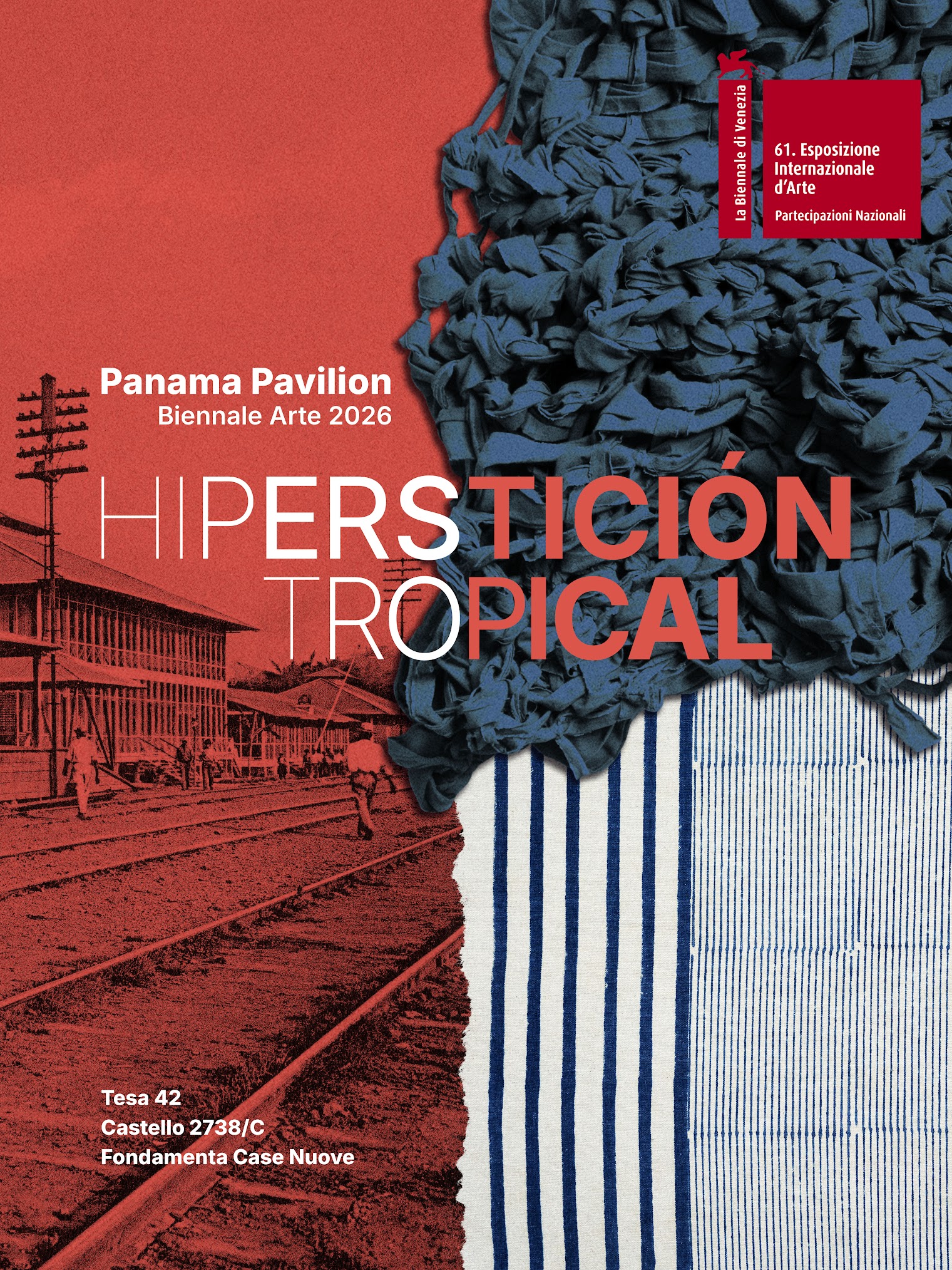
Panama presents its second participation as National Pavilion at the International Art Exhibition - La Biennale di Venezia. As part of the Biennale Arte 2026, which opens in May, the Panama Pavilion will show Tropical Hyperstition, a large-scale installation and performance work by Antonio José Guzmán and Iva Jankovic, the artistic duo known as Messengers of the Sun. For the official opening, the performance Occupied Dub Frequencies vs. the Eviction Engine will further activate the Pavilion through a live intervention.
At the intersection of art, history, and political memory, Tropical Hyperstition reactivates silenced narratives of communities displaced during the construction of the Panama Canal and the creation of the Canal Zone — a ten-mile-wide territorial enclave governed by the United States for much of the twentieth century. The work positions Panama not only as a global place of passage, but as a territory deeply marked by imperial ambition, logistical power, and the social engineering of colonial modernity.
At the heart of the installation hangs a twenty-meter-long suspended hammock, handwoven from indigo-dyed fabric. The hammock carries multiple genealogies, tracing its origins to ancestral practices across the Americas, where elevation from the ground is associated with protection and life cycles. The hammock was also embedded in the domestic material culture of workers from the Antilles who migrated to Panama to build the Canal.
In the Panama Pavilion, the hammock is transformed into a monumental architecture of refuge—a structure of peacefulness, memory, and survival. It gathers layered histories of Indigenous traditions, Afro-Caribbean migration, and Panamanian nationhood, embodying both shelter and displacement. Indigo blue envelops the space, linking intimacy and landscape, rest and extraction, refuge and historical violence. Long central to Guzmán and Jankovic’s textile practice, indigo is invoked as a material bound to colonial economies, forced labor, and racial hierarchies.
As part of the installation, printed fabrics form visual collages incorporating archival photographs and illustrations of the “lost towns” and their inhabitants—spectral presences of eradicated realities. These images are interwoven with patterns derived from Guzmán’s DNA sequences, autochthonous designs, and symbols of ancestral traditions, creating a textile cartography where personal, genetic, and collective memory intersect.
Antonio Jose Guzmán and Iva Jankovic - Messengers of the Sun said: “Our practice treats ritual and community as living forces that activate history rather than simply represent it. Working with indigo means confronting its colonial entanglements while reclaiming it as a site of resilience and decolonial imagination. We understand culture not as fixed heritage, but as something continually shaped by migration, musical traditions and everyday practices.”
“Our work moves beyond the neutrality of the white cube, insisting instead on embodied experience and collective presence. Textiles carry memory, ritual becomes a space for repairing historical rupture, and collaboration with ancestral knowledge opens an ongoing process of transformation. We propose art as a space of emancipation—where sound, cloth, and movement generate new forms of belonging.”
For nearly a century, the Panama Canal Zone operated as a country within a country, imposing borders that reshaped daily life, restricted freedom, and produced parallel systems of segregation and control. Entire villages—family homes, commercial structures, local governments, and long-rooted cultural traditions—were forcibly removed. In the name of progress, tens of thousands of people were expelled, their towns erased from maps and gradually from national memory. Now remembered as “lost towns, ” these settlements expose the human cost behind the triumphalist narrative of the canal as a civilising feat in a supposedly empty landscape.
The pavilion is further activated through a spatialised sonorous environment that blends the sounds of water, human voices, and the machinery of large-scale engineering. These sonic layers are interlaced with Caribbean rhythms, understood as coded forms of cultural survival that have carried memory and ritual across generations. Their cadences guide visitors through a landscape of displacement and fragmented belonging, evoking a diaspora shaped by evictions and ongoing negotiations of identity.
With Tropical Hyperstition, Messengers of the Sun transform the Panama Pavilion into a space of remembrance and resistance, where art becomes a vessel for confronting colonial infrastructures, reimagining erased geographies, and restoring presence to histories pushed to the margins.
Curators Ana Elizabeth González and Mónica E. Kupfer said: “This project offers a different way of engaging with history in the exhibition space—one shaped by lived experience and sustained presence. By centering indigo and textile practices as active forms of knowledge, the artists bring colonial histories and diasporic memory into dialogue with contemporary cultural expression. The work invites visitors to connect physically and sensorially, using ritual as a way of opening art into a shared space of remembrance and cultural re-imagination.”
Commissioner Gianni Bianchini from the Panama Ministry of Culture said: “Commissioning this project affirms our commitment to artistic practices that rethink how institutions engage with history and material knowledge. Messengers of the Sun propose a model of practice rooted in collaboration, cultural continuity, and critical reflection on colonial legacies. The Panama Pavilion becomes, through this work, a space for encounter that is collective, sensorial, and socially engaged—one that reflects the Ministry’s responsibility to support art that speaks to lived histories and contemporary realities.”
Commissioner: Gianni Bianchini
Curators: Ana Elizabeth González; Mónica Kupfer