Ended Jun 1
Klara Kristalova
Beast
Apr 13 – Jun 1, 2024
More from Klara Kristalova on Gallop
[Scroll down for French version / Veuillez trouver ci-dessous la version française]
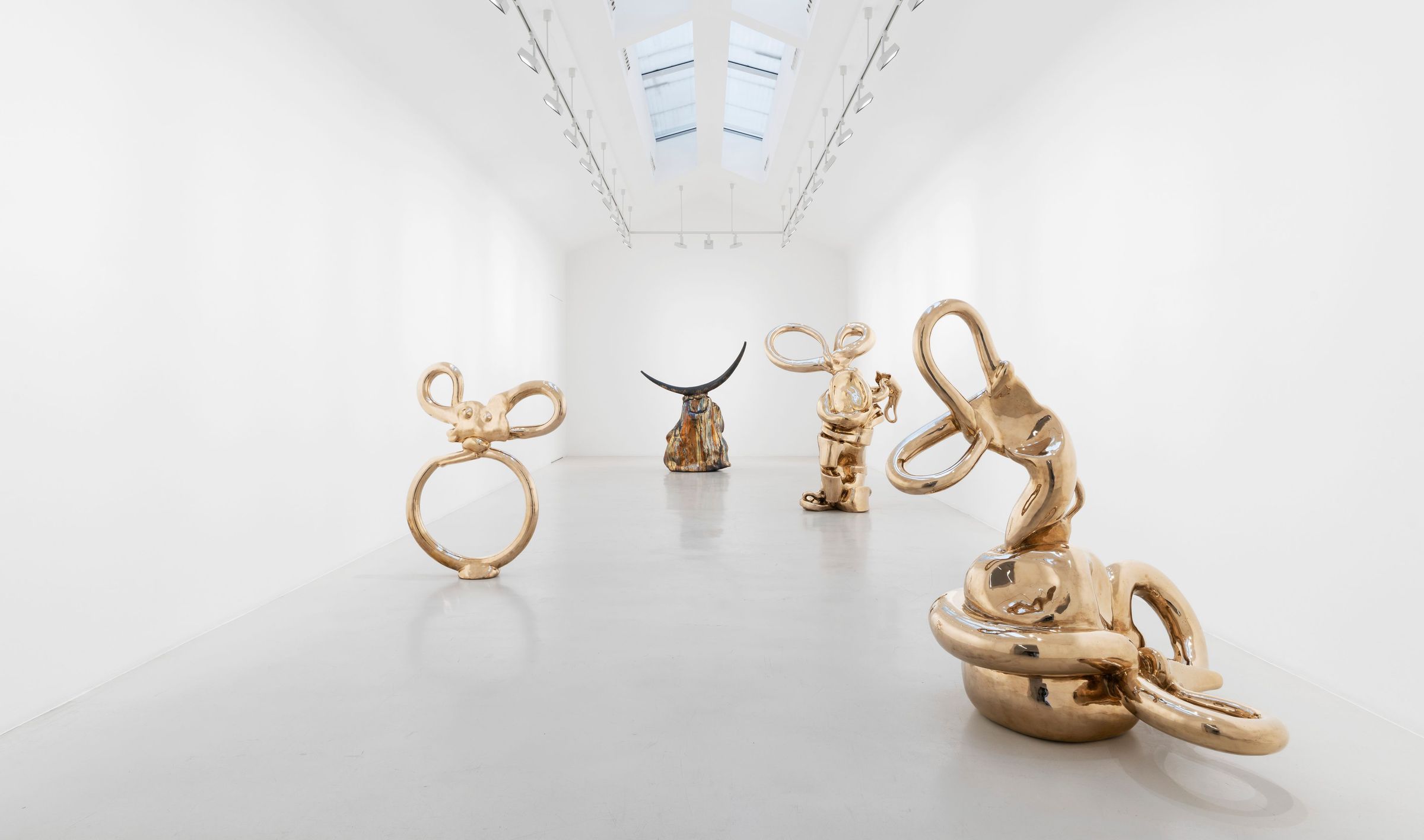
Perrotin is pleased to present Beast, Klara Kristalova's eighth solo exhibition with the gallery and her fourth at Perrotin Paris. On this occasion, the artist showcases a new series of sculptures and works on paper in which reality blends with fiction and boundaries between nature and humanity become blurred, revealing the fragility of life and the complexity of the relationships between beings.
“I am a sculpting draughtsman and painter”: Klara Kristalova, born in 1967, doesn’t let herself be pigeonholed into categories, and even takes pleasure in defying them. Far from any conventional approach, she allows unexpectedness and singularity to emerge from the abolition of boundaries between the arts, from the exploration of undefined margins. In the mid-1990s, her artistic path took her away from pure painting and towards modelling. She approaches this discipline with a great deal of freedom and playfulness, appreciating both its shaping and its materiality. Kristalova’s ceramics arise from successive transformations. A quick drawing is soon followed by modelling, which develops this initial intention. By kneading, she reconnects with an ancestral practice. The clay is worked directly with the fingers, creating irregularities and shifting surfaces. An initial firing precedes the moment of painting on ceramic, quick and playful... Finally comes the ultimate transformation: the final firing and its unpredictability. Kristalova’s creative process incorporates imperfection, emergence and a certain amount of chance: when the kiln is opened, she particularly likes it when the colours have dripped and blended. When they nestle in an unexpected space, blurring the contrast between the purity of the white and the intentionally cold, dark colours.
In the midst of this ceramic population, a few vigorous bronzes temper the vulnerability of the clay.
[Beast]
Beast invites us to plunge into Kristalova’s enigmatic universe. Reality blends with fiction: human or animal heads and masks rub shoulders with hybrid beings, with unusual distortions of scale. What emerges is a fantastic world where anxiety borders on humour, as with the gigantic insect in The fly’s kiss, whose flower-like proboscis delicately touches the child’s lips. An unexpected moment of tenderness is born from this supernatural kiss.
Kristalova blurs the boundaries between nature and humanity. Fascinated by the connection between humans, animals and plants, she combines them at will, like playful and disturbing exquisite corpses. Man as a natural being is omnipresent: he merges into an invasive, all-encompassing nature; the plants incorporate human faces. Are Kristalova’s beings humanoid animals, or are they animalised, vegetalised humans? Probably neither: the hybrid being occupies a space between, a limbo land. Far from the classifications in which humans like to confine the world in order to control it better.
The indeterminate nature of these hybrid beings places them in a fantastical universe rooted in symbolism: in front of All my thoughts or the flower-faces, we are irresistibly reminded of Odilon Redon’s Smiling Spider. These beings become “phantasms,” in the etymological sense of apparitions. Are we in another reality or are we in the world of dreams, or even nightmares, a distant cousin of the visions of Munch or Goya? Kristalova’s creatures’ non-compliance with real beings gives them the status of “beasts.” As such, they embody an otherness, a uniqueness, a difference that raises questions: the beast externalises and transposes fears, frustrations, rage and panic into its very appearance, but also expresses a form of outlet, of freedom... A strange people not unlike Gauguin’s ceramic monsters.
[Vacillations]
Kristalova’s hybrid beings sound out the way we look at others, our society’s complex relationship with monstrosity and deviations from the norm. What room is there for difference when smooth, standardised beauty is valued above all else? The hybrid world challenges the definition of the human, and raises the question of the definition of the body, its limits and its integrity. The transformations undergone by these imaginary bodies are sometimes tinged with a muted violence. The tree branches and roots that sprout from the bodies are as much factors of power, bulwarks against human excess, as they are potential prisons: such is the case of the astonishing Log, a young girl trapped in a trunk that is reminiscent of the piece of wood cradled by the enigmatic “Log Lady” in David Lynch’s universe. When difference calls existence into question.
The eruption of plant life into the bodies of young people also reflects the mutation of adolescent bodies, bearers of a vitalistic sap. Power and fragility, playfulness and seriousness, growth and invasion are all at work in these young beings steeped in questions, contradictions and doubts. Worry mingles with insouciance, grandeur with a fragility that can be seen in the attitude of the Mouse, with his hands in his pockets. Yet adolescence is the age of all possibilities, before gender determines how an individual is viewed, before the divorce between the sexes is irrevocably consummated. There is an omnipresent nostalgia for this suspended time.
The liminality of physical appearance is also the liminality of an instant: the narrative seems interrupted, without a thread to hold on to. The viewer questions both the nature of the beings and the links between them: why does All my thoughts stand apart? Larger than life, a smiling young girl perched on never-ending stick-legs, seems to move slowly and benevolently amongst the others, like a carnival monster on stilts. A timeless moment in which social norms and conventions are turned on their head. Non-conformity, freedom, distance and entertainment are always active in Kristalova’s work: in the shade of the head-flowers, a Reclining bird lounges in high heels. In Ordinary day, rabbits taunt a disgruntled wolf from the top of a tree.
There is no Manichaeism in this suspended world of possibilities. The tipping point is never certain, even when anxiety wells up: is the humanoid Mouse just shy, encircled by the beings around him, or is he threatening them? The young mouse-man reflects the complexity at work in all of us, whether or not we are inclined towards darkness. Simultaneously vulnerable and powerful, he reflects the threat that man poses to the earth. His invocation by the artist is invested with a cathartic value, in the Aristotelian sense of the term: a purifying of the passions. The work therefore has an almost magical, prophylactic value.
Concerned about the rise of extremes and mankind’s destructive attitude, Kristalova constructs a world that reveals the fragility of life and the complexity of the relationships that are forged between beings. The viewer is invited to question his or her perception, which changes according to his or her psychology and state of mind. “My art is about language, communication,” says Kristalova. This imaginary dialogue, the keys to which are not revealed, allows each of us to project our own feelings and anxieties... A genuine relationship that engages the individual and integrates him or her into the space of the work: art as experience, to paraphrase John Dewey.
—Ophélie Ferlier-Bouat, director of Bourdelle museum, Paris
*****
La galerie Perrotin a le plaisir de présenter Beast, la huitième exposition personnelle de Klara Kristalova avec la galerie et la quatrième à Perrotin Paris. À cette occasion, l’artiste présente un ensemble de nouvelles sculptures et œuvres sur papier où la réalité se mélange avec la fiction, où les frontières entre nature et humanité se brouillent, révélant la fragilité de la vie et la complexité des relations nouées entre les êtres.
«Je suis une dessinatrice et peintre qui sculpte» / [I am a sculpting draughtsman and painter]: née en 1967, Klara Kristalova ne se laisse pas enfermer dans des catégories qu’elle se plaît à défier. Loin de toute approche conventionnelle, elle laisse l’inattendu et la singularité surgir de l’abolition des frontières entre les arts, de l’exploration de franges indéfinies. Son parcours artistique la voit quitter au milieu des années 1990 la peinture pure pour le modelage. Elle aborde avec une grande liberté et esprit du jeu cette discipline, dont elle apprécie le façonnage, comme la matérialité.
Les céramiques de Kristalova naissent de transformations successives. Un rapide dessin est bientôt suivi du modelage, qui fait évoluer cette intention première. Par le pétrissage, elle renoue avec une pratique ancestrale. La terre est travaillée directement avec doigts, source d’irrégularité et de surfaces mouvantes. Après une première cuisson vient l’instant de la peinture sur céramique, rapide et ludique... Enfin survient a mue ultime: la cuisson finale et ses imprévus. Kristalova intègre l’imperfection, le surgissement et une part de hasard dans son processus créatif: à l’ouverture du four, elle aime particulièrement quand les couleurs ont fusé, se sont mêlées. Quand elles se nichent dans un espace imprévu, qu’elles brouillent le contraste entre la pureté du blanc et des couleurs volontiers sombres et froides.
Au milieu de ce peuple céramique, quelques bronzes vigoureux tempèrent la vulnérabilité des terres.
Monstre [Beast]
Monstre invite à une plongée dans l’univers énigmatique de Kristalova. La réalité se mélange avec la fiction: têtes et masques d’humains ou d’animaux voisinent avec des êtres hybrides, dans des distorsions d’échelles insolites. En jaillit un monde fantastique où l’inquiétude voisine avec l’humour, tel le gigantesque insecte de The fly’s kiss, dont la trompe floriforme touche délicatement les lèvres de l’enfant. Un moment de tendresse inattendu nait de ce baiser surnaturel.
Kristalova brouille les frontières entre nature et humanité. Fascinée par la connexion entre les hommes, les animaux et les végétaux, elle les combine à l’envi, comme un cadavre exquis ludique et inquiétant. L’homme en tant qu’être naturel est omniprésent: il se confond dans une nature englobante, envahissante ; les végétaux incorporent des visages humains. Jaillissements issus de l’inconscient, les êtres de Kristalova sont-ils des animaux humanoïdes ou bien des hommes animalisés, végétalisés? Probablement ni l’un, ni l’autre: l’être hybride occupe un entre-deux, un territoire de limbes. Loin des classifications dans lesquelles l’humain aime à enfermer le monde pour mieux le maîtriser.
La nature indéterminée de ces êtres hybrides les place dans un univers fantastique issu du symbolisme: devant All my thoughts ou les fleurs-visages, on pense irrépressiblement à L’Araignée souriante d’Odilon Redon. Ces êtres deviennent des «phantasmes», au sens étymologique d’apparitions. Se trouve-t-on dans une autre réalité ou bien dans le monde du rêve, voire du cauchemar, cousin lointain des visions de Munch ou de Goya?
La non-conformité des créatures de Kristalova avec les êtres réels le confère le statut de «monstres». En tant que tels, ils incarnent une altérité, une unicité, une différence qui interroge: le monstre extériorise et transpose dans son apparence même des peurs, des frustrations, de la rage, de la panique, mais exprime aussi une forme d’exutoire, de liberté... Un peuple étrange qui n’est pas sans rappeler les monstres céramiques de Gauguin.
[Vacillements]
Les êtres hybrides de Kristalova sondent le regard porté sur l’autre, le rapport complexe de notre société avec la monstruosité, avec l’écart de la norme. Quelle place pour la différence quand sont valorisées à l’excès des beautés lisses, standardisées? Le monde hybride bouscule la définition de l’humain, pose la question de la définition du corps, de ses limites et de son intégrité. Les transformations subies par ces corps imaginaires sont parfois porteurs d’une violence sourde. Branches d’arbre et racines qui jaillissent des corps sont autant des facteurs de puissance, des remparts contre la démesure humaine, que de potentielles prisons: ainsi de l’étonnante Bûche, jeune fille prisonnière d’un tronc qui n’est pas sans évoquer le morceau de bois tenu tel un nourrisson par l’énigmatique «femme à la bûche» [Log lady] dans l’univers de David Lynch. Quand le décalage interroge l’existence.
L’irruption du végétal dans les corps renvoie également à la mutation des corps adolescents, porteurs d’une sève vitaliste. Puissance et fragilité, jeu et sérieux, croissance et envahissement sont à l’œuvre dans de jeunes êtres pétris d’interrogations, de contradictions, de doutes. L’inquiétude se mêle à l’insouciance, la grandeur à une fragilité décelable dans l’attitude de la Souris, les mains dans les poches. L’adolescence est pourtant l’âge de tous les possibles, avant que le genre ne détermine le regard posé sur un individu, que le divorce entre les sexes ne soit irrémédiablement consommé. La nostalgie de ce temps suspendu est omniprésente.
L’entre-deux de l’apparence physique est aussi celui de l’instant: la narration semble interrompue, sans fil auquel se raccrocher. Le regardeur interroge tant la nature des êtres que les liens qu’ils entretiennent: pour-quoi la femme-tête de All my thoughts se tient-elle à l’écart? Larger than life, jeune fille souriant juchée sur des jambes-bâtons interminables, semble évoluer avec lenteur et bienveillance au milieu des autres, telle un monstre de carnaval sur échasses. Un moment hors du temps dans lequel normes et conventions sociales sont renversées. L’anticonformiste, la liberté, la distance et l’amusement sont toujours à l’œuvre chez Kristalova: à l’ombre des fleurs-têtes, un oiseau couché [Reclining bird] chaussé d’escarpins se prélasse. Dans Ordinary day, des lapins narguent du haut de l’arbre un loup mécontent.
Aucun manichéisme dans ce monde suspendu des possibles. La bascule n’est jamais certaine, même lorsque l’inquiétude sourd: la Souris humanoïde est-elle seulement timide, encerclée par les êtres qui l’entourent ou les menace-t-elle? Le jeune homme-souris reflète la complexité à l’œuvre dans chacun, susceptible de basculer ou non vers la noirceur. À la fois vulnérable et puissant, il est à l’image de la menace que l’homme fait peser sur la terre. Son invocation par l’artiste est investi d’une valeur cathartique, au sens aristotélicien du terme: purificatrice des passions. L’œuvre possède dès lors une valeur presque magique, prophylactique.
Inquiète de la montée des extrêmes et de l’attitude destructrice de l’homme, Kristalova construit un monde qui révèle la fragilité de la vie et la complexité des relations nouées entre les êtres. Le regardeur est invité à interroger sa perception, mouvante selon sa psychologie et son état d’esprit. «Mon art parle du langage, de la communication» [“My art is about language, communication“], affirme Kristalova. Ce dialogue imaginaire dont les clés ne sont pas livrées permet à chacune et chacun d’y projeter ses propres sentiments et inquiétudes... Une véritable relation qui engage l’individu et l’intègre dans l’espace de l’œuvre: l’art comme expérience, pour paraphraser John Dewey.
—Ophélie Ferlier-Bouat, directrice du musée Bourdelle, Paris