Ended Jan 5
Charles Gaines
Palm Trees and Other Works
Sep 14, 2019 – Jan 5, 2020
More from Charles Gaines on Gallop
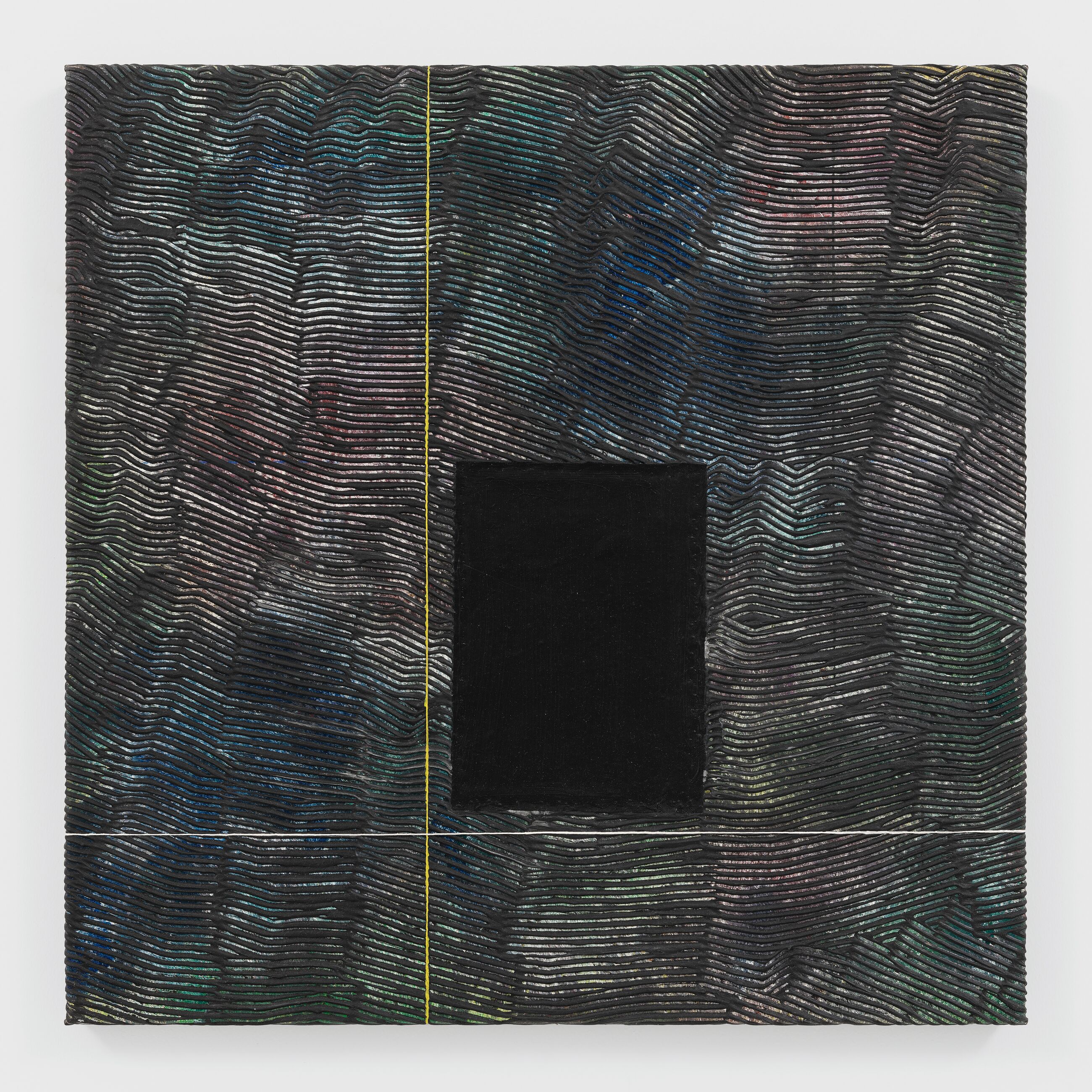
Hauser & Wirth presents its first exhibition with American artist and revered Los Angeles educator Charles Gaines. Unveiling new grid works that focus on native trees from Palm Canyon, Gaines employs his singular ‘systems’ – methods he has engaged for over four decades to challenge subjectivity and direct personal experience. Alongside this entirely new body of Plexi work, Gaines will show a new series of watercolors as well as ‘Manifestos 3’ (2018), which comes from his acclaimed Manifestos series, of which earlier examples are in the permanent collections of The Museum of Modern Art, New York, and The Hammer Museum, Los Angeles. This landmark exhibition in the artist’s adopted hometown sheds light on Gaines’s influence in the Los Angeles artistic community and beyond. His ongoing investigation of aesthetics, content, and ‘systems’ reveals the paradoxes of perception and implicit meaning: ‘The system has never changed, but the outcome is always different,’ Gaines has said of his long-standing practice.
In the Numbers and Trees series, Gaines layers paint on acrylic sheets that sits in front of black and white photographs of the landscape. Each painted tree is formed by differently colored and numbered squares, taken together, they eventually collapse into a single image. By creating space between a specific symbol and the systems applied to its representation, Gaines’s distinctive approach forges a critical link between the first generation of conceptualists like Sol LeWitt and contemporary artists, including Gaines’s students Edgar Arcenaux, Andrea Bowers, Mark Bradford, Sam Durant, and many others.
A pivotal figure in the field of Conceptual Art, Charles Gaines’ body of work engages formulas and systems that interrogate relationships between the objective and the subjective realms. Using a generative approach to create series of works in a variety of mediums, he has built a bridge between the early conceptual artists of the 1960s and 1970s and subsequent generations of artists pushing the limits of conceptualism today.
Born in 1944 in Charleston, South Carolina, Gaines began his career as a painter, earning his MFA from the School of Art and Design at the Rochester Institute of Technology in 1967. In the 1970s, Gaines’ art shifted dramatically in response to what he would later call ‘the awakening.’ Gaines’ epiphany materialized in a series called Regression (1973 – 1974), in which he explored the use of mathematical and numeric systems to create soft, numbered marks in ink on a grid, with each drawing built upon the calculations of the last. This methodical approach would carry the artist into the subsequent decades of his artistic journey.
Working both within the system and against it, Gaines points to the tensions between the empirical objective and the viewers’ subjective response. The concept of identity politics has played a central role within Gaines’ oeuvre, and the radical approach he employs addresses issues of race in ways that transcend the limits of representation. His recent work continues to use this system with sociopolitical motivations at the forefront. ‘Faces 1: Identity Politics’ (2018) is a triptych of colorful portraits of historical icons and thinkers, from Aristotle to Maria W. Stewart and bell hooks. Gaines reduces the images to pixelated outlines, layered among the faces of the preceding portraits to create a palimpsest of faces, employing this system in a critique of representation and the attachment of meaning to images.
Gaines lives and works in Los Angeles, where he is a member of the CalArts School of Art faculty. He has been the subject of numerous exhibitions in the United States and internationally, and his work is in prominent public collections including the Museum of Modern Art, New York NY, the Whitney Museum of American Art, New York NY, the Studio Museum in Harlem, New York NY and the Los Angeles County Museum of Art, Los Angeles CA. Gaines’ work was presented at the Venice Biennale in 2007 and 2015.