Ended Jan 28
William T. Wiley
Nov 12, 2017 – Jan 28, 2018
More from William T. Wiley on Gallop
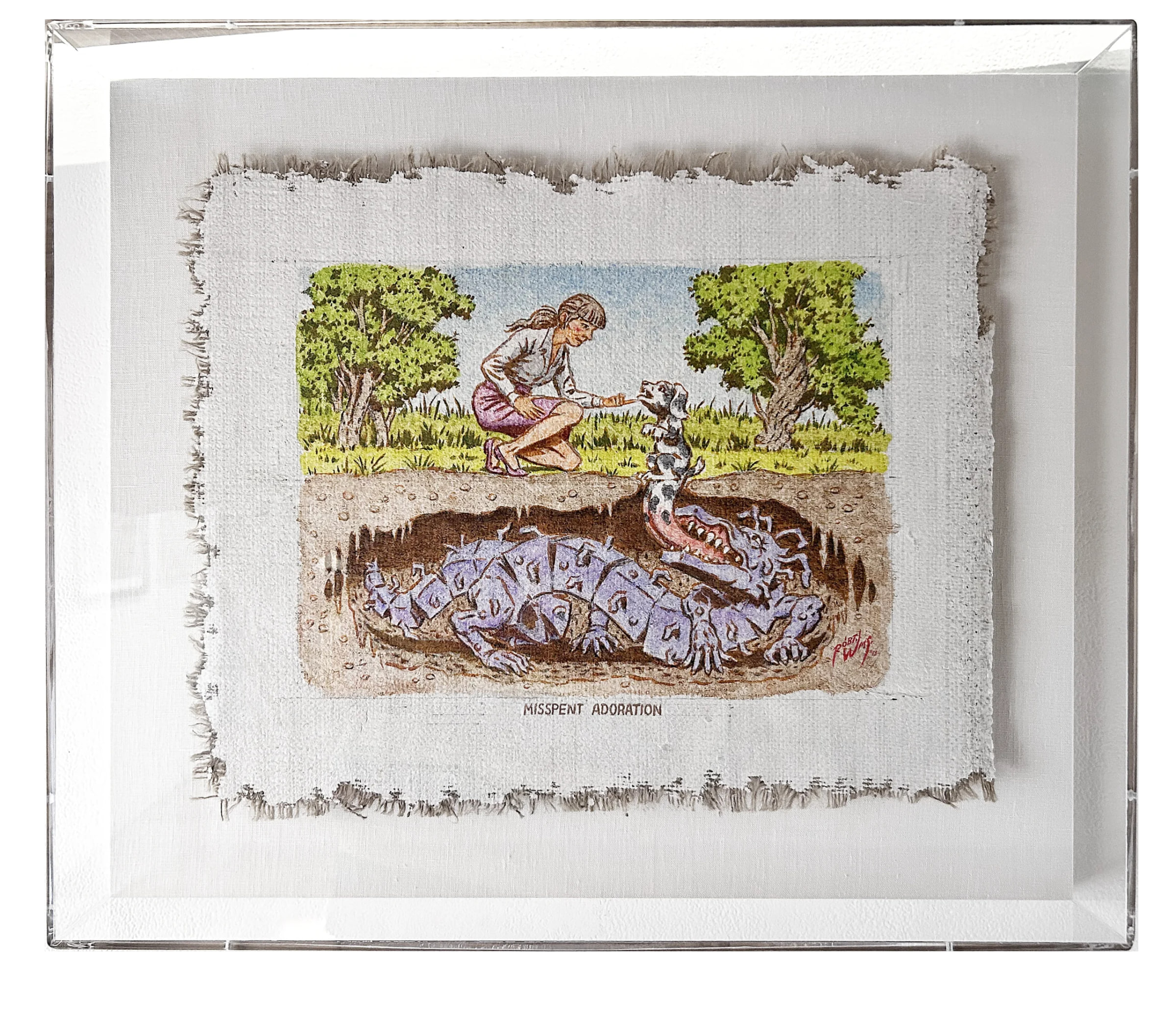
Parker Gallery is proud to present an intimate solo exhibition of works by William T. Wiley. The exhibition includes three recent black and white paintings, together with two historical sculptural works from 1968 and 1971.
Over a nearly sixty-year career, William T. Wiley has addressed some of the most urgent social, political and environmental issues with a distinctive blend of wit and wisdom. His work is layered with complex puns and riddles; dotted with crumbs of clues to guide the viewer through a maze of meaning and message.
William T. Wiley’s multifarious output has included painting, drawing, watercolor, printmaking, assemblage, film, music, tapestry and pinball. Among the works on view in this exhibition is a sculptural assemblage titled Movement to Black Ball Violence (Homage to Martin Luther King) (1968). The construction presents a performative act of social protest: a ball composed entirely of black friction tape whose layers are successively applied by viewers to commemorate the assassination of Martin Luther King, Jr. Being exhibited for the first time since Wiley's retrospective at the Smithsonian American Art Museum, the work now includes an addition by the artist H.C. Westermann, Walnut Log Container (1968), a vessel for extra rolls of friction tape.
Addition and subtraction have always played an integral role in Wiley’s work; the installation or configuration of a particular work is subject to change. Wiley will often remake or replace components of a work, as seen here with First Stage of Infinity (1971). In place of a long-lost fabric banner, Wiley has substituted an anecdotal watercolor that describes the missing element and augments the original narrative with details of his high school in Richland, WA.
The paintings on view reflect the enduring influence of the California School of Fine Arts (San Francisco Art Institute), where Wiley received a BFA in 1960 and a MFA two years later. Abstract expressionism had anchored the painting department with faculty such as Clyfford Still and Hassel Smith. Although Wiley quickly moved away from muscular impasto, his newest works can be seen to subvert his earliest painterly inclinations, by flattening his paint with a palette knife. The surprise appearance of comic imagery shows Wiley wryly giving shape to abstract form.
William T. Wiley (b. 1937 in Bedford, IN) lives and works in Novato, CA. Wiley has been the subject of numerous solo museum exhibitions, including a retrospective at the Smithsonian American Art Museum in 2009, and in venues such as the Stedelijk Van Abbemuseum, Frankfurter Kunstverein, Walker Art Center, Museum of Modern Art in New York and the University Art Museum at the University of California, Berkeley.