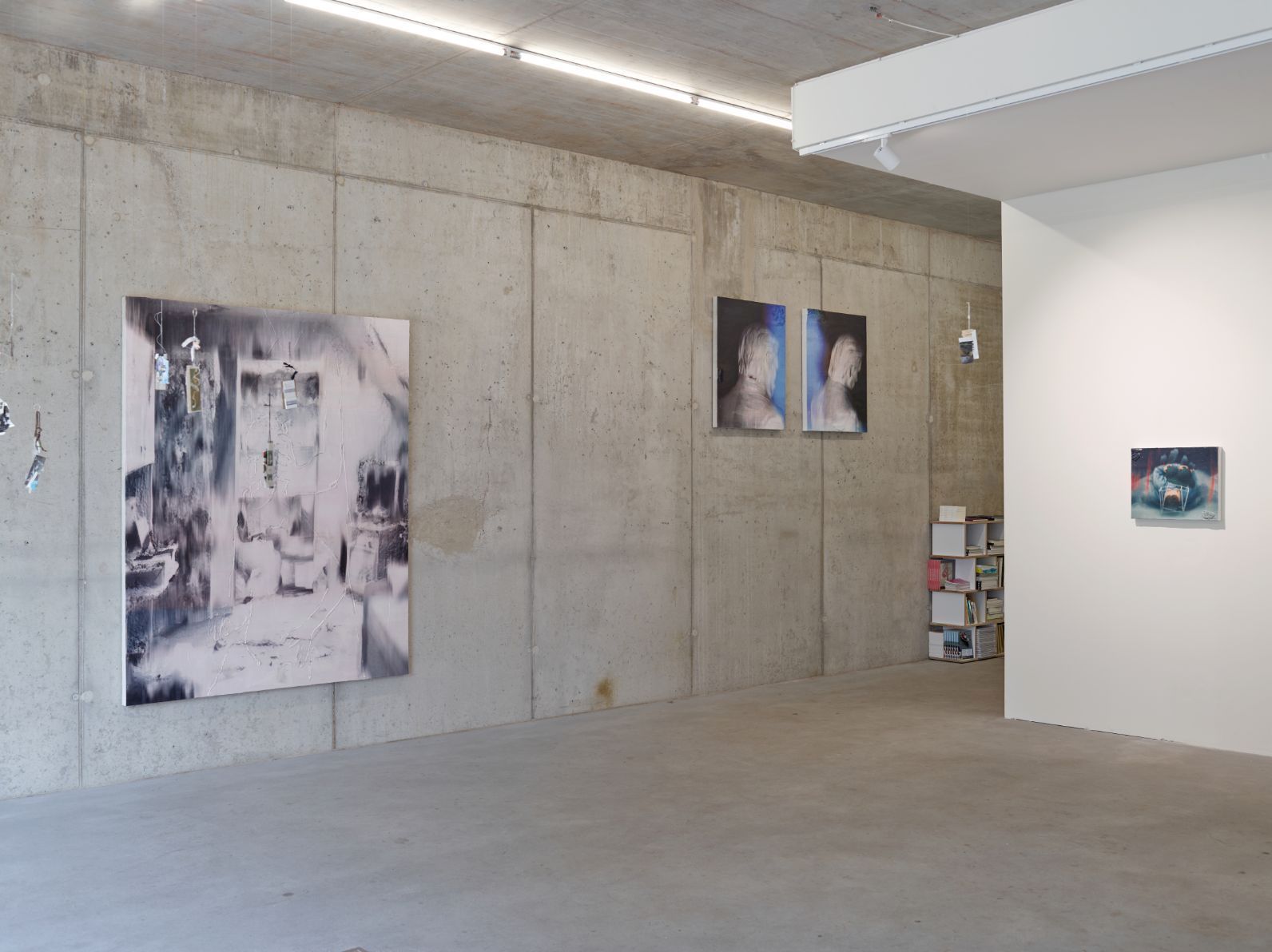

Ended
Cornelia Schleime
Ohne Lippen Sind die Zähne Kalt
Apr 26 – Jun 1, 2024
Cornelia Schleime is the grande dame of German painting, the great observer and storyteller who effortlessly blends reality and fantasy into visually powerful compositions, and in doing so persues German Romantic traditions in a way that is as sophisticated as it is aesthetical. Meanwhile, the artist, who celebrates her 70th birthday in 2023, can look back on an oeuvre that is not only of art historical, but also of political and social relevance.
Cornelia Schleime was born in 1953 in East Berlin, where she trained as a hairdresser and makeup artist. Early on, her interest in visualizing the many “faces” of people is apparent, and becomes a common thread throughout her work. In 1975 Schleime took up the study of graphics and painting in Dresden. Her radical and political works soon hit the confines of what was possible in the GDR and drew the displeasure of the authorities. Undeterred, she nevertheless continued her path, with performances, for instance, which she recorded in the form of photographs or films. Photographs show the artist putting a plastic bag over her head or, despite being gagged, looking fearlessly into the camera. She is never the victim, but the protester and rebel. These works, which blatantly denounced the repression she personally experienced as well as the general state of repression in the GDR, already drew noticeable criticism. After participating in an exhibition that addressed the concept of freedom on a metaphorical level, she was finally banned from exhibiting altogether in 1981. Schleime subsequently applied to leave the GDR. After several rejections, the application was granted in 1984 under fateful circumstances. The single mother and her young son were ordered to leave the GDR within a few hours, forcing her to leave her belongings – including her entire oeuvre – behind. Only her Super 8 films, photographs and artist’s books were saved and brought to West Berlin with a diplomat’s help. Later, in her autobiographically inspired novel Weit fort (2008), Schleime even extracted something “liberating” about this rupture: “One can always redefine oneself, even with empty pockets. Dreams, energies, experiences cannot be robbed.”
No sooner had the artist settled in West Berlin than her world began to falter again. After the German reunification, Schleime discovered that a former lover with whom she had played in the punk band Zwitschermaschine had acted as a Stasi informer and spied on her. Once again, however, she was not prepared to play the role of victim, but courageously launched a counterattack. Under the title Auf weitere gute Zusammenarbeit (1993), she contrasted the absurd notations from her state security files with artistic satire. Witty, poignant, and visually powerful, she transformed the intrusion into her private sphere into an impressive, universal work of art. The artistic breakthrough in reunified Germany followed on its heels. The first editions of the series were purchased by German museums. With her portraits of people and animals – and corresponding hybrid creatures – she then experienced success and recognition on a broad scale. To this day, Schleime has a penchant for portraying expressive and mysterious individual figures that continue both cheerful and somber traditions of German Romanticism.
Schleime has become known primarily as a grandiose painter of fictional portraits. However, this abbreviation in no way does justice to her oeuvre. The artist looks back on a broad spectrum of media, ranging from paintings, watercolors, collages, and artist’s books to performances, photographs, films, and literature. In her novel, Schleime described artists as “hunters,” which also applies to herself. Regardless of the medium, the artist chases after a certain motif, a certain expression. The medium itself is of secondary importance. It is the image that counts. Her motivic hunting ground is just as extensive. Her travel diaries, for example, lead into realms outside our Eurocentric gaze, or her frivolously playful watercolors and collages into erotic fantasies. Even before the churches’ sexual abuse scandals become omnipresent, she investigated Catholic bigotry in a comprehensive group of works. Incidentally, the arsenal of her techniques in painting is just as versatile. Through the application and removal of paint and the use of asphalt or shellac, pastose, relief-like surfaces emerge, on the contrary, almost translucent and fragile skins.