Ended Aug 13
Clorox/Envy
Jul 17 – Aug 13, 2015
Andrew Wyeth
Lew Welch
Luke Barber-Smith
Michael E. Smith
Jeremy Sigler
Jeffery Scudder
Shellyne Rodriguez
Jenna Pietrobon
Wyatt Niehaus
Richard Merkin
Andy Meerow
Rose Marcus
Justin Lieberman
David X. Levine
Kate Levant
Myeong soo Kim
JPW3
Miles Huston
Otis Houston Jr. (AKA Black Cherokee)
Becky Howland
Nate Heiges
Curran Hatleberg
Andrew Greene
Adam Gordon
Barbara Gallucci
Marisol Escobar
Dru Donovan
Agnes Denes
Kyla Cheverie
Noel Anderson
Organized by Miles Huston
Dear Friends,
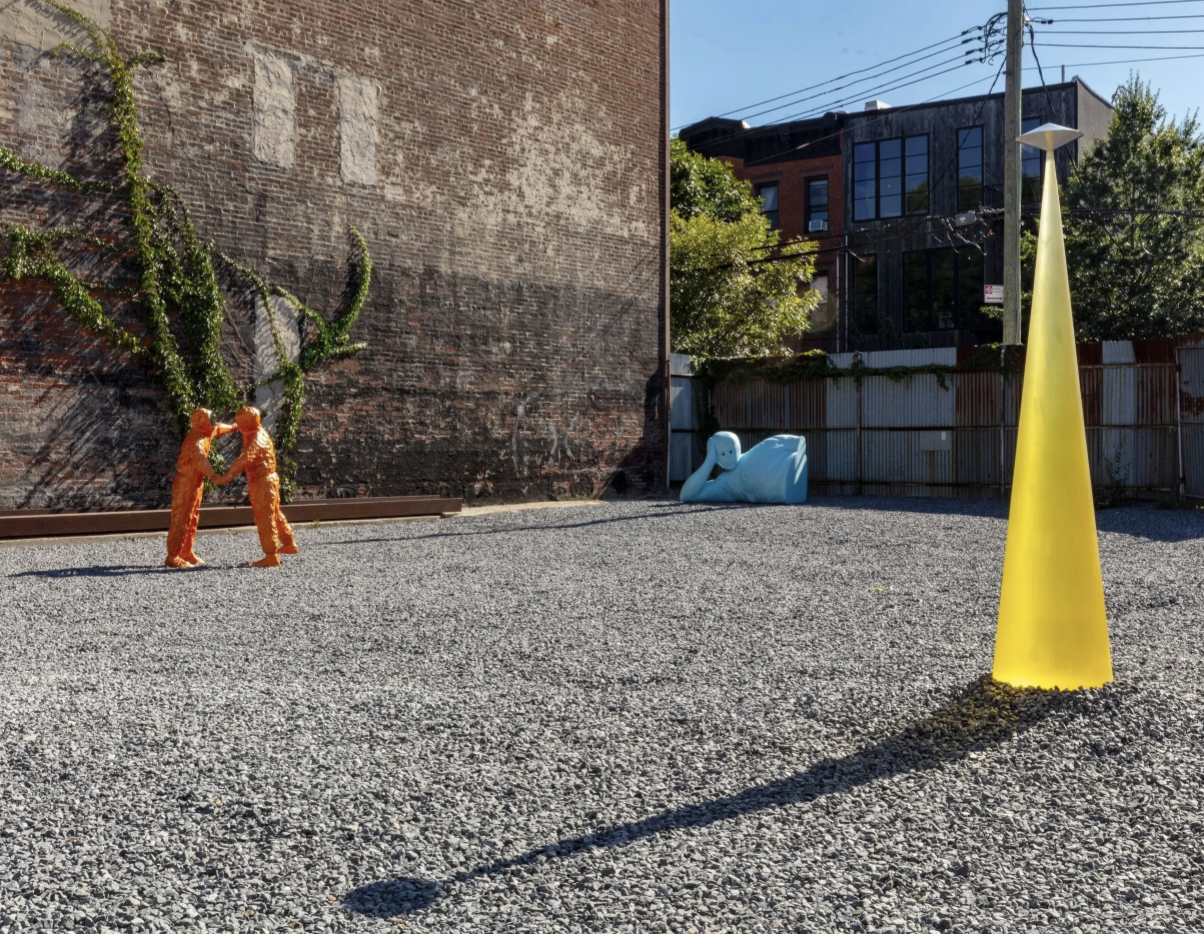
I am leaving NYC indefinitely. The destination, for now, is Detroit, Michigan. Before I go, I want to thank all Artists, and friends that have pushed me to make this leap. This exhibition is full of Artworks that have inspired me to the extent that I had to take something from them, ingest them, and let them not purify, but clarify the water. Francis Picabia once said, "If a man's work illustrates my dream, then his work is mine". So, thank you. But, as I take, I also battle with the idea of Art as accumulation. Mel Bockner said, "Artists don't make new images, they only combine them". This is usually true, when you add this thing to that thing, you get a new thing. You know how it happened, it's stacked, it's linear, and it's reaffirming in its process. This group of Artworks, I believe, all strive to confuse this type of traceable construction. There is a process of reduction amidst the accumulation. The processes in these works are almost reversed engineered, doubling back on our ability to track and apprehend them. The layers of content compress and distill into a complex reduction sauce. In the end, objects, materials, language, and images are what they are, and are what they are not. Unsettlingly, they are iconic to themselves, graphic. However, their meaning is estranged like a local resident lurking around an empty bus station. They point in an indeterminate direction, or maybe they point the finger back at themselves, admitting that they don't know what they are or what you thought they were. So with dignity, they may chant, "Hands up, Don't shoot". As a group, my intention was that these Artworks would form a varied landscape, a very American one at that. My hope is that many of you who will come to the show will scrutinize the works looking back at you as you peer down a sight-line. Maybe you will overlook something waiting around a corner. Like Grandma would say, "Sometimes it is it is and sometimes it is it ain't".
Below you will find the list of Artists in reverse alphabetical order. Note, this list is certainly not complete, as it should be. That means there can be another show someday. Finally, in this email you will find a link to an audio recitation of Lew Welch's Chicago Poem. It's part of the show, so please take a moment, read while you follow along.
Bon voyage,
Miles Huston
https://soundcloud.com/sig-other/cloroxenvy-chicago-poem-by-lew-welch
Chicago Poem by Lew Welch
I lived here nearly 5 years before I could
meet the middle western day with anything approaching
Dignity. It's a place that lets you
understand why the Bible is the way it is:
Proud people cannot live here.
The land's too flat. Ugly sullen and big it
pounds men down past humbleness. They
Stoop at 35 possibly cringing from the heavy and
terrible sky. In country like this there
Can be no God but Jahweh.
In the mills and refineries of its south side Chicago
passes its natural gas in flames
Bouncing like bunsons from stacks a hundred feet high.
The stench stabs at your eyeballs.
The whole sky green and yellow backdrop for the skeleton
steel of a bombed-out town.
Remember the movies in grammar school? The goggled men
doing strong things in
Showers of steel-spark? The dark screen cracking light
and the furnace door opening with a
Blast of orange like a sunset? Or an orange?
It was photographed by a fairy, thrilled as a girl, or
a Nazi who wished there were people
Behind that door (hence the remote beauty), but Sievers,
whose old man spent most of his life in there,
Remembers a "nigger in a red T-shirt pissing into the
black sand."
It was 5 years until I could afford to recognize the ferocity.
Friends helped me. Then I put some
Love into my house. Finally I found some quiet lakes
and a farm where they let me shoot pheasant.
Standing in the boat one night I watched the lake go absolutely
flat. Smaller than raindrops, and only
Here and there, the feeding rings of fish were visible a hundred yards
away – and the Blue Gill caught that afternoon
Lifted from its northern lake like a tropical! Jewel at its ear
Belly gold so bright you'd swear he had a
Light in there. His color faded with his life. A small
green fish . . .
All things considered, it's a gentle and undemanding
planet, even here. Far gentler
Here than any of a dozen other places. The trouble is
always and only with what we build on top of it.
There's nobody else to blame. You can't fix it and you
can't make it go away. It does no good appealing
To some ill-invented Thunderer
Brooding above some unimaginable crag . . .
It's ours. Right down to the last small hinge it
all depends for its existence
Only and utterly upon our sufferance.
Driving back I saw Chicago rising in its gases and I
knew again that never will the
Man be made to stand against this pitiless, unparalleled
monstrosity. It
Snuffles on the beach of its Great Lake like a
blind, red, rhinoceros.
It's already running us down.
You can't fix it. You can't make it go away.
I don't know what you're going to do about it,
But I know what I'm going to do about it. I'm just
going to walk away from it. Maybe
A small part of it will die if I'm not around
feeding it anymore.