Exhibition · Nathalie Obadia
Looking Forward
Mar 18 – Jul 27
5 images · swipe
About the show
Brook Andrew, Rina Banerjee, Lu Chao, Manuel Ocampo, Agnès Varda, Wang Keping, Ni Youyu
[Scroll down for French version / Veuillez trouver ci-dessous la version française]
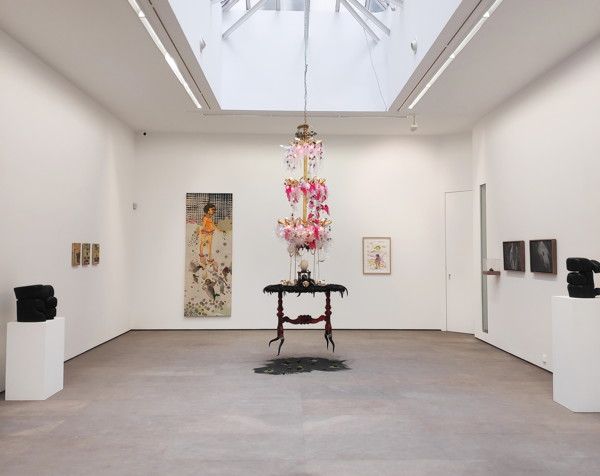
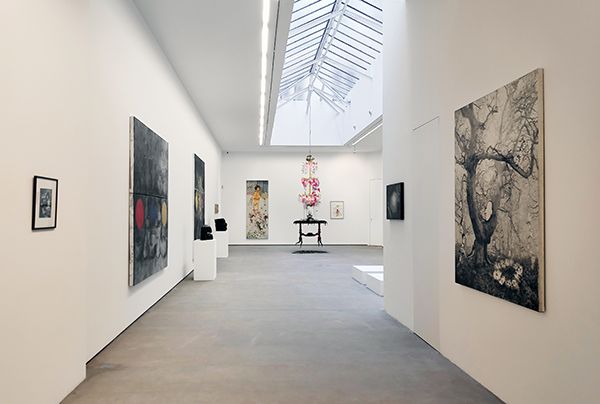
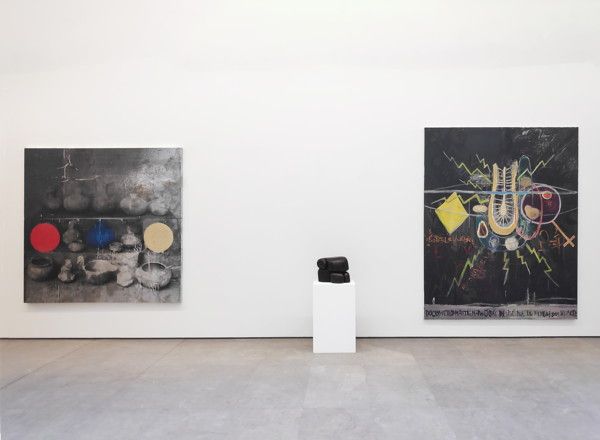
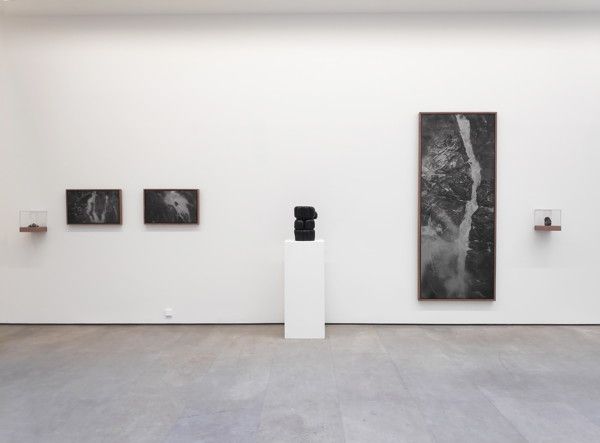
Having participated in Art Basel Hong Kong since 2013, a fair that quickly became a major player on Asia’s artistic scene, Galerie Nathalie Obadia decided to exhibit, in one of its two Parisian spaces, the works it had intended to present in the 2020 edition, which was unfortunately canceled due to the Coronavirus epidemic. This presentation is an extension of Art Basel’s iniative, Online Viewing Rooms, which aims to give participating galleries the possibility of promoting the works that were supposed to be shown on their stands. It seemed a shame not to exhibit what we had chosen with the artists and the estate of Agnès Varda. Thus, we decided to install the stand, exactly as we’d imagined it, to dampen our regret at not being in Hong Kong this spring.
This is group exhibition is the occasion to promote the ties that the gallery has woven with the art scene of China and the broader Asia-Pacific region, which it deeply wants to support via collaborations and cultural exchanges that have multiplied in recent years. Chinese artists Lu Chao, Wang Keping and Ni Youyu are thus given the place of honor in a hanging that also spotlights works by Brook Andrew, Rina Banerjee and Manuel Ocampo, originally from Australia, India and the Philippines, respectively.
A few years separate Lu Chao and Ni Youyu, who incarnate the vitality of a young generation of Chinese artists, whose international careers are as attached to their cultural roots as they are open to the most foreign and varied of aesthetic forms, characteristic of today’s art. In the background, these artists demonstrate a will to rediscover a rich legacy through a syncretic approach that is resolutely anchored in its time. Born in 1988, in Shenyang, in the province of Liaoning, China, Lu Chao lives and works in London where he has developed a superb body of paintings, in an essentially black and white palette, marked by both Eastern and Western inspirations. The juvenile impressions of his homeland inspired the artist to create a metaphorical work, somewhere between traditional Chinese painting and German romanticism. The relationship between the individual and the masses, the feeling of loneliness in the midst of a group, the concepts of solid and void derived from a type of zen ideology, are at the heart of his oeuvre: “[…] I’ve always been very sensitive to crowds of people who jostle each other, these images of depressed, vulnerable and impotent crowds that accompanied me as I grew up. […] I always thought that each face could tell a story, the story of a recent experience or even of an event about to happen. Every figure in my paintings is a response to every stranger I crossed paths with in my life.” The artist’s statement takes on a particular connotation in light of the current health situation.
Ni Youyu joined the gallery after an exhibition on “Ink Art,” in 2015, which aimed to shed light on certain key figures of this scene from China, where the practice of ink painting is emblematic of the dialogue between tradition and modernity. In Ni Youyu’s work, there is the same willingness to connect Eastern and Western influences, as well as classic and contemporary concepts. Born in 1984, in the Jiangxi province, Ni Youyu also studied ink painting at the Institute of Visual Arts in Shanghai, where he still resides part of the year. Underpinned by a reflection on the aesthetic conventions that forge the history of art and its market, his protean oeuvre draws, todays, as much from calligraphy, Asian gardens and Zen philosophy, as it does from Greco-Roman antiquity, contemporary history and the major figures of Western art such as Marcel Duchamp and Thomas Ruff. Following an important solo exhibition at the Yuz Museum, in Shanghai, the artist will take over the Bourg Tibourg gallery on April 29.
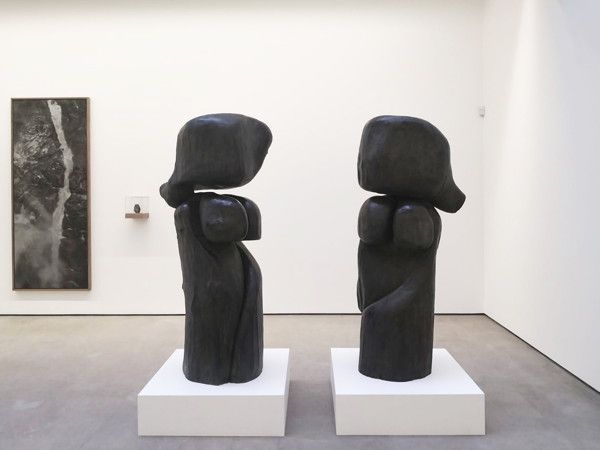
The gallery is also delighted to have represented Wang Keping since 2017. Keping is one of the founders of Chinese contemporary art, notably due to the key role he played during China’s cultural revolution in the 1970s. Born in 1949, he is one of the protagonists of the Stars Art Group (Xing Xing), which celebrated its 40th anniversary last fall. Following early years marked by political engagement, Wang Keping sought exile in France, where he has since dedicated himself entirely to sculpture. In an aesthetic and spiritual search, inspired by Taoist philosophy, antique statuary from the Han dynasty or the popular art of rural China, but also by the great masters of sculpture like Constantin Brancusi, Wang Keping has made nature his main formal matrix and wood carving, in particular, an artform that coincides with a quest for purity and timelessness.
We also pay homage to Agnès Varda by presenting original prints from the series she realized in China in 1957. Invited by the Chinese government, along with a French delegation of eight people, the young photographer shows great humanity in the way she gazes on scenes of daily life, at the dawn of the Great Leap Forward. Toiling workers, schools letting out, floating villages, families and children are photographed with a sincerity and kindness that are far from espousing the aesthetic standards advocated, at the time, by the official propaganda of Socialist Realism. This series was presented in China for the first time in 2012, during an exhibition dedicated to Agnès Varda at Beijing’s CAFA Museum.
Western civilization and its ties to colonialism are at the heart of Brook Andrew’s research. Born in Sydney, in 1970, the artist is considered to be one of the key figures of the Asia-Pacific art scene, all the more with the upcoming 2020 Biennale of Sydney of which he is the artistic director. Through meticulous research, study and archiving, Brook Andrew builds a multidisciplinary work centered on the notions of history, memory, commemoration and modernity, with the objective of triggering a discussion on the legacy of imperialistic ideologies and the complexity of ties between populations and culture – which he strives to translate as accurately as possible in his work filled with juxtapositions and assemblages.
Multiculturalism is an essential dimension in the artistic practice of Rina Banerjee, who is also sensitive to the relationship between East and West, herself originally from India and currently residing in New York. The different cultures she encounters, crosses paths with, resuscitates, constitute a reservoir of images, senses and symbols that is as fertile as her country of origin. In a world where exchanges are constant and infinite, her chimeric sculptures appear as a point of convergence for a multitude of flows, crossings and migratory movements, on the border between nature and civilization. Reading between the lines, the main issue is the threat to biodiversity and the future of mankind, as reflected in the fragility of the diverse materials she uses in her assemblages. Her delicate paintings are full of colorful motifs and mysterious, dreamlike biomorphic figures, marked by the influence of ancient Asian art. Rina Banerjee is at the moment the subject of a traveling retrospective in the United States, and the gallery will dedicate a solo booth to her at the Armory Show in March.
The burlesque and iconoclastic paintings of Manuel Ocampo, born in 1965, in Quezon City, Philippines, complete the hanging. The artist, who is now based in Manilla and represented his country in the 57th Biennale of Venice (2017), has, since the 1980s, developed a particularly singular visual language, filled with a refreshing insolence and gripping plurality. His work brings together symbols from colonialist iconography, popular art, Judeo-Christian civilization, Spanish Catholicism, Manilla’s underground culture, naïve art, comics, graffiti and Mexican ex-votos, or even science fiction – the aforementioned elements are combined in subversive and parodic compositions, Dadaist at heart.
*****
Participant depuis 2013 à Art Basel Hong Kong, qui s’est imposée comme un des rendez-vous majeurs de la scène artistique en Asie, la Galerie Nathalie Obadia a décidé d’exposer dans un de ses deux espaces parisiens les oeuvres qu’elle devait présenter pour l’édition 2020, qui a malheureusement été annulée suite à l’épidémie du Coronavirus. Cette présentation prolonge l’initiative d’Art Basel, « Online Viewing Rooms », qui donne la possibilité aux galeries participantes de promouvoir les oeuvres qui devaient être montrées sur les stands. Il était dommage de ne pas exposer celles que nous avions choisies avec les artistes et les ayants-droit d’Agnès Varda, ainsi nous avons décidé d’installer le stand tel que nous l’avions imaginé, pour qu’il soit un peu moins triste de ne pas être à Hong Kong au printemps.
Cette exposition de groupe est l’occasion de mettre en avant les liens que la galerie tisse avec la scène artistique chinoise, et plus largement la région Asie-Pacifique qu’elle a à coeur de soutenir, à travers des collaborations et des échanges culturels qui se sont multipliés ces dernières années. Les artistes chinois Lu Chao, Wang Keping et Ni Youyu sont ainsi mis à l’honneur dans un accrochage qui fait également la part belle aux oeuvres de Brook Andrew, Rina Banerjee et Manuel Ocampo, originaires d’Australie, d’Inde et des Philippines.
Quelques années séparent Lu Chao et Ni Youyu, qui incarnent tous deux la vitalité d’une jeune génération d’artistes chinois à la carrière internationale, autant attachée à ses racines culturelles qu’ouverte aux formes esthétiques les plus lointaines et variées qui caractérisent l’art d’aujourd’hui. En arrière-plan, une volonté de redécouvrir un héritage d’une grande richesse à travers une approche syncrétique et résolument ancrée dans son temps. Né en 1988 à Shenyang dans la province de Liaoning en Chine, Lu Chao vit et travaille à Londres où il développe une oeuvre picturale virtuose dans une gamme essentiellement noir et blanc, aux inspirations à la fois orientales et occidentales. Ses impressions juvéniles de son pays natal inspirent à l’artiste un travail métaphorique entre peinture chinoise traditionnelle et Romantisme allemand, notamment. Le rapport de l’individu à la masse, le sentiment de solitude au sein du groupe, les notions de plein et de vide dans une certaine filiation zen, se situent au coeur de son oeuvre. «(...) J’ai toujours été très sensible aux foules de gens qui se bousculent, ces images de foule où la dépression, la vulnérabilité et l’impuissance m’ont toujours accompagné en grandissant. (...) J’ai toujours pensé que chaque visage pouvait raconter une histoire, l’histoire d’une expérience récente ou encore un événement sur le point de se produire. Tous les personnages de mes peintures sont une réponse à chaque inconnu que j’ai croisé lors de mon existence.» - Un témoignage de l’artiste qui prend une connotation particulière à la lumière de la situation sanitaire actuelle.
Ni Youyu a rejoint la programmation de la galerie à l’issue d’une exposition sur «l’Ink Art» en 2015, qui avait pour vocation de mettre en lumière quelques représentants de cette scène venue de Chine, à travers la pratique de la peinture à l’encre emblématique du dialogue entre tradition et modernité qui la définit. Il y a, dans l’oeuvre de l’artiste Ni Youyu, une même propension à croiser les influences de l’Est et de l’Ouest et des concepts classiques et contemporains. Né en 1984 dans la province de Jiangxi, Ni Youyu a d’ailleurs étudié la peinture à l’encre à l’Institut des Beaux Arts de l’Université de Shanghai, où il vit encore une partie de l’année. Sous-tendue par une réflexion sur les conventions esthétiques qui forgent l’histoire de l’art et son marché, son oeuvre protéiforme puise aujourd’hui autant du côté de la calligraphie, des jardins asiatiques, de la philosophie zen que de l’antiquité gréco-romaine, de l’histoire contemporaine et de figures majeures de l’art occidental comme Marcel Duchamp ou Thomas Ruff. Faisant suite à une exposition personnelle importante au Yuz Museum à Shanghai, l’artiste investira la galerie rue du Bourg Tibourg à partir du 29 avril prochain.
La galerie est également heureuse de représenter depuis 2017 Wang Keping, l’un des fondateurs de l’art contemporain chinois, en raison notamment du rôle clé qu’il a joué pendant la Révolution culturelle en Chine au cours des années 1970. Né en 1949, il est l’un des acteurs principaux du Mouvement des Etoiles, dont on fêtait cet automne le quarantième anniversaire. Après ces premières années très engagées Wang Keping s’exile en 1984 en France, où il se consacre depuis entièrement à la sculpture. Dans une recherche esthétique et spirituelle inspirée de la philosophie taoïste, de la statuaire antique de la dynastie Han, de l’art populaire des campagnes chinoises mais également de grands maîtres de la sculpture comme Constantin Brancusi, Wang Keping a fait de la nature sa principale matrice formelle et de la taille du bois, un art qui coincide avec une quête d’épure et d’intemporel.
En guise de clin d’oeil et d’hommage sont également présentés des tirages d’époque de la série qu’Agnès Varda a réalisée en Chine, en 1957. Invitée par le gouvernement chinois au sein d’une délégation française de huit personnes, la jeune photographe d’alors porte un regard plein d’humanité sur des scènes de la vie quotidienne à l’aube du Grand Bond en Avant. Travailleurs à l’ouvrage, sorties d’école et villages flottants, familles et enfants sont saisis avec une sincérité et une bienveillance bien éloignées des standards esthétiques prônés à la même époque par la propagande officielle du Réalisme socialiste. Cette série a été présentée pour la première fois en Chine en 2012, lors d’une exposition consacrée à Agnès Varda au CAFA Museum de Pékin.
La civilisation occidentale et son rapport au colonialisme est par ailleurs au coeur des recherches de Brook Andrew. Né à Sydney en 1970, l’artiste est considéré comme l’une des figures incontournables de la scène Asie-Pacifique et bénéficie d’une importante actualité internationale, avec l’édition 2020 de la Biennale de Sydney dont il est le directeur artistique. Par un minutieux travail de recherche, d’étude et d’archivage, Brook Andrew construit une oeuvre pluridisciplinaire autour des notions d’histoire, de mémoire, de commémoration et de modernité, avec comme perspectives de réflexion l’héritage des idéologies impérialistes, la complexité des liens entre peuples et cultures - que son travail de juxtaposition et d’assemblage s’attache à rendre avec justesse.
Le multiculturalisme est une dimension essentielle de la pratique artistique de Rina Banerjee, également sensible aux rapports entre Orient et Occident, étant elle-même originaire d’Inde et installée à New York. Les différentes cultures qu’elle rencontre, croise, ressuscite constituent un réservoir d’images, de sens et de symboles aussi fécond que son pays d’origine. Dans un monde où les échanges sont constants et infinis, ses sculptures chimériques apparaissent comme le point de convergence d’une multitude de flux, de croisements et de mouvements migratoires, à la frontière entre nature et civilisation. En filigrane, c’est bien de la menace qui pèse sur la biodiversité et le devenir de l’homme dont il est question, à l’image de la fragilité des matériaux aux nombreuses origines qu’elle assemble. Ses délicates peintures regorgent de motifs colorés et de figures biomorphiques mystérieuses et oniriques, marqués par l’influence de l’art asiatique ancien. Rina Banerjee fait actuellement l’objet d’une rétrospective itinérante aux Etats-Unis et la galerie lui consacre un solo show à l’Armory Show en mars.
Venant compléter cet accrochage, les peintures burlesques et iconoclastes de Manuel Ocampo, né en 1965 à Quezon City, aux Philippines. L’artiste, qui vit aujourd’hui à Manille et a représenté son pays à la 57ème Biennale de Venise (2017), a su développer depuis les années 1980 un langage plastique particulièrement singulier, empli d’une insolence rafraîchissante et d’une pluralité saisaissante. Se mêlent dans son oeuvre des symboles issus de l’iconographie colonialiste, de l’art populaire, de la civilisation judéo- chrétienne, du catholicisme espagnol, de la culture undergound de Manille, de l’art naif, des comics, graffitis et ex-votos mexicains, ou encore de la science-fiction - le tout conjugué dans des compositions subversives et parodiques, dadaistes dans l’âme.
About Nathalie Obadia
Since the opening of the first gallery in Paris in 1993, followed by the one in Brussels in 2008 and a second space in Paris in 2013, Nathalie Obadia has exhibited emerging and recognized artists of the international contemporary art scene. In the fall of 2021, Galerie Nathalie Obadia has opened...
More about Nathalie Obadia →