Ended Jul 29
Colin Snapp
National Charter
Jun 3 – Jul 29, 2023
More from Colin Snapp on Gallop
[Scroll down for French version / Veuillez trouver ci-dessous la version française]
The work of L.A.-based artist Colin Snapp presents a rare melding of intimacy and alienation. Stemming from the political zeitgeist of his native culture, as well as his travels in multiple continents, Snapp’s forays into film and photography document the perceptual interference of brands, insignia, and technology itself, across vistas that would otherwise appear romantic, metaphysical, or allegorical. This is not to say that Snapp’s work eschews the numinous significance embedded in, say, a landscape, or the sudden flashes of insight that can follow from handling a particular item of technology. Rather, his work is a kind of mediated commentary on the rituals pervasive mediation has imposed on us.
Like a crosshair drawn across our very capacity for conscious perception, National Charter documents how every vantage point we take on the world is branded in some way; and while the ubiquity of technology has an irrefragable influence on this, it doesn’t tell the whole of Snapp’s story.
For National Charter in particular, which was developed around 2013, Snapp used a digital camera. Today, of course, most iPhones can easily emulate these images in quality; but the sophistication of Snapp’s achievement goes beyond pictorial clarity. In the teeth of the ready-to-hand accessibility of his tech, Snapp’s focus lay on a studied ambiguity. His process emphasizes not just how images appear; but how the subtle dynamism of their manner of appearance feeds into what images capture.
This dynamic approach to seeing, coupled with a candor capable of sussing out beautiful overtones in what many would describe as intrusive, corporate imagery, lends Snapp’s work a sort of visionary modesty. His photos look out to the world in a way that always refers back to the intelligence of the viewer. What’s captured by his lens is never closed in on itself, in the manner of an isolated monad, but opens toward novel expressions of networked interrelationships.
Like a documentarian, Snapp traces the paths of corporate imagery along the byroads of the political-economy. By capturing the sudden appearance of brands and logos—less like shapes, markers, or signage, and more like contemporary hieroglyphs—he responds not only to how the world is experienced today, but how our experience of experience, our very self-awareness, is shaped by mediation.
The alienating aspect that underscores perspective once it’s translated into a brand partly derives from the programmable techniques which Snapp alludes to across each photo. The strangeness in each picture, the tension between its thematic content and what it actually shows, owes everything to how Snapp combines the analogue and the digital, photography with the image.
In relation to the logos for Barclays Center or Cadillac, for example, these forms of imagery are registered as iconic because they’ve already stamped experience with their own likeness, determining the latent meaning of all we might discover around them. By decontextualizing them so that their iconicity seems strange, almost indecipherable, Snapp captures a sort of ghost in the machine—a scrim of variance through which the directness of corporate influence loses its immediacy, yet becomes stately in its ambiguity.
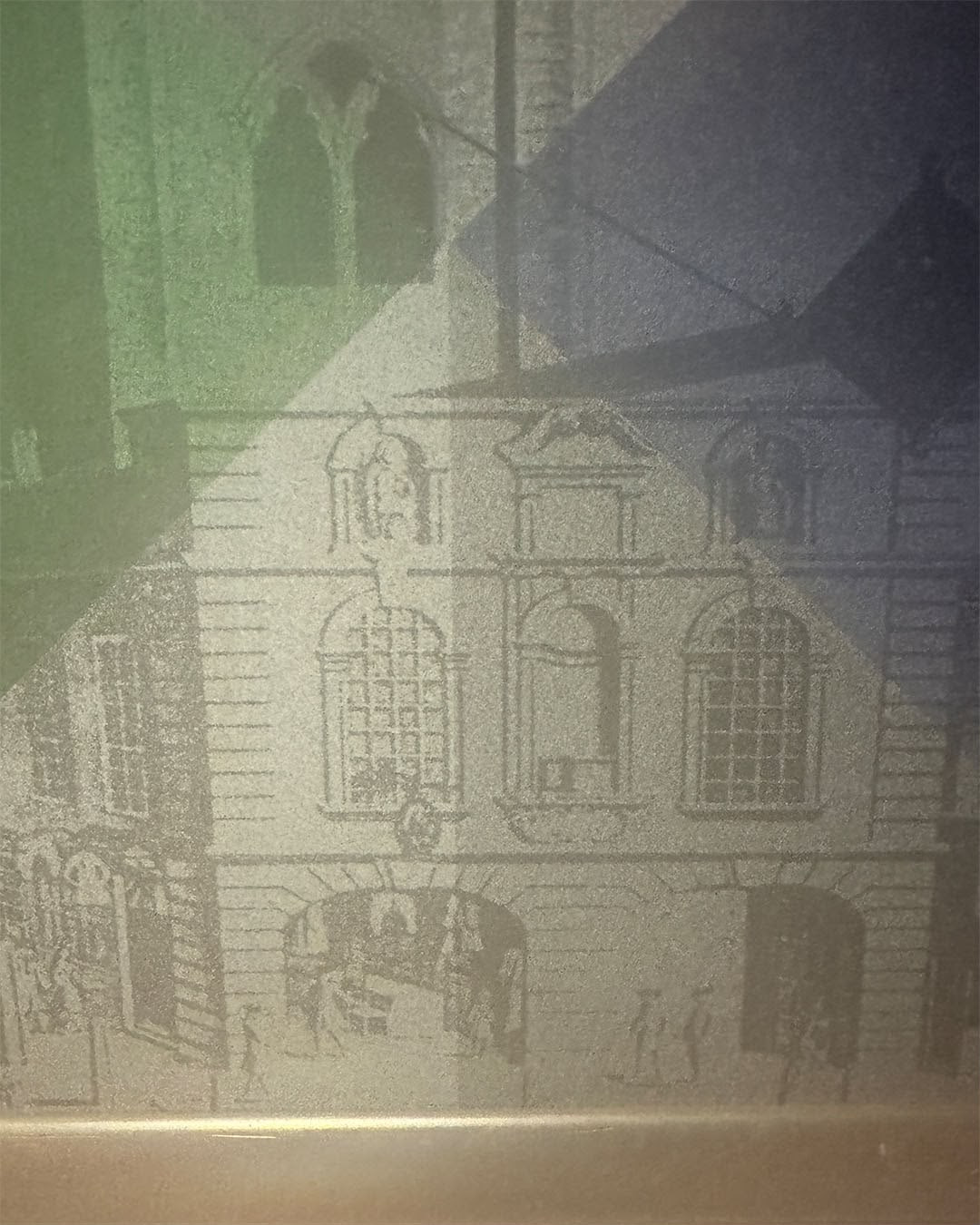
Snapp’s picture featuring a nondescript building darkly outlined through a window is especially pointed in this regard. The literalness of the building takes on the characteristics of a symbol, becoming the backdrop for an incidental play of light. The clarity of detail captured in the image forms part of a greater concatenation of circumstances. The hard lines running across the building give the photo a gridlike appearance in relation to which the darkened trees at the bottom seem caught in the moment—making what would otherwise be a contemplative experience something equally meditative and reflexive.
To take ready-made iconographies and make them untranslatable is the crux of Snapp’s artistry. Borne on vantage points discovered at the margins of anything programmable, Snapp’s photos are portals onto new realms of experience. For all the familiarity that informs them, there’s a note of transcendence which only takes off at the point where his subjects become unfamiliar.
Without being preoccupied with formalism or materiality, utopia or dystopia, Snapp reframes the physical presence of his subjects. Even when this presence is as gargantuan as a mountain range, Snapp uses technique against itself, showing how a mountainous expanse can appear as something both possessable, like a postcard, and impersonal: a mystery designated, named and related, so as to translate its monolithic monumentality into an instrumental neutrality. The fact that his photos are digital infuses them with an ethereal significance, a superordinate meaning which halos them like the answer to a forgotten question.
—Jeffrey Grunthaner
American artist Colin Snapp (b. 1982 Lopez Island, Washington. Lives and works in Los Angeles, USA) consistently challenges the mediated viewing experi- ence. Obsessively cataloguing the American landscape and the way that we access it, his photos, videos and sculpture investigate the manner we are delivered, and choose to accept, an image of reality. Continually accessing the landscape (and consequently all life) through screens, we encompass ourselves in glass. Whether that be arriving within the glass windows of a charter bus, looking though a telescopic photo, or iPhone, lens or consequently en route by way of a high- way and through the wind- screen, Snapp reminds us that what we accept is only a mere apparition of what is actually in front of us.
Selected solo exhibitions include at the Botanical Gardens, University of Siena, Italy; Alexander Levy Gallery, Berlin Germany; Galerie Allen, Paris, France; PS1 MoMA, New York, USA; The Journal Gallery, Brooklyn, New York, USA; Unosunove Galleria, Rome, Italy; Martos Gallery, New York, USA; White Box Gallery, New York, USA.
Selected group exhibitions include the 58th October Salon, Belgrade Biennale. Belgrade, Serbia; Sculpture Center, New York, USA; Hauser and Wirth, New York, USA; 356 Mission Rd., Los Angeles, California, USA; To______Bridges_____, New York, USA; MOCT, Moscow, Russia; New York, USA; Ibid Projects, Los Angeles, California, USA; Marlborough Madrid, Spain.
*****
Le travail de Colin Snapp, artiste basé à Los Angeles, propose un rare mélange d’intimité et d’aliénation. S’inspirant du Zeitgeist politique de sa culture natale et de ses voyages sur plusieurs continents, les incursions de Snapp dans les domaines du cinéma et de la photographie documentent l’interférence perceptuelle des marques, des insignes et de la technologie elle-même, à travers des vues qui, autrement, pourraient sembler romantiques, métaphysiques ou allégoriques.
Cela ne veut pas dire que l’œuvre de Snapp néglige la signification numineuse que recèle, par exemple, un paysage, ou les éclairs soudains de perspicacité qui peuvent résulter de la manipulation d’un objet technologique particulier. Il s’agit plutôt d’une sorte de commentaire médiatisé sur les rituels que la médiation omniprésente nous a imposés.
Comme une ligne de mire tracée sur notre capacité même de perception consciente, National Charter documente la façon dont chaque point de vue que nous prenons sur le monde est marqué d’une manière ou d’une autre ; et bien que l’omniprésence de la technologie ait une influence irréfragable sur ce point, elle ne raconte pas toute l’histoire de Snapp. Pour la série National Charter, élaborée vers 2013, Snapp a utilisé un appareil photo numérique. Aujourd’hui, bien sûr, la plupart des iPhones peuvent facilement reproduire ces images en terme de qualité, mais la sophistication de la réalisation de Snapp va au-delà de la clarté picturale. Face à l’accessibilité immédiate de la technologie, Snapp s’est concentré sur une ambiguïté soigneusement étudiée. Son processus met l’accent non seulement sur l’apparence des images, mais aussi sur la manière dont le dynamisme subtil de leur mode d’apparition alimente ce que les images capturent.
Cette approche dynamique de la vue, associée à une candeur capable de déceler de belles nuances dans ce que beaucoup qualifieraient d’images intrusives et corporatives, confère au travail de Snapp une sorte de modestie visionnaire. Ses photos regardent le monde d’une manière qui renvoie toujours à l’intelligence du spectateur. Ce qui est capturé par son objectif n’est jamais fermé sur lui-même, à la manière d’une monade isolée, mais s’ouvre vers de nouvelles expressions d’interrelations en réseau.
À la manière d’un documentariste, Snapp retrace le parcours de l’imagerie dite corporate le long des chemins de l’économie politique. En capturant la soudaine apparition de marques et de logos - moins comme des formes, des marqueurs ou des enseignes, et plus comme des hiéroglyphes contemporains - il répond non seulement à la façon dont le monde est vécu aujourd’hui, mais aussi à la façon dont notre expérience de l’expérience, notre conscience de soi même, est façonnée par la médiation.
La dimension aliénante qui souligne la perspective une fois qu’elle est traduite en marque découle en partie des techniques paramétrables auxquelles Snapp fait allusion dans chaque photo. L’étrangeté de chaque image, la tension entre son contenu thématique et ce qu’elle montre réellement, doit tout à la façon dont Snapp combine l’argentique au digital, la photographie à l’image.
En ce qui concerne les logos du Barclays Center ou de Cadillac, par exemple, ces formes d’imagerie sont enregistrées comme iconiques parce qu’elles ont déjà marqué l’expérience de leur propre image, déterminant le sens latent de tout ce que nous pourrions découvrir autour d’elles. En les décontextualisant de sorte que leur iconicité semble étrange, presque indéchiffrable, Snapp capture une sorte de fantôme dans la machine - un écran de variance à travers lequel l’influence directe de l’entreprise perd de son immédiateté, tout en devenant majestueuse dans son ambiguïté.
La photo de Snapp présentant un bâtiment ordinaire dont les contours sombres sont visibles à travers une fenêtre est particulièrement intéressante à cet égard. Le caractère littéral du bâtiment prend les caractéristiques d’un symbole, devenant la toile de fond d’un jeu de lumière fortuit. La clarté des détails capturés dans l’image fait partie d’un plus grand concaténation de circonstances. Les lignes dures qui traversent le bâtiment donnent à la photo une apparence de quadrillage, par rapport à laquelle les arbres sombres au fond semblent pris dans l’instant, faisant de ce qui serait autrement une expérience contemplative, quelque choses tout à fait méditatif et réflexif.
Prendre des iconographies toutes prêtes et les rendre intraduisibles, tel est le noyau de l’œuvre de Snapp. Prises à partir de points de vue découverts en marge de tout ce qui est programmable, les photos de Snapp sont des portails vers de nouveaux domaines d’expérience. Malgré toute la familiarité qui les imprègne, il y a une note de transcendance qui ne prend son envol que lorsque ses sujets deviennent méconnaissable.
Sans se soucier de formalisme ou de matérialité, d’utopie ou de dystopie, Snapp recadre la présence physique de ses sujets. Même lorsque cette présence est aussi gargantuesque qu’une chaîne de montagnes, Snapp utilise la technique contre elle-même, montrant comment une étendue montagneuse peut apparaître comme quelque chose d’à la fois appropriable, comme une carte postale, et impersonnelle : un mystère désigné, nommé et mis en relation, de manière à traduire sa monumentalité monolithique en une neutralité instrumentale. Le fait que ses photos soient numériques leur confère une signification éthérée, un sens suréminent qui les couronne comme la réponse à une question oubliée.
—Jeffrey Grunthaner, Traduit de l’anglais par Noam Assayag