
Ended
Chris Ofili
Joyful Sorrow
Oct 14 – Nov 30, 2024
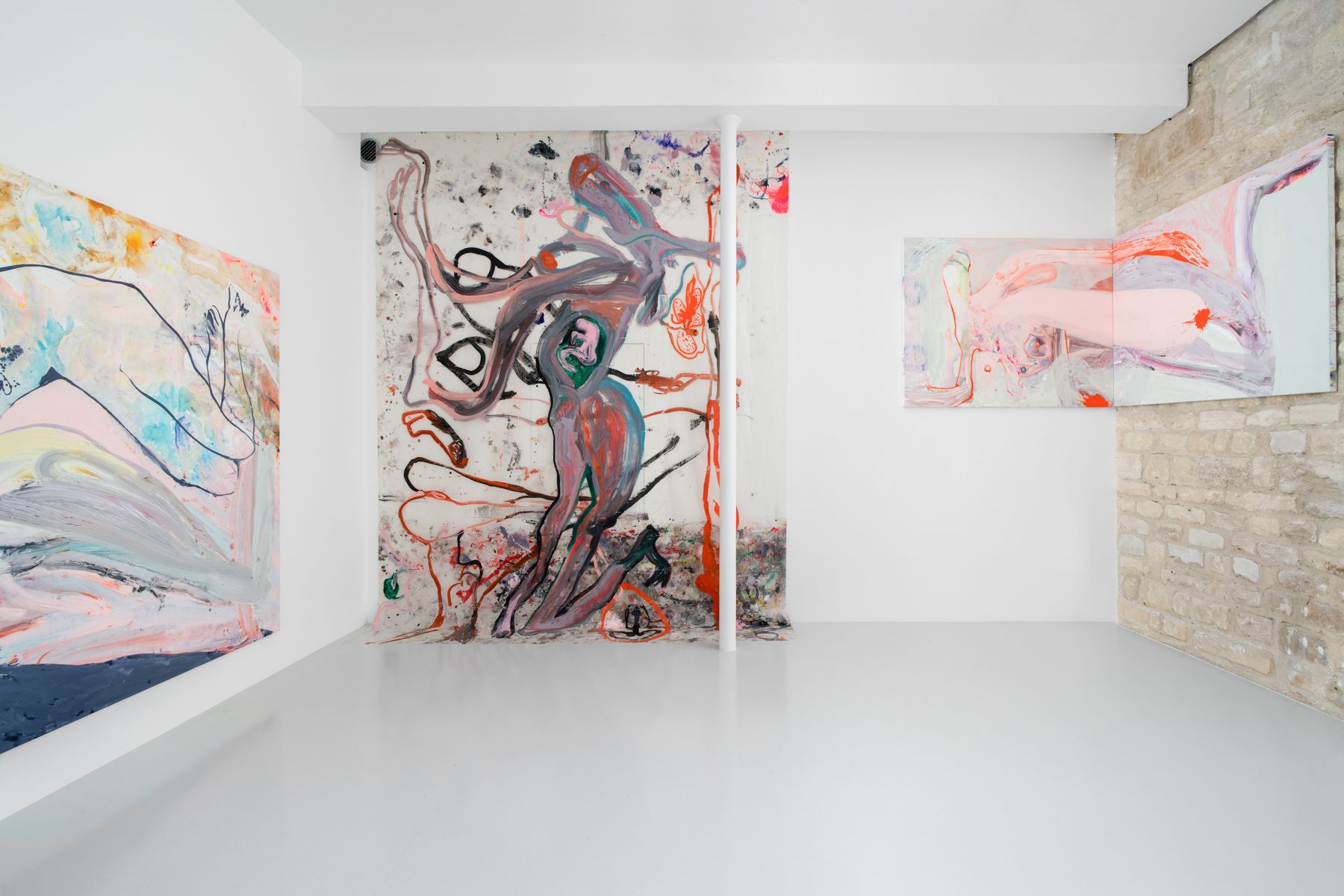
David Zwirner is pleased to present Joyful Sorrow, an exhibition of new paintings by Chris Ofili, to inaugurate the gallery’s second-floor exhibition space in Paris. This is the artist’s first solo presentation in France, and his fifth solo show with the gallery. Joyful Sorrow is staged in partnership with Victoria Miro, who presents a companion exhibition of works on paper in its Venice gallery. These exhibitions are accompanied by a catalogue, published jointly by David Zwirner Books and Victoria Miro, that features poems from Jason Allen-Paisant’s 2023 collection Self-Portrait as Othello.
The works on view at David Zwirner Paris and Victoria Miro Venice continue the artist’s yearslong engagement with William Shakespeare’s Othello. For Ofili, the titular tragic Moorish general—whose emotions span the apexes of love and joy and the nadirs of sorrow—powerfully embodies the dualities that structure our being human. The artist first depicted Othello in a 2018 suite of white-ink etchings made on paper coated with black mica, then in a subsequent 2019 oil-on-linen painting in which hazily iridescent features emerge slowly from a dark background. These works were published in 2019 by David Zwirner Books in William Shakespeare x Chris Ofili: Othello, the first volume in Seeing Shakespeare.
At David Zwirner Paris, Ofili presents a series of paintings titled Othello – Shroud. The word Othello is abstractly spelled out in loosely looping script at the bottom of each canvas, accompanied by a scrolling procession of interlinked, playful figures. The central subject is portrayed in full chromatic splendor; textures range from foaming scallops of paint to skin rendered with an almost liquid shine. Although the artist considers these works to be partly self-portraits, this does not imply that he somehow sought to cast himself as Othello as he made them. Instead, self-portraiture here is explored as a movement of imaginative empathy—a turning toward the other in the mind’s eye. This project of approaching the other through the self is undertaken in the knowledge that acts of representation can never fully capture either self or other. As the artist’s studio shares in relation to this series:
The face of Ofili’s subject—so joyfully, repeatedly named, as though a name could be only a portal to limitless wonder rather than an imposition—splits and metamorphoses with each representation, disturbed by ripples.... Form is disturbed, too, features scudding—sometimes with a bright flare—into being and disappearing in the same moment on these ruffled, sensitive surfaces. The lodestar of portraiture (of the self and/or the other) may still be just visible, but the sense that selfhood might be something that an act of depiction could stabilise, finalise, feels ever more remote. And no act of even self-portraiture is airtight: gaps open up between the moments of looking and the moments of mark-making, gaps that leave space for things less nameable, that smell of the infinite, to blow through.[1]
With their large, curling horns, these figures recall the mythical Greco-Roman satyr, a pleasure-loving nature spirit often depicted as a half-human, half-goat hybrid. The satyr has featured prominently in many of Ofili’s recent works, this traditionally peripheral character fulfilling the role of protagonist and at times functioning as an allegorical stand-in for the artist himself; here, he too is drawn into Othello’s sphere of resonance.
Intricately carved artist’s frames of charred wood both present and conceal the paintings in this series and the watercolors exhibited at Victoria Miro. At David Zwirner, the paintings are shrouded by curtains of black cloth, on which a self-portrait of the artist can only just be made out. These pieces of fabric are nailed to the frames, which evoke theatrical proscenium arches; at the same time, their organic silhouettes and textures suggest elemental activity—fire burning, water churning. Lifting a shroud, uncovering a luminous face beneath, the viewer comes to participate in a quiet drama of availability and nonavailability, invited to consider the complexities of selfhood and its representation.
Chris Ofili’s (b. 1968) atmospheric and enigmatic paintings investigate the intersection of desire, identity, and representation. Portraying characters from a range of aesthetic and cultural sources through a kaleidoscopic visual mode that bridges abstraction and figuration, his works serve as sites for journeys of creative transformation. Born in Manchester, England, Ofili received his BFA from the Chelsea School of Art, London, in 1991 and his MFA from the Royal College of Art, London, in 1993. He has been working with David Zwirner since 2005.
In 2023, Requiem, a major site-specific mural by Ofili, was unveiled at Tate Britain, London, and remains on long-term view. In 2022, the Wallach Art Gallery, Columbia University, New York, presented Chris Ofili: The Othello Prints, in conjunction with a yearlong festival centered on Duke Ellington and Billy Strayhorn’s Shakespeare-inspired jazz piece. In 2017, the National Gallery, London, presented Chris Ofili: Weaving Magic, which marked the first time the artist had worked in the medium of tapestry. In 2012, Ofili designed sets and costumes for Metamorphosis: Titian 2012, a collaborative interdisciplinary project organized with The Royal Ballet in London. The artist’s first major solo museum exhibition in the United States, Chris Ofili: Night and Day (2014–2015), was held at the New Museum, New York, and subsequently traveled to the Aspen Art Museum in Colorado.
Other monographic exhibitions have taken place at the Arts Club of Chicago (2010); Tate Britain, London (2005 and 2010); Kestner Gesellschaft, Hanover, Germany (2006); and The Studio Museum in Harlem, New York (2005). In 2015, Ofili’s work was included in All the World’s Futures, the International Art Exhibition of the 56th Venice Biennale, curated by Okwui Enwezor; and Ofili represented Britain at the British Pavilion, 50th Venice Biennale (2003). In 2017, Ofili was a recipient of Commander of the Most Excellent Order of the British Empire (CBE), and in 1998, he was awarded the prestigious Turner Prize.
The artist’s works are represented in prominent institutional collections worldwide, including The British Museum, London; The Broad, Los Angeles; Carnegie Museum of Art, Pittsburgh; Centre national des arts plastiques, Puteaux, France; The Dakis Joannou Collection, Athens; Dallas Museum of Art; Fortress House Museum, Gibraltar; Glenstone Museum, Potomac, Maryland; Hammer Museum, Los Angeles; Institute of Contemporary Art, Miami; The Metropolitan Museum of Art, New York; Museu Coleção Berardo, Lisbon; Museum of Contemporary Art, Los Angeles; The Museum of Modern Art, New York; National Gallery of Art, Washington, DC; National Gallery of Canada, Ottawa; National Portrait Gallery, London; Pérez Art Museum Miami; Royal College of Art, London; Rubell Museum, Miami; Saastamoinen Foundation Art Collection, Helsinki; San Francisco Museum of Modern Art; The Studio Museum in Harlem, New York; Tate, United Kingdom; Victoria and Albert Museum, London; Walker Art Center, Minneapolis; and Zeitz Museum of Contemporary Art, Cape Town.
1 - Studio of Chris Ofili, “Othello: Notes on Love and Portraiture,” in Chris Ofili: Joyful Sorrow. Exh. cat. (New York/London: David Zwirner Books/Victoria Miro, 2024).