
Ended
Férielle Doulain-Zouari
Ce Qu'elles Façonnent de Jour Comme de Nuit
Feb 16 – Apr 13, 2024
"Wherever they go and whatever they do, Man draws lines"
—Tim Ingold
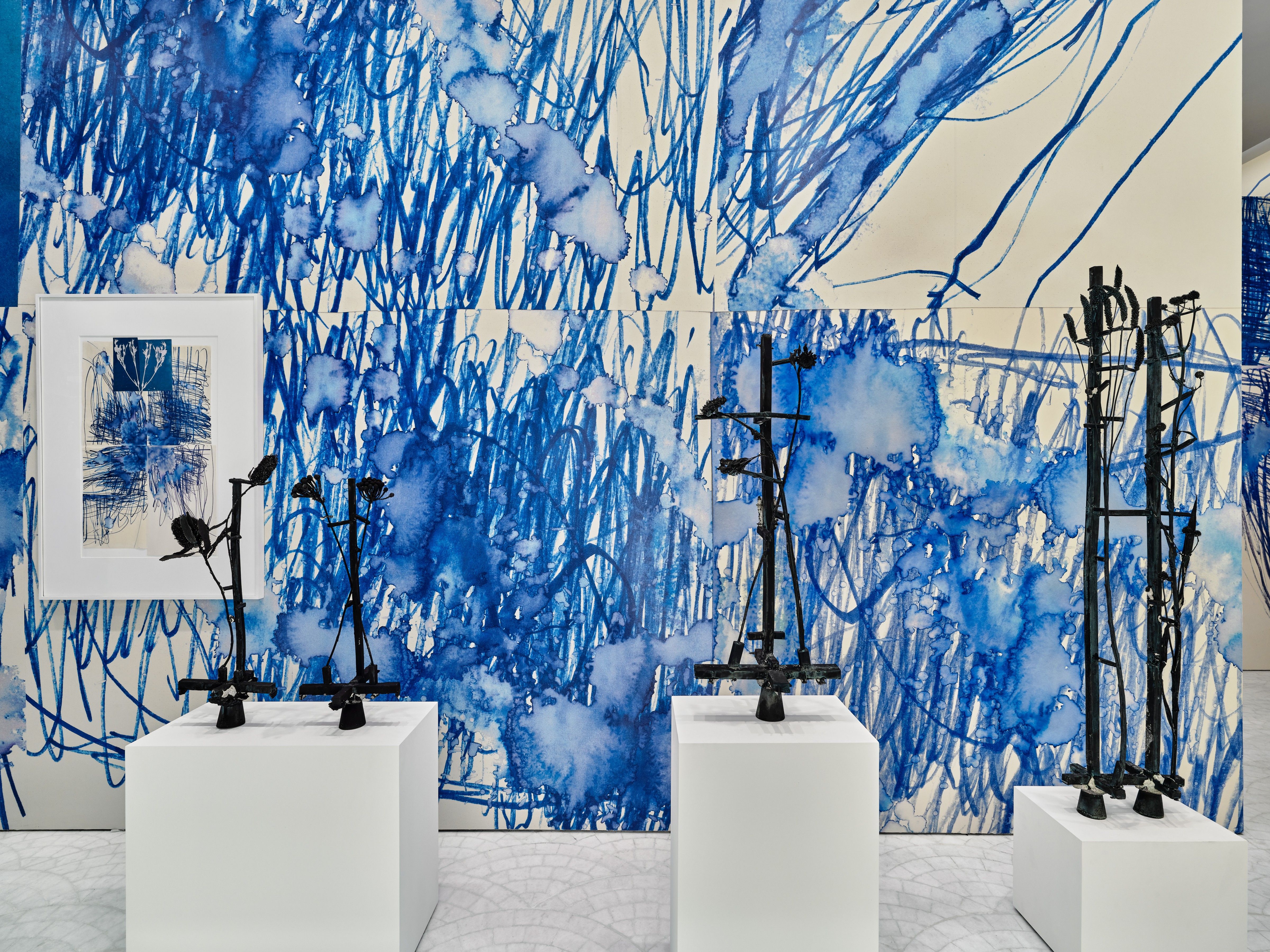
It's through a terracotta checkerboard that Férielle Doulain-Zouari meanders around the line, in order to question its production as much as its existence. She focuses on those natural and those traced by man; those of roots and those that delimit plots of land; those of the trace of water on rocks or those carved into cobblestones to prevent slipping; those that separate water and earth and those that separate people from each other. Yet the line connects, skirts and crosses; it unites and unties to draw the space of the world and its contours in order to build the space that sustains it. Férielle Doulain-Zouari's installation is an ensemble that can be assembled and disassembled, a subject of its own place where the line operates before our very eyes. Ce qu'elles façonnent de jour comme de nuit (What They (Elles) Shape Day and Night), is a tiling, a realignment that juxtaposes and interconnects, embracing the architecture of the space that hosts it as well as its constraints, giving strength to the primary physicality of the material.
According to Tim Ingold, through modernity, lines have become straight, abandoning the trace and imprint of gesture. Férielle is committed to questioning manual work as a means of reconnecting with nature, in order to return lines to their primary liveliness and rediscover the tremor of their trace. The reproduction and interweaving of lines recalls weaving, Férielle's first field of experimentation, through plastic and then wire, before moving on to earth. An anchoring material that offers roots, it is what we walk on and welcomes the lines of our furrows.
Working the earth using processes rooted in Tunisia's history also means tracing back the line of time. For the production of this checkerboard, Férielle worked in Belkhir, in southern Tunisia, with a line of women potters who extract the clay by hand, sift it, work it and then store it. It's a technique dating back to prehistoric times, based on the assembly of lines of clay, called colombins, which enabled these women to sculpt their models vertically. Having been superseded by the advent of the potter's wheel, colombin pottery is now closer to the organic, allowing the earth its freedom to be and the random to take its place.
It is 160 tiles that have been molded from cast clay, dried, rubbed, smoothed and engraved with hollow lines by hand before being covered with engobe - wet clay applied to dry clay before firing to tint it white, ochre or brown. These handmade potteries are then fired with fire or ashes, fed with cow dung or dried cactus leaves, following a method that pre-existed the use of kilns. Férielle has opted for ash firing, offering a more controllable finish but with more subtle traces of firing.
Despite the fervor of the labor, mastery is impossible. By kneading the unexpected, Férielle Doulain-Zouari wanted to give back to nature what belongs to it, the reign of randomness. Shape, color and density impose themselves right out of the kiln. Here, pink and mauve reflections have timidly invited themselves into the checkerboard hue. Once assembled, it's the irregularity that prevails and sets it apart. The lines carved by Férielle's hand, which divide each tile, cement the checkerboard as a collective unit. Adding a line for Férielle is reminiscent of nature, of water flowing, of roots growing, of the lines that unite symbionts.
Sand has been added to the soil. Heated to extraordinary temperatures, it is transformed. The gravels of glass, blown or melted into blocks, also trace lines. Most of Tunisia's artisan glassmakers work with recycled glass. Their firings are organized by color session. The furnaces are dedicated to green, then blue, then transparent, depending on the glass collected. At each color change, the furnaces are cleaned, and scoops of liquid glass are extracted. This artificial lava is then cooled and reused. This dried mass can be crushed into granules. This powder is not sharp, but reminiscent of the friability of crumbled clay. Sand is almost restored to its original state through this circular process, where the earth regains its attributes.
A stratum of solid lines of this material is applied to the cut checkerboard, an inverted groove reminiscent of the piles of earth formed when digging agricultural furrows. With this complementary gesture, Férielle Doulain-Zouari returns fullness to emptiness, creating a multiplication of earth lines. This new grid of lines is deformed by curves, recalling the circularity of the natural world's order, just like this work, composed of essential elements - earth, water and fire - that can be remelted and transformed to give it another form dictated by a new infinity of lines.
—Léa Perier Loko
"What They (elles) Shape Day and Night
Elles.* The women who dig with their hands, extract the clay, sift it, knead it, shape it, and fan the fire.
Elle.** The earth. The clay. That forms, dries and hardens.
Elle. Water. That which flows, quenches, and gives life.
Elles. Lines. Those dug by water into the earth.
Those of untamed nature and stone erosion. Those of cultivated fields. Those of writing. Those of paths and roads.
Those that weave or are sculpted. Those that tell of our first origins. Elles. The traces. Those of lines, subtracted or added.
Those of materials that meet.
Those of time that passes and leaves its mark.
Elles. Natures.
*French plural feminine personal pronoun
**French singular feminine personal pronoun"
—Férielle Doulain-Zouari
Férielle Doulain-Zouari, of French-Tunisian origin, born in 1992, lives and works in Tunis. Férielle studied applied art and textile design and explores the link between weaving, art and her environment. Her work has been exhibited in many national and international museums such as the Musée des Beaux-Arts in Angers, the Musée des arts et des traditions populaires in Kef and the Chapelle Saint Monique in Carthage, Tunisia. In 2022, she received the Revelation Prize from the Senegalese Ministry of Culture at the 14th edition of the Dakar Biennale - Dak’Art 2022, thanks to her installation Current Water, which was highly acclaimed. She was exhibited in the international exhibition, Ĩ Ndaffa #/ Forger/Out of the fire, curated by Malick Ndiaye, director and curator of the Musée Théodore-Monod d’art africain in Dakar, Senegal.
Through the use of manual techniques that operate in the present, she questions the different cohabitations that exist between the natural world and the artificial. She questions the ways of materially representing the meeting, the reconciliation and the resolution of conflicts (identity, contextual...). Her work takes the form of installations, sculptures and weavings of different styles. They are linked to daily life, are inspired by the environment, the elements that surround it (industrial materials, functional objects, local flora) and the coping systems implemented on a daily basis. Her studio moves according to the opportunities encountered, including with craftsmen. Through this journey, the reference to manual work has become essential in its creation as well as the desire to spark exchanges and questions thanks to an artistic language.