Ended Nov 16
Marjetica Potrč
Of Domes and Toilets: Architecture and Social Architecture Are One
Sep 6 – Nov 16, 2019
More from Marjetica Potrč on Gallop
[Please scroll down for German version / Für Deutsch bitte scrollen Sie nach unten]
In her sixth solo exhibition at Galerie Nordenhake the artist and architect Marjetica Potrč shows two architectural case studies and a selection of related drawings. The title of the exhibition serves as a proposition pointing to Potrč's concept of collaborative social architecture. The dome–the epitome of architectural achievement and powerful architectural symbol–is placed on the same level as the toilet, which is a form hardly recognised in architectural history, but culturally and infrastructurally of no less importance, and one which will certainly confront us with extremely pressing challenges in the future.
Potrč is internationally renowned for her architectural case studies and collaborative site-specific projects, rooted in a multidisciplinary practice that merges art, architecture, ecology, and social sciences. At the core of her artistic practice lie questions of our current living conditions and the failures of modernist architecture.Potrč's work points to alternative building strategies and resources, taking into account both advanced technology and traditional approaches. Thereby she places emphasis on individual empowerment as well as sustainable and democratic strategies for the future.
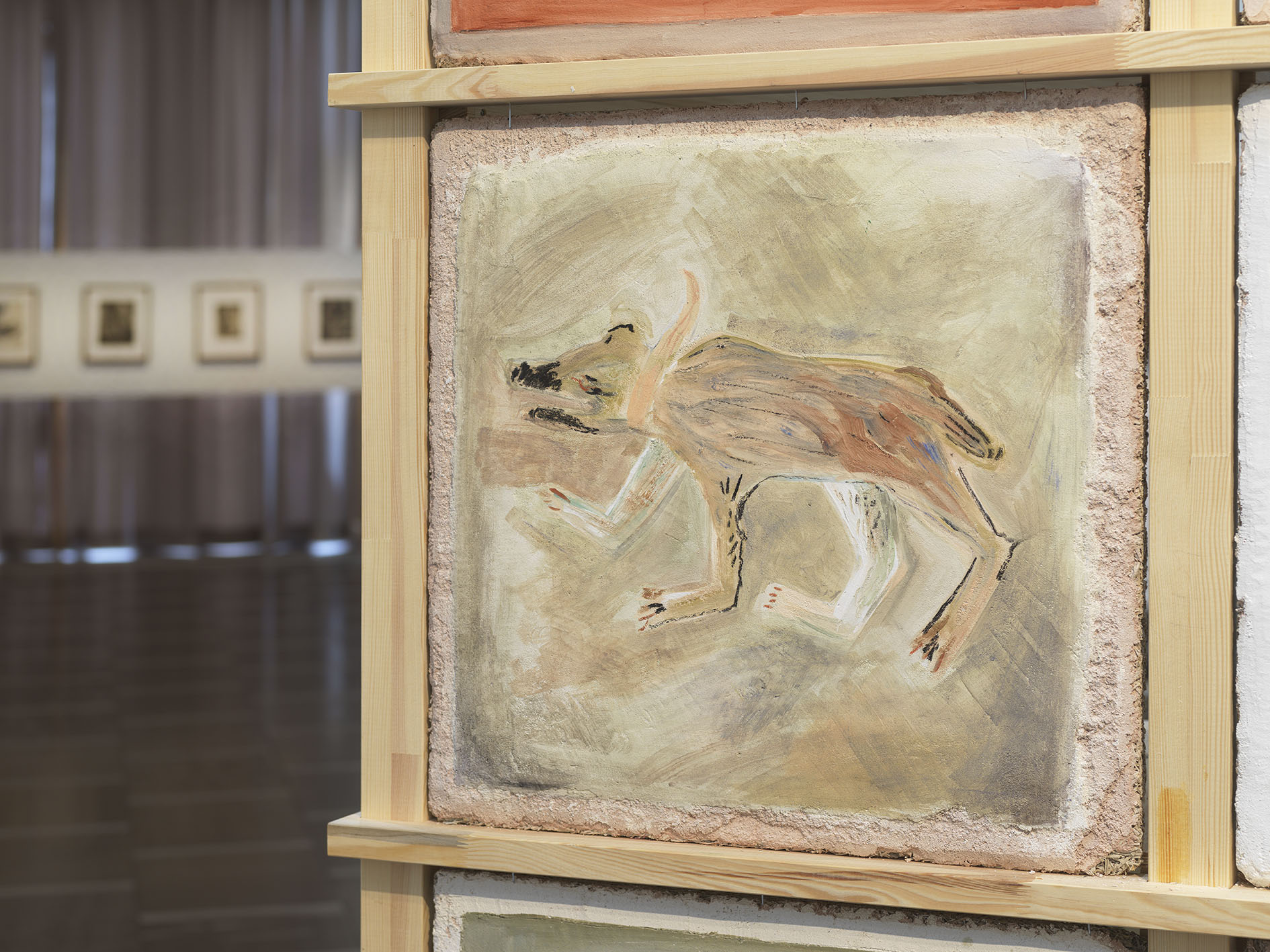
The sculpture Drop City Giant (2012-2019) is based on Potrč's research on the legendary Drop City community in Colorado, a commune founded in the mid-1960s by art students. Inspired by Buckminster Fuller's concept of the Geodesic Dome, the community built structures using affordable components like recycled industrial materials, and developed passive solar devices. Considered a utopian counterculture at the time, Drop City is–even after its gradual dissolution in the early 1970s–an important example for alternative architectural concepts and an intentional community with different social structures. Potrč conceives this work as a contemporary version of an archaic sculpture, the Kouros, to symbolise the commons. Constructed from recycled street signs and basic building materials like wood and aluminium bars the dome–due to its ingenious construction principle–is extremely strong despite its light weight. The accompanying eight-part drawing series presents a contemporary example of a community-focused project, pointing out that the ideas from 1968 are reemerging today as small-scale local strategies.
Caracas: Dry Toilet (2003-2019) was created in collaboration with the residents of the La Vega barrio and architect Liyat Esakov. Together they constructed an ecologically safe waterless toilet that collects waste and turns it into fertilizer, in an informal settlement of Caracas that had no access to the municipal water grid. Although the water toilet is still considered the desired standard, one can argue that it was a major maldevelopment of civilisation, given its negative ecological and sanitary effects. The installation on view is the ninth elaboration of the original architecture: a hybrid structure, built from simple and locally sourced materials, and realised in collaborative exchange with the gallery team. The transfer into the gallery space translates the architectural structure from a context of literal use to a context of theoretical reflection. In a global context of deregulation and ecological crisis it becomes a relational object, a potential tool of cultural change rethinking our social contract from the bottom up. As Potrč puts it, “I’m not interested in architectural constructions. I’m interested in social architecture […, structures formed by society]. People don't want to just inhabit the city they live in; they want to produce it. We have to change our way of living, which is more difficult than building a house."
Marjetica Potrč is an artist and architect based in Ljubljana, Slowenia, where she was born 1953. Her work has been featured in exhibitions worldwide, including Yinchuan Biennial (2018), Venice Biennial (2009, 2006 and 2003), São Paulo Biennial (2006, 1996), Gwangju Biennale (2004) and Skulptur Projekte Münster (1997). She has had solo shows at Kunsthall Trontheim (2017), Flora ars+natura, Bogota (2017), PAMM Pérez Art Museum, Miami (2015), Eli and Edythe Broad Art Museum, East Lansing, MI (2012), Barbican Art Gallery, London (2007), PBICA, Lake Worth, FL (2003), MIT List Visual Arts Center, Cambridge, MA (2004), Kunsthalle Fridericianum, Kassel (2004) and Guggenheim Museum New York (2001), among others. Her many on-site installations include: Of Soil and Water: King's Cross Pond Club, London (2015), The Commons Project, Gemeentemuseum Den Haag (2013), Théàtre Évolutif, Bordeaux (2011), Between the Waters: The Emscher Community Garden, Emscherkunst, Oberhausen (2010), The Cook, the Farmer, His Wife and Their Neighbour, Stedelijk Goes West, Amsterdam (2009) and Dry Toilet, Caracas (2003). From 2011 to 2018 she was a professor at the University of Fine Arts (HFBK) in Hamburg, where she taught Design for the Living World, a class on participatory practices. Furthermore she has taught at MIT, Cambridge, MA (2005) and IUAV University in Venice (2010, 2008). Potrč is recipient of numerous grants and awards, including the Vera List Center for Arts and Politics Fellowship at The New School in New York (2007), Caracas Case Project Fellowship from the Federal Cultural Foundation, Germany and the Caracas Urban Think Tank, Venezuela (2002) and the Hugo Boss Prize, administered by the Guggenheim Museum (2000).
*****
In ihrer sechsten Einzelausstellung in der Galerie Nordenhake zeigt die Künstlerin und Architektin Marjetica Potrč zwei architektonische Fallstudien und dazugehörige Zeichnungen. Der Titel der Ausstellung fungiert wie eine These, die Potrčs Konzept der kollaborativen sozialen Architektur umreist: Die Kuppel als Inbegriff architektonischer Leistung und machvolles architektonisches Symbol, wird auf eine Ebene mit der Toilette gestellt, eine in der Architekturgeschichte kaum beachtete, aber kulturell und infrastrukturell nicht weniger wichtige Bauform, die uns sicherlich in der Zukunft vor extreme Herausforderungen stellen wird.
Potrč ist international für ihre architektonischen Fallstudien und ortsbezogenen Gemeinschaftsprojekte bekannt, die in einer multidisziplinären Praxis wurzeln, welche Kunst, Architektur, Ökologie und Sozialwissenschaften miteinander verknüpft. Im Zentrum ihrer künstlerischen Praxis steht die Frage nach unseren aktuellen Lebensbedingungen und dem Scheitern modernistischer Architekturen. Sie zeigt in ihrer Arbeit alternative Baustrategien und Ressourcen auf und berücksichtigt dabei sowohl fortschrittliche Technologien als auch traditionelle Ansätze. Dabei legt sie Gewicht auf individuelle Selbstermächtigung sowie nachhaltige und demokratische Zukunftsstrategien.
Die Skulptur Drop City Giant (2012-2019) entstand im Rahmen von Potrč's Recherchen zu der legendären Drop City Kommune in Colorado, die Mitte der 1960er Jahre von Kunststudenten gegründet wurde. Inspiriert von Buckminster Fullers Geodätischer Kuppel baute die Kommune mit erschwinglichen Mitteln wie recycelten Industriematerialien Konstruktionen und entwickelte passive Solargeräte. Drop City galt damals als utopische Gegenkultur und ist, auch nach ihrer allmählichen Auflösung Anfang der 1970er Jahre, ein wichtiges Beispiel für alternative architektonische Konzepte sowie für eine Wahlgemeinschaft mit neuen sozialen Strukturen. Potrčs Skulptur ist als zeitgenössische Version einer archaischen Skulptur, als Kouros, konzipiert, und symbolisiert das gemeine Volk. Die Kuppel ist aus recycelten Straßenschildern und einfachen Baumaterialien wie Holz und Aluminiumstangen gebaut und — aufgrund ihres genialen Konstruktionsprinzips — trotz ihres geringen Gewichts extrem stabil. Die dazugehörige achtteilige Zeichnungsserie beschreibt ein aktuelles Beispiel für ein gemeinschaftsorientiertes Projekt und macht so deutlich wie heute Ideen von 1968 auf kleinem, lokalen Maßstab wieder aufgegriffen werden.
Caracas: Dry Toilet (2003-2019) ist in Zusammenarbeit mit den Bewohnern des Viertels La Vega und der Architektin Liyat Esakov entstanden. Gemeinsam entwickelten Sie für die informelle Siedlung in Caracas', die nicht an das städtische Wassersystem angeschlossen ist, eine ökologische wasserlose Toilette, die die Fäkalien sammelt und zu Kompost umwandelt. Die Wassertoilette gilt weiterhin als der ersehnte Standard, wenngleich man argumentieren könnte, dass sie aufgrund ihrer negativen ökologischen und gesundheitlichen Auswirkungen, eine zivilisatorische Fehlentwicklung ist. Bei der jetzt ausgestellten Installation handelt es sich um die neunte Version der ursprünglichen Architektur: eine hybride Struktur aus einfachen und lokal verfügbaren Materialien, die in Kollaboration mit den Mitarbeitern der Galerie realisiert wurde. Der Transfer in den Galerieraum überführt die Gebrauchsarchitektur in den Kontext theoretischer Reflexion. Im globalen Kontext von Deregulierung und ökologischen Krisen wird sie zu einem relatonialen Objekt, zu einem potentiellen Werkzeug kulturellen Wandels, der den Sozialvertrag neu bedenkt. Wie Potr č es formuliert: "Ich bin nicht an architektonischen Konstruktionen interessiert. Ich interessiere mich für Soziale Architektur [..., Infrastrukturen, die von der Gesellschaft gebildet wurden]. Menschen wollen nicht einfach nur die Stadt bewohnen, in der sie leben; sie wollen sie gestalten. Wir müssen unsere Lebensweise ändern, was viel schwieriger ist, als ein Haus zu bauen."
Marjetica Potrč ist Künstlerin und Architektin und lebt und wohnt in Ljubljana, wo sie 1953 geboren wurde. Ihre Arbeiten wurden in Ausstellungen weltweit gezeigt, darunter die Yinchuan Biennale (2018), Venedig Biennale (2009, 2006 und 2003), São Paulo Biennale (2006, 1996), Gwangju Biennale (2004) und Skulptur Projekte Münster (1997). Sie hatte u.a. Einzelausstellungen in der Kunsthalle Trontheim (2017), Flora ars+natura, Bogota (2017), PAMM Pérez Art Museum, Miami (2015), Eli and Edythe Broad Art Museum in East Lansing, MI (2012), Barbican Art Gallery, London (2007), PBICA, Lake Worth, FL (2003), MIT List Visual Arts Center, Cambridge, MA (2004), Kunsthalle Fridericianum Kassel (2004) und Guggenheim Museum, New York (2001). Zu ihren zahlreichen ortsspezifischen Installationen zählen: Of Soil and Water: King's Cross Pond Club, London (2015), The Commons Project, Gemeentemuseum Den Haag (2013), Théàtre Évolutif, Bordeaux (2011), Between the Waters: The Emscher Community Garden, Emscherkunst, Oberhausen (2010), The Cook, the Farmer, His Wife and Their Neighbour, Stedelijk Goes West, Amsterdam (2009) und Dry Toilet, Caracas (2003). Von 2011 bis 2018 war sie Professorin für Design for the Living World an der Hochschule für Bildende Künste (HFBK) in Hamburg und partizipative Praktiken lehrte. Sie hat weiterhin u.a. am MIT, Cambridge MA (2005) und IUAV University in Venedig (2010, 2008) gelehrt. Potr č erhielt zahlreiche Stipendien und Auszeichnungen, darunter das Vera List Center for Arts and Politics Stipendium an der New School in New York (2007), das Caracas Case Projektstipendium der Kulturstiftung des Bundes Deutschland und des Caracas Urban Think Tanks, Venezuela (2002), und den Hugo Boss Prize, vergeben vom Guggenheim Museum (2000).