
Exhibition · Kasmin
Robert Indiana
The Source (1959–1969)
Feb 27 – Mar 29
2 images · swipe
About the show
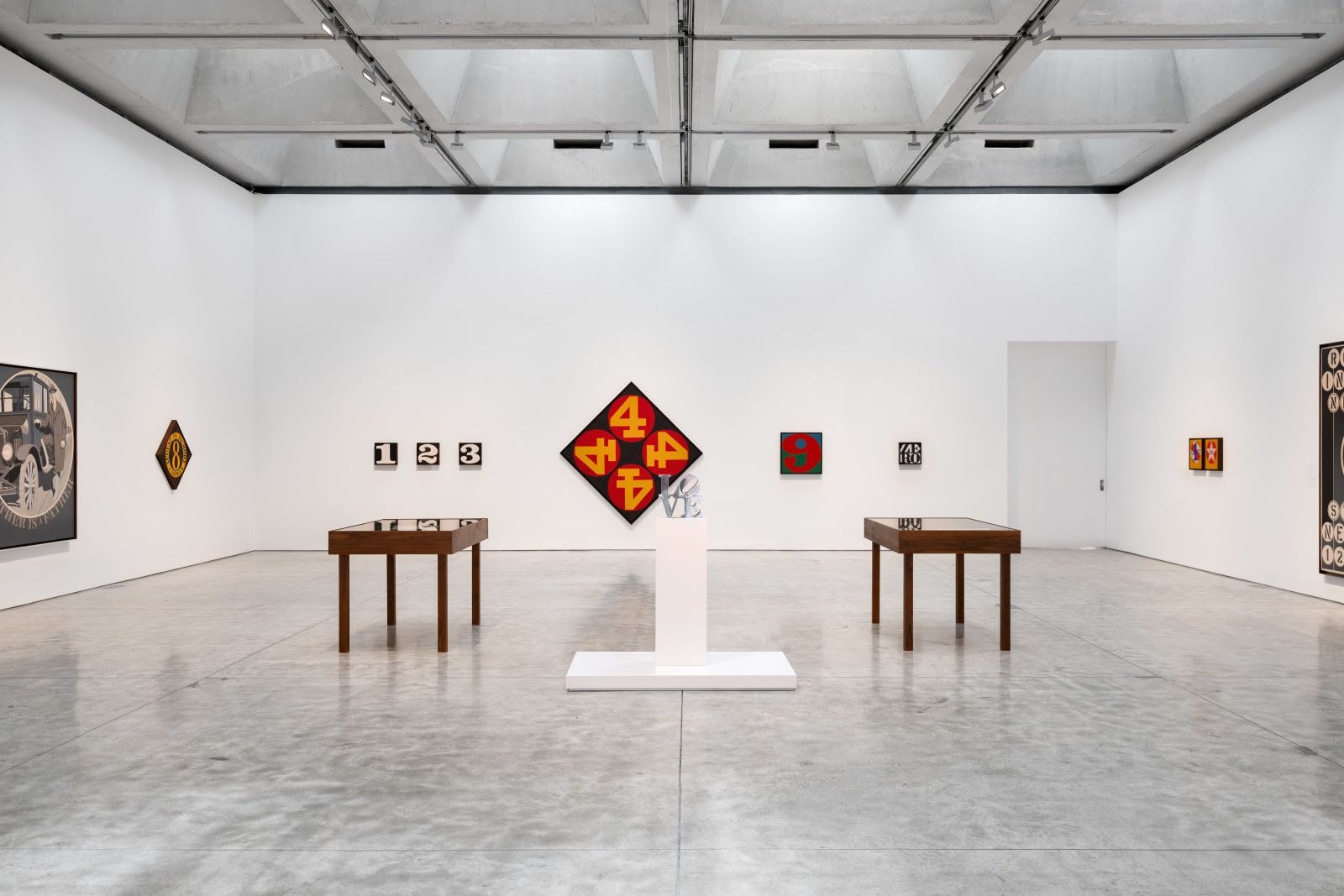
Kasmin presents Robert Indiana: The Source, 1959 -1969, a focused survey of the transformative decade in which Indiana established his unique artistic language, achieving wide recognition and cementing his place as an icon of American art. Featuring over 20 paintings drawn exclusively from the artist's personal collection as endowed by Indiana to the Star of Hope Foundation, the exhibition also includes an example from the artist's first edition of Love sculptures, conceived in 1966 and executed between 1966--1968, and a vitrine display of archival materials including some of the artist's journals. This exhibition marks Kasmin's first collaboration with the Star of Hope Foundation, which was established by the artist in his lifetime, and the gallery's eighth solo exhibition of work by Indiana since 2003.
Robert Indiana: The Source, 1959 -1969 chronicles the Minimalist origins of Indiana's signature use of signs, symbols, words and numbers. Pairing canonical works with those rarely seen by the public, the exhibition provides a deeper understanding of Indiana as an artist whose output remains emblematic of American culture. The paintings on view demonstrate the personal iconography the artist ascribed to his artwork: as his peers withdrew from the aesthetics of self-expression, Indiana embarked on a career-defining inquiry into the power of symbols to represent meaning. Organized thematically, the exhibition charts Indiana's influential depictions of words and numbers in bold colors through his early abstractions, reflections on his personal history and the stages of life, and the poetic inevitability of transcendence--a return to the source.
The selection of works on view demonstrate the emergence and progression of the artist's distinct visual language, drawing formal and historical throughlines across significant bodies of work. Early abstractions including Source I(1959) and Source Egg(1959) anchor the exhibition and propose a guiding framework to consider Indiana's personal, spiritual, and visual reflections. Both of these paintings feature an oval in flattened pictorial space, employing the emerging language of hard-edge painting and an expressive use of color and form to nod to Indiana's close friends and neighbors on Coenties Slip in lower Manhattan, where Indiana worked near artists Ellsworth Kelly, Jack Youngerman, Agnes Martin, James Rosenquist, and others between 1957 and 1965. Subtle allusions to those close to the artist would recur over the next decade as Indiana developed his unique approach to painting.
Circles, which Indiana introduced to his paintings and sculptures alongside ovals, proliferate across the exhibition works. The abstract triptych Ra (c. 1960-61) demonstrates Indiana's early arrangement of particular numbers of orbs to create abstract compositions, while its titular reference to the Egyptian sun god indicates an interest in ancient mythology. Through the decade, Indiana would adopt the circular format to extrapolate upon his own biography: the diptych Mother and Father(1963-66) pictures the artist's parents within two circles, as if seen through a pair of binoculars. Reflecting on their lives and deaths, the artist described the work in an accompanying artist statement as essential to his celebrated American Dream series (1961-2001). He exhibited the painting extensively from 1964 onward including in the 1967 Sao Paulo Biennial and in his traveling institutional retrospectives of 1968, 1977, 1982, and 2013.
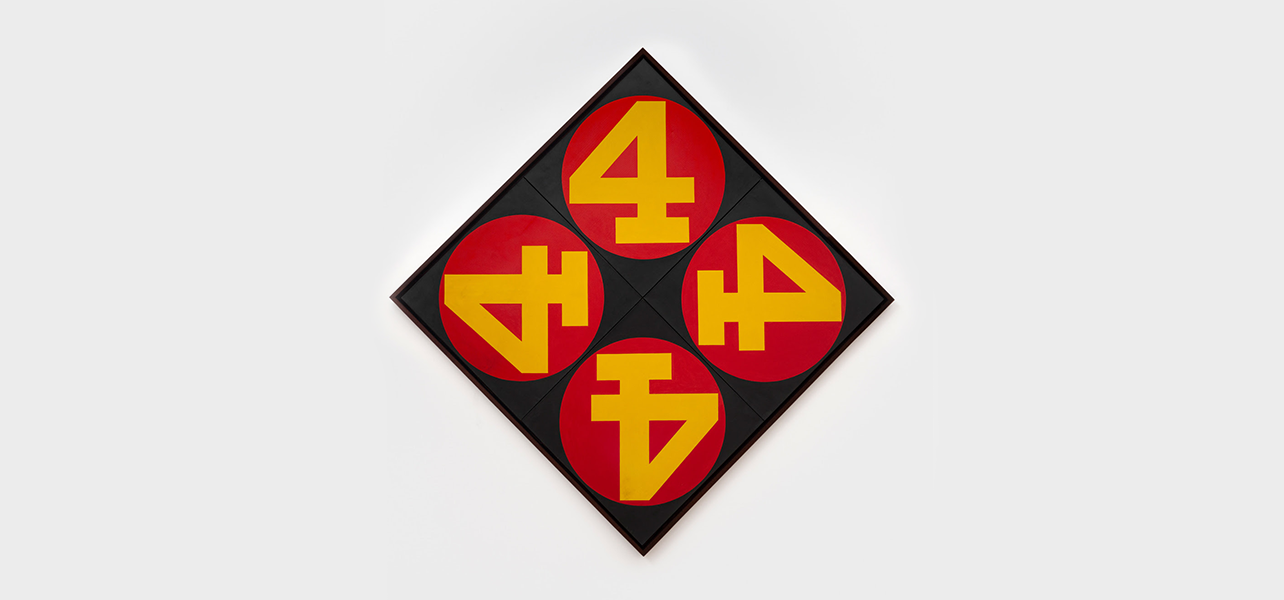
The circle visualizes the cyclical nature of life, a subject that Indiana explored in his compositions incorporating numbers. Indiana's famed Cardinal Numbers(1966), from which the 24-inch Cardinal Nine is on view, encapsulates his notion that each of the ten numerals signifies a stage of life--beginning with one for birth and ending with zero for transcendence. He often assigned color combinations to his numbers, famously describing the union of red, blue and green as a memory of seeing the red and green signage of Phillips 66--the petroleum company where his father worked--against an open sky. The Big Four (1963) exemplifies Indiana's inclination to pair colors with numbers according to their placement in the life cycle, with four signaling the developmental phase of adolescence. For this work, Indiana selected the cautionary colors of red and yellow--alluding to the railroad signage his paternal grandfather followed while driving trains for the Pennsylvania Railroad--to picture the numeral "4" rotating over each of four panels arranged in a diamond.
The self-referential quality of The Big Four extends to a semiotic inquiry of the power of symbols to represent meaning. After discovering a trove of nineteenth-century packaging stencils in 1960, Indiana began incorporating words and numbers in his paintings, spearheading the adoption of commercial advertisement as a language of art. LIP (1960-61), an early example of a single word painting, features the title word's yellow letters at the center of two intersecting orbs, whose contours suggestively form a pair of red lips. Unraveling the distinction between sign and symbol, the composition suggests a kiss, a universal bodily expression of love. Nearby, the only artist proof of Indiana's first Love sculpture (1966-68), standing 12 inches tall in hand-cut aluminum, pairs with a red, blue and green Love painting (1967).
Unique paintings made in preparation for distinguished mid-1960s print projects are featured, documenting milestones in the artist's life and career while underscoring the diaristic quality of the works on view. These include New York State Theater(1964) and Robert Indiana, New Art, Stable New York(1964), revealing the artist's working method behind his celebrated practice as a printmaker. The former was produced to advertise the opening of the New York State Theater at Lincoln Center in April 1964 and Indiana selected red and yellow to echo the colors of the auditorium. Conceived as a companion, the latter served as the basis for a poster advertising Indiana's second solo exhibition at the Stable Gallery in New York, where The Big Four and an early state of Mother and Father were featured.
Robert Indiana: The Source, 1959 -1969 is presented in dialogue with Pace Gallery's upcoming exhibition Robert Indiana: The American Dream. The Star of Hope Foundation, in collaboration with Kasmin Gallery, and The Robert Indiana Legacy Initiative, represented by Pace Gallery, have developed these distinct exhibitions in parallel to explore different aspects of Indiana's artistic output and offer a diverse set of perspectives on the most formative decade of his career.
—Robert Indiana
One of the preeminent figures in American art since the 1960s, Robert Indiana (1928–2018) played a central role in the development of assemblage art, hard-edge painting, and Pop art. Indiana, a self-proclaimed “American painter of signs,” created a highly original body of work that explores American identity, personal history, and the power of abstraction and language, establishing an important legacy that resonates in the work of many contemporary artists who make the written word a central element of their oeuvre. His work continues to resonate through contemporary art and popular culture worldwide. Indiana’s artwork has been featured in numerous solo and group exhibitions around the world, and his works are in the permanent collections of important museums such as the Museum of Modern Art and the Whitney Museum of American Art in New York; the National Gallery of Art, the Hirshhorn Museum and Sculpture Garden, and the Smithsonian Museum of American Art in Washington, D.C.; the Albright-Knox Art Gallery in Buffalo, New York; Tate Modern, London, the San Francisco Museum of Modern Art; the Menil Collection in Houston; the Currier Museum of Art, Manchester, New Hampshire; the Museum Ludwig in Cologne, Germany; the Van Abbemuseum in Eindhoven, the Netherlands; MUMOK (Museum Moderner Kunst Stiftung Ludwig Wien) in Vienna, Austria; the Art Museum of Ontario in Toronto; and the Israel Museum in Jerusalem. He has also been included in numerous international publications and is the subject of a number of monographs.
The Star of Hope Foundation is a non-profit organization founded by American artist Robert Indiana in 2016. Its mission is to support artists and cultural initiatives in Maine and on the island of Vinalhaven, where Indiana lived in the historic Star of Hope building for 40 years. As an artist-endowed foundation, the Star of Hope Foundation’s activities are overseen by a Board of Directors whose philanthropic priority includes promoting visual arts in the State of Maine and the community of Vinalhaven. The Star of Hope Foundation will collaborate with other Maine-based entities to promote the visual arts and support working artists, while partnering with the Archives of American Art to assemble and organize Indiana’s personal and professional papers, memorabilia, and photographs.