
Ended
Urs Lüthi
Trademarks
Feb 7 – Apr 18, 2020
“Who am I, and if so, how many?”
- Richard D. Precht, German philosopher
The Artist is Present
The artist is present. That is obvious. But who is he, and how many? This question arises immediately when overlooking the 143 sheets that Urs Lüthi selected in 2007 for the Trademarks box to represent his artistic production to date.
The clearly ambiguous slogan: ‘I is another,’ with which Rimbaud provocatively showed modernity the way and which to this day defines the oscillatory disposition of artist and artwork, sets the artistic compass of Urs Lüthi in a state of permanent unrest.
The artist himself is conspicuously at the center of his visual chronicle. He is present whether active or passive. As self-exposer and role player, as a readymade, a multiple, as working material — few other artists make their own persona so central to their work, inflicting so much on it, trying out identities and exploring realms of life as intensively as Urs Lüthi. Without having to leave his immediate surroundings, his everyday world, even if he transforms himself into a constellation and paints visions of his longing. Few push their own metamorphoses with such obsession or expose themselves to such diverse and contradictory appearances — lover and loser, tragedian and clown, drag queen and jogger — and to the rollercoasters of emotions and experience: adolescence and sexuality, happy family life and illness, aging and death, to name but a few.
It also becomes clear that he does it neither out of vanity, complacency, narcissistic self-reflection (well, perhaps a little bit), nor out of self-loathing. Rather, Lüthi makes himself available as a fashion model, a role model, through which he discloses our existence, our being in the world.
Let us assess his work over the years, with its spectrum from the morbidly lascivious to the moribund and droll. Not only do we learn of change, the high and low points as well as the banal in the life of Urs Lüthi, we also learn about every day annoyances, the malevolence of the inanimate, and — with the artist as our alter ego — learn how to see parallels to events, vicissitudes, and sensitivities in our own lives. Hence the title of one work: I’ll be Your Mirror.
The image Urs Lüthi Also Weeps for You is proof of the artist’s empathy. Like, I’ll Be Your Mirror, it is part of a series of large black and white photos, titled The Numbergirls. They present the young artist as an androgynous model in various roles and poses that instantly made Lüthi internationally famous at the beginning of his career. Not least because of their subtle sex appeal. In this context, a concept central to his work, that of ‘Trademarks’was born; the figure, in particular the distinctive head of the artist, is introduced as a memorable figurative mark, a corporate identity. A successful branding element with high recognition potential as it turned out.
Another photo, clearly taken years later, demonstrates how Lüthi can switch between high and low. It shows the artist in a fitness outfit. With his right hand he pulls a black garbage bag behind him, in the outstretched left he holds up a colorful bouquet of flowers like a banner, a trophy. He smiles at us, half innocently, impish, half ashamed, as if he felt caught. It is an allegory of a schizophrenic situation: a deep longing for beauty and harmony on the one hand, and the annoying and hopeless struggle for liberation from everyday impositions on the other. The garbage functions as a compact symbol of all that is ugly, disturbing, chaotic. The quotidian reality of contrasts and contradiction, we all contribute to.
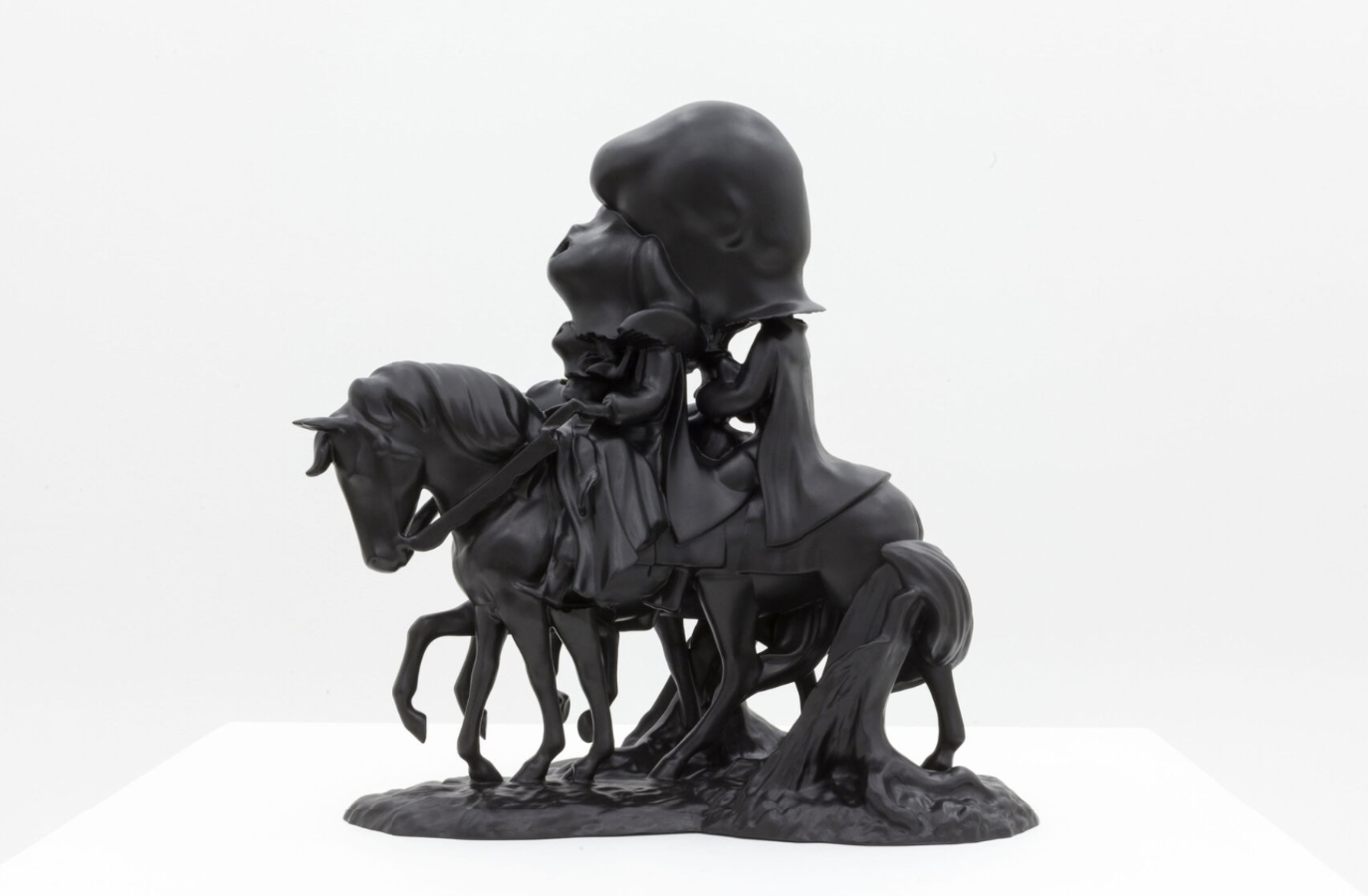
The artist is present: this statement obviously does not apply to all pictures in the box. In addition to the artist portraits, we also find a variety of other forms and content as well as materials, some of which are stylistically of a quite disparate nature. Urs Lüthi does not claim any style, he plays with styles. Abstract patterns and naturalistic seascapes, striking texts in captivating typography and exquisite coloring; cartoons, frisbees and bronzes, plastic and glass. However, in the end, these alternative images serve as only the one desire: Art for a Better World.
Take, for example, the attention-grabbing geometric ornaments. They visualize Lüthi’s idea of a ‘Universellen Ordnung,’ a universal order, a powerful order that creates harmony and beauty which reminds one of Plato’s doctrine of forms, of his idea that behind the reality we perceive, a metaphysical, geometric based system of order — for Plato, the real reality — is at work.
For Urs Lüthi, the cosmic and the comic differ only by one letter. Just as irony and profound meaning, humor and lofty tone, pose and farce, pathos and slapstick, can lie close together and are connected for him by a complicated dialectic, through which they simultaneously potentiate and relativize themselves.
With Art for a Better World, Lüthi postulated a noble program, not without awareness of its inherent contradictions and failings. It is not simplistic either-or, a Manichean struggle, a martial endgame, but rather an “embrace with the simplemindedness of the world” (Lüthi). It is a confrontation grounded by serenity and cheerfulness, which despite striving for aesthetic perfection, shows an understanding of the aesthetic stimuli found in the trivial and ugly, and won’t deny the stylistic brilliance and dignity of a junkpile. Despite knowledge of the futility of fighting the world’s horrible disorder, he persists. Accepting the facts and defeat, he will not cease to stand for the true, beautiful and good. In the absurdity of this behavior, he resembles Sisyphus, or at least the Sisyphus that Camus introduced as the artist’s prototype. Camus writes of Sisyphus: “The struggle, itself, toward the summit suffices to fill the human heart. One must imagine Sisyphus happy”. Like Sisyphus, we can imagine Urs Lüthi, the tireless repeat offender, happy.
In the end the edition Trademarks itself is characteristic of Lüthi’s particular hands-on artistic practice and creative thinking in that these reproductions are not mere reproductions. For various reasons Lüthi has consistently subjected his work to conscious re-examination and revision. He covered, as an example, reproductions of a collection of earlier works with a pink color. And in doing so, works of which only archive photos currently exist or to which he no longer has access, were recovered again in an ideal and material way. I know of no other artist who so often and systematically revises, revitalizes and updates his work. Removed from the archive, such works are subjected to a creative relaunch, giving them a new identity without affecting their historical authenticity.
The dual nature of the sheets in the ‘Trademarks’ box must also be seen against this background: on the one hand, they document originals as reproduction, on the other hand, they gain the status of an Original. In a sense, this practice follows the same pleasure principle at the core of Lüthi’s art: the constant desire for transformation, for otherness.
- Heiner Georgsdorf
Urs Lüthi was born in 1947 in Kriens, Switzerland and is a Swiss Conceptual artist who works across photography, sculpture, performance, video, painting, and printmaking. In the 1960’s and 1970’s, Lüthi became famous for using his body, sexual ambiguity, and his alter ego in his work. In the 1970’s, Lüthi exhibited at the famous Rodolphe Stadler gallery in Paris which championed the Art corporel (body art) movement. This is his first solo show at The Women’s Darkroom + Gallery where he will be exhibiting a box of 143 archival digital images from his oeuvre.
Lüthi studied at the School of Applied Arts in Zurich where he met and worked with David Weiss among others. Lüthi has exhibited widely throughout the world. He is in the following public collections:
Kunstmuseum Bern, Kunsthaus Zürich, Kunstmuseum Luzern, Kunstmuseum Winterthur, Kunstmuseum St.Gallen, Kunsthaus Glarus, Kunstmuseum Aarau, Cabinet des Estampes, Geneva, MAMCO, Geneva, grafische Sammlung der ETH Zürich, Centre Pompidou Paris, Villa Arson Nice, Lenbachhaus München, Kunsthalle Hamburg, Kunstmuseum Stuttgart, Sammlung Falckenberg Hamburg, Museum Neue Sammlung Kassel, ZKM Karlsruhe, Kunstmuseum Chur, museum der Moderne Salzburg, Sammlung Verbund Wien, Museo Macro Roma, Museo del Novecento Milano, Fondazione Brodbeck Catania, Museo Madre Napoli, MoMA New York, San Francisco Museum of Modern Art, MACBA Barcelona, and The Guggenheim Museum.
Heiner Georgsdorf, based in Frankfurt am Main, was born in 1939 and is a German art educator and curator. From 1959 to 1963 he studied at the Kunsthochschule, Kassel, inter alia with Arnold Bode, founder of documenta. He experienced documenta III, 1964, as an assistant to Herbert von Buttlar. From 1973 to 2004 he taught art didactics as a professor and colleague of Urs Luethi at the Art Department of the Kassel University. He is chairman of the advisory board of the Arnold Bode Prize Foundation.