
Ended
Helen Frankenthaler
Pittura/Panorama: Paintings, 1952–1992
Apr 25 – Nov 17, 2019
The Helen Frankenthaler Foundation and Venetian Heritage are pleased to announce an exhibition of Helen Frankenthaler’s paintings drawn from the Foundation’s collection, which will be the first presentation of her work in Venice since its appearance in 1966 at the American Pavilion of the 33rd Venice Biennale. The exhibition will feature fourteen paintings covering a forty-year span of the artist’s career. It will focus on the relationship in Frankenthaler’s development of the pittura and the panorama: the interplay of works like easel paintings, although made on the floor, and large, horizontal paintings that open onto shallow but expansive spaces, in the way that panoramas do.
Helen Frankenthaler (1928–2011), whose career spanned six decades, has long been recognized as one of the great American artists of the twentieth century. She was eminent among the second generation of postwar American abstract painters and is widely credited for playing a pivotal role in the transition from Abstract Expressionism to Color Field painting. Through her invention of the soak-stain technique, she expanded the possibilities of abstract painting, while at times referencing figuration and landscape in unique ways. She produced a body of work whose impact on contemporary art has been profound and continues to grow.
The exhibition was organized by the Helen Frankenthaler Foundation and Venetian Heritage, in association with Gagosian. It will be presented at the Palazzo Grimani in Santa Maria Formosa, one of the most important cultural centers in Venice during the 16th century and home to a family famous for both its collections and its patronage of the arts. Helen Frankenthaler was influenced in her use of color by the great Venetian artists of the 1500s, making the venue particularly appropriate for this exhibition.
The exhibition was curated by John Elderfield, Chief Curator Emeritus of Painting and Sculpture, The Museum of Modern Art, New York; Consulting Curator, Princeton University Art Museum; and a Senior Curator, Gagosian. It includes panoramic works ranging from Open Wall (1953), a painting that anticipated the work of the Color Field school of the 1960s, to Frankenthaler’s richly atmospheric canvases of the early 1990s. The works will be installed in a broadly but not strictly chronological sequence, revealing connections between works of different periods, and a development of both continuity and continuing change. They comprise four major groupings:
1950s: Frankenthaler’s first experience of large, horizontal contemporary paintings was in 1950 when, as a twenty-one-year-old artist not long out of college, she saw abstract compositions by Jackson Pollock made with looping skeins of poured paint. In the earliest canvas in the exhibition, Window Shade No. 2 (1952), she tried something similar on a smaller scale; then applied the lesson to works alluding to landscape, as with 10/29/52. And, when Frankenthaler made a big horizontal picture, such as Open Wall, it was with broad areas as well as lines of paint: Its title shows that she was conscious of the early 1950s debate among New York painters and critics, as to whether a painting should be like a window or a wall. She wanted both, a wall that was open.
1960s: For Frankenthaler, a painting was an expanse of flat surface that created the illusion of spatial depth. In the 1960s, the former tended to dominate in her work. In Italian Beach (1960), painted at Alassio, abbreviations for a hilltop, a band of foliage, and an expanse of sand bridge the space from a pool of sea-blue to the right edge of the canvas. Pink Bird Figure (1961) expands the flat image of a bird above a flight path drawn horizontally across the painting. But with Riverhead (1963), she re-engaged the painterliness of her 1950s canvases in a more sumptuous manner.
1970s–1980s: The graphic treatment of New Paths (1973) may suggest that the artist has, in fact, revived the old path of her 1960s canvases. But it is a new one, combining flat, schematic marking with an inventive manner of opening pictorial space: She graded the narrow ribbons that span the light horizontal channel so that they appear to recede as they diminish in size. By the early 1980s, though, Frankenthaler had first amplified the painterly approach of Riverhead—as in For E.M. (1981)—and then again readjusted her pictorial vocabulary: She laid down monochromatic fields of atmospheric color and superimposed a scatter of dabs, dots, and dashes of more tangible pigment, as with Brother Angel (1983), or floating islands of color and calligraphic lines, with Madrid (1984).
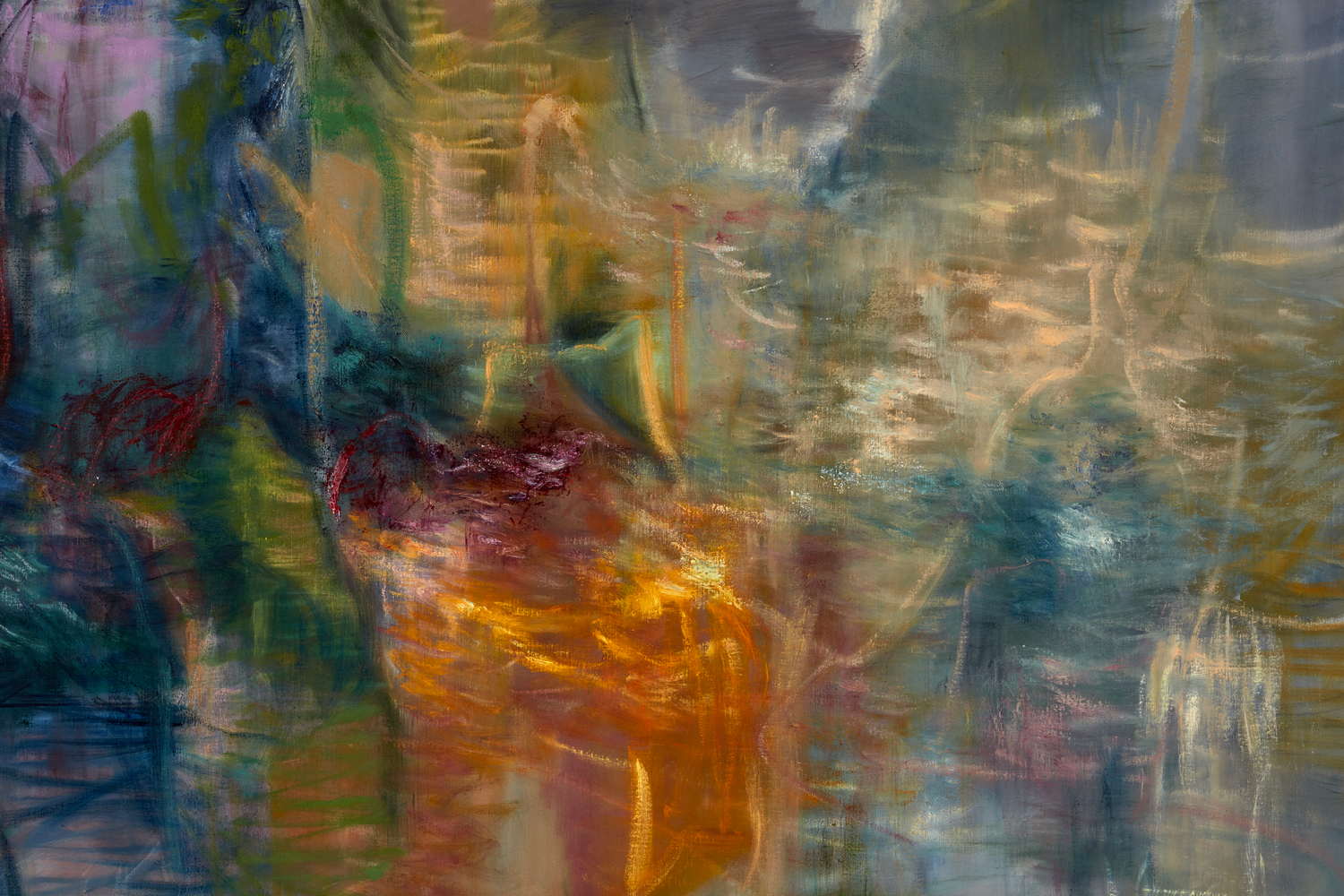
1990s: Frankenthaler’s work of the 1990s, being less well-known, is represented here by four major canvases from early in that decade. In these, she looks back again to the painterliness of Riverhead thirty years earlier, filling out these new canvases in an even more dramatic manner. As a younger artist she had said, “My pictures are full of climates, abstract climates, and not nature per se.” The titles of her canvases of the 1990s evoke extreme climatic conditions—Maelstrom (1992)— or places in which they occur—Snow Basin (1990)—or their beginning to occur—Overture (1992)— or their measurement—Barometer (1992). And Frankenthaler’s spreading and layering of stained pigment creates a richly atmospheric evocation of water and sky that ultimately looks back to Venetian painting of the sixteenth century—doing so in a highly personal manner that also points ahead to the work of the many artists who take inspiration from her today.