Ended Mar 4
Peter Halley
Jan 14 – Mar 4, 2023
More from Peter Halley on Gallop
Karma is pleased to present a solo exhibition of paintings by Peter Halley, marking his return to Los Angeles after nearly two decades.
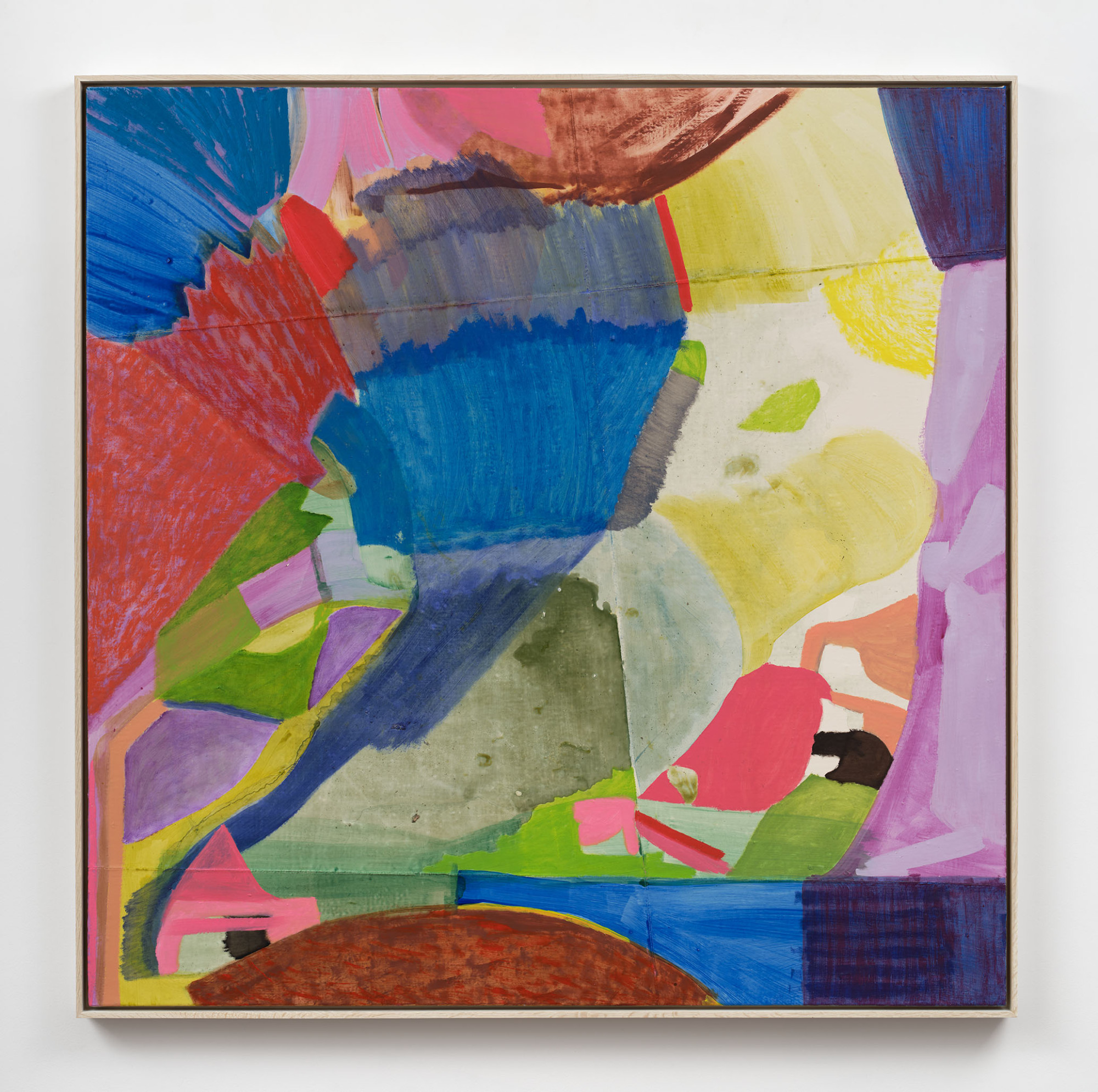
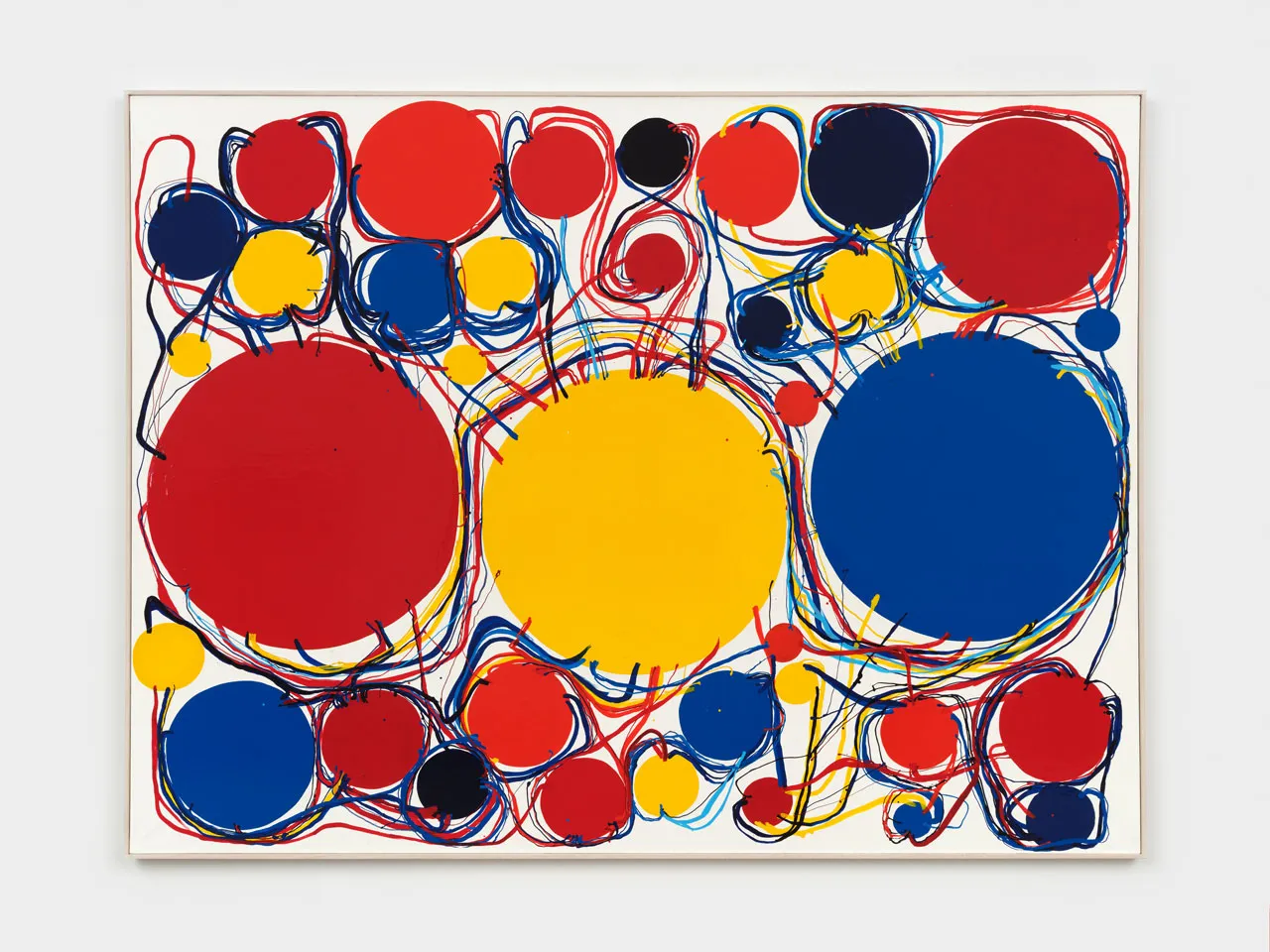
Ten new paintings by Peter Halley display the evolution of his critically-driven practice and reveal further insight into his systematic approach to abstraction, through which repeated geometric arrangements become windows into our shifting social realities.
For Halley, a system of stable elements produces unexpected outcomes. The repeated use of a closed, reductive set of forms, his “prisons” and “cells,” inform a critical strategy: one which both reassesses the implications of abstraction and maps the hidden systems of power that govern our social life. His syntax, which began as a way to respond to his social isolation in New York in the early 1980s, has been perpetually reinvented, influenced by the burgeoning digital era and Halley’s need to reinterpret his modernist precedents. Now his singular language is deployed in precarious, top-heavy compositions of conjoined canvases. Conduits that once jutted out from, crossed over, and connected his prisons and cells, have disappeared.
Over the years Halley has related to the visual elements in his paintings in contrasting ways, at times viewing them as actors on the set of an absurdist play, at other times as diagrams of our social reality. Rejecting traditional fine art materials, Halley’s paintings are coated in vibrant Day-Glo paint and Roll-A-Tex, a readymade imitation stucco used in home fabrication. In his new work, rectangular canvases have been replaced by works in which multiple canvases are interwoven, allowing individual elements to break free from their background.
In the legacy of artists such as Josef Albers, Hanne Darboven, Ellsworth Kelly, Dan Flavin, and Agnes Martin, Halley uses a limited aesthetic vocabulary to create a richly varied language. His latest work testifies to the ongoing importance of his experimentation, in which modernist abstraction is diverted from its self-referentiality and channeled into signifiers which prefigure and illuminate our social conditions.
Halley, who came to prominence as a central figure in New York’s Neo-Conceptualist movement of the early 1980s, was influenced by his childhood experience of Manhattan’s transformation into a skyscraper-dense metropolis. As he was developing his unique artistic practice in the 1980s, he also published an influential body of critical essays on art and culture. Halley served as professor and director of the MFA painting program at the Yale School of Art from 2002 to 2011. From 1996 to 2005, Halley published Index magazine, an influential platform for interviews with figures in a variety of creative fields.
Halley’s work can be found in the collections of the Museum of Modern Art, New York, New York; Whitney Museum of American Art, New York, New York; Solomon R. Guggenheim Museum, New York, New York; Broad Art Foundation, Los Angeles, California; Museum of Contemporary Art, Los Angeles, California; San Francisco Museum of Modern Art, San Francisco, California; Boston Museum of Fine Arts, Boston, Massachusetts; Dallas Museum of Art, Dallas, Texas; Albright-Knox Art Gallery, Buffalo, New York; Tate Modern, London, United Kingdom; Stedelijk Museum, Amsterdam, The Netherlands; Sammlung Marx, Berlin, Germany; Museo Nacional Centro de Arte Reina Sofia, Madrid, Spain; Museum of Contemporary Art, Tokyo, Japan; and the Seoul Museum of Art, Seoul, South Korea, among others.