
Exhibition · Nathalie Obadia
Fabrice Hyber
Habiter la Forêt
Nov 12 – Jan 23
5 images · swipe
About the show
[Scroll down for French version / Veuillez trouver ci-dessous la version française]
Galerie Nathalie Obadia is pleased to host artist Fabrice Hyber’s third exhibition, Habiter la Forêt, after Hyber Dubuffet in 2017, which took place in both Paris galleries.
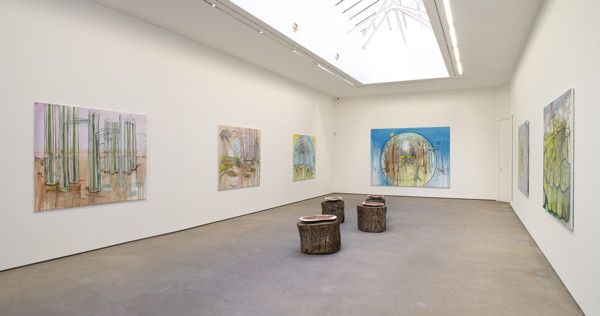
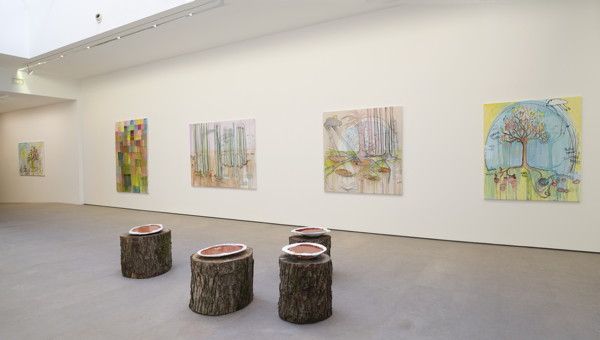
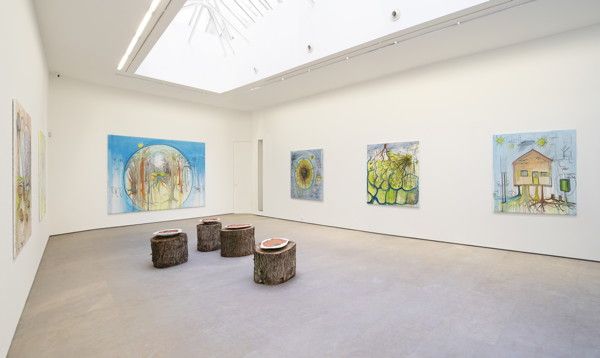
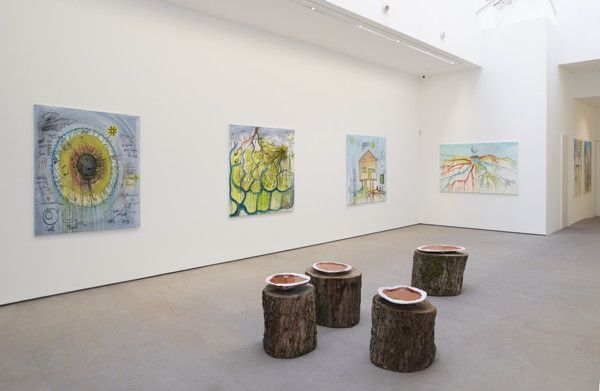
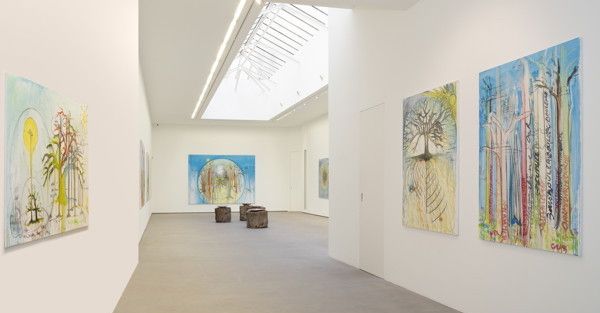
Twenty years ago, the artist began sowing 70 hectares of woods near his studio in Vendée. With this exhibition, he returns to the theme of this biotope, which is omnipresent in his work and is simultaneously subject, paradigm, utopia and life project. Through a group of recent paintings and ceramics, Fabrice Hyber examines the ties between forest and city, nature and civilization, the mutations that occur when they shift back and forth, at a time when a “return to green” is more relevant than ever.
Winner of the Golden Lion at the 1997 Venice Biennale, Fabrice Hyber has, for the last 30 years, developed an oeuvre reminiscent of a gigantic rhizome, a complex system where thought, protean activity and visual experimentation come together in a network, according to a principle of perpetual transformation and proliferation. “Most of the time, my paintings become projects. Research projects, designs for objects or even new behaviors.” Fabrice Hyber’s pictorial work cannot therefore be dissociated from the experiments and initiatives that he carries out, such as this sowing of the grounds in Vendée: resembling control panels or story boards, his paintings allow him to take stock, digest and assimilate the data and information that emerge from his research, and are visual indicators of a thought in action that transcends the canvas’s frame.
The forest is all the more central in Fabrice Hyber’s practice and in his engagements, given how the principle of germination has often served him as a template for creation and analogy. Numerous species, “man-trees,” flora, mushrooms and tentacular roots dwell in this great ecosystem that is the artist’s visual universe, where the primary concern has to do with circulation, flux, natural cycles—all brought to life by an aesthetic of scribbled observation, quick sketch and scientific intuition steeped in humor. In fact, Fabrice Hyber defines his work as being “mushroom seeds that can wait thousands of years before sprouting and spreading according to a process of uncontrollable proliferation.” Semantic and linguistic slippages, communicating vessels, underground connections and the addition and continual reuse of external objects all originate from this organic and viral abundance, which itself mimics the movement of life, where resin, serving as a binding agent, also plays the role of sap. Unsurprisingly, this “Hyber green”—borrowed mischievously from the ecologists—has become a true signature: in this intentionally joyous and artificial artist’s palette, the “Hyber green” acts as a unifying substance and a program in and of itself.
What’s more, Fabrice Hyber appropriates climate issues with an overflowing and inspired imagination that nurtures a utopic project, that of “living in a forest.” From the microcosmic transformation of the molecule that becomes an atom, to the mutation of a virgin nature into a civilization, Fabrice Hyber focuses his recent research around the tipping point. Based on the idea that a city is perhaps modeled after a forest, he weaves a parallel that generates all the thematic declinations and visual inventions that fill his work: “The rules of survival in a forest have been replaced by regulations that quickly become repression. [...] A house’s plumbing when connected to a city’s network resembles branches or roots, but also streams or springs.” Artistic intuitions and concrete actions inform each other in this project that hopes to inspire new behaviors: “The puddles can become containers, the bark an element of comfort, the clearing a garden, the foliage a roof. Over the last few months, I focused on this change of point of view, which I embraced 20 years ago by sowing a forest, and I renewed with familiar gestures or reinvented them.”
Not wanting to live in conflict with the world, Fabrice Hyber advocates, instead, a positive and fertile ecology, one that is open and favorable to change, just like his work, which he built around the happy assimilation of diverse mutations. This enthusiasm is apparent in everything he makes and he sets it as a rule of conduct: “I think that a real ecology is truly generous rather than nostalgic and dried out, why not the artifice of a very sophisticated, refined construction.”
*****
La Galerie Nathalie Obadia est heureuse d’accueillir la troisième exposition de l’artiste Fabrice Hyber, Habiter la forêt, après Hyber Dubuffet en 2017 qui investissait les deux galeries parisiennes.
L’artiste, qui a entrepris de semer depuis vingt ans 70 hectares de forêt à proximité de son atelier en Vendée, revient sur le thème de ce biotope omniprésent dans son travail, à la fois comme sujet, paradigme, utopie et projet de vie. À travers un ensemble de peintures et de céramiques récentes, Fabrice Hyber s’intéresse aux rapports entre forêt et ville, nature et civilisation, aux mutations qui surviennent de l’une à l’autre et inversement, à l’heure où le « retour au vert » sonne plus actuel que jamais.
Lauréat du Lion d’Or de la Biennale de Venise en 1997, Fabrice Hyber développe depuis 30 ans une œuvre à l’image d’un gigantesque rhizome, véritable système où pensée, activité protéiforme et expérimentation plastique fonctionnent en réseau, selon un principe de transformation et de prolifération perpétuels. « Mes tableaux, la plupart du temps, deviennent des projets. Des projets de recherches, des projets d’objets, ou encore des projets de nouveaux comportements. » L’œuvre picturale de Fabrice Hyber ne peut ainsi être dissociée des expériences et initiatives qu’il entreprend à l’instar de cette semaison sur les terres vendéennes : conçues comme des tableaux de bord ou des story boards, ses peintures permettent de faire le point, de digérer et assimiler les données et informations issues de ses recherches, témoins visuels d’une pensée en action qui dépasse le strict cadre de la toile.
La forêt est d’autant plus centrale dans la pratique de Fabrice Hyber et dans ses engagements que le principe de germination lui a très souvent servi de modèle de création et d’analogie. Nombre d’espèces, « d’hommes arbres », de végétaux, de champignons et de racines tentaculaires peuplent ce grand écosystème qu’est l’univers plastique de l’artiste, où il est avant tout question de circulation, de flux, de cycles naturels – le tout matérialisé par une esthétique de l’observation griffonnée, du croquis rapide, de l’intuition scientifique, non dénuée d’humour. Fabrice Hyber définit en effet son œuvre comme « les graines de champignon qui peuvent attendre des milliers d’années avant de germer et de se répandre selon des processus de prolifération incontrôlable ». Glissements sémantiques et linguistiques, vases communicants, connexions souterraines, ajout et réutilisation continuelle d’objets extérieurs procèdent de ce foisonnement organique et viral à l’image du mouvement de la vie, où la résine, servant de liant, apparait comme une sève. Rien de surprenant à ce que le « vert Hyber » soit devenu une véritable signature, empruntée avec malice aux écologistes : dans la palette de l’artiste volontairement joyeux et artificiel, il agit comme une substance unifiante et un programme en soi.
Aussi Fabrice Hyber s’approprie les enjeux climatiques avec une fantaisie débordante et inspirée qui nourrit un projet utopique, celui « d’habiter la forêt ». De la transformation microcosmique de la molécule devenant atome, à la mutation d’une nature vierge en civilisation, Fabrice Hyber axe ses recherches récentes autour du point de bascule. Selon l’idée que la ville est peut-être construite sur le modèle de la forêt, il tisse un parallèle générant de multiples déclinaisons thématiques et inventions visuelles dont regorgent son travail : « Les règles de survie de la forêt ont été remplacées par des règlements qui se transforment en répression. (...) Les tuyauteries d’une maison connectée aux réseaux de la ville s’apparentent aux branches ou aux racines mais aussi aux ruisseaux ou aux sources. » Intuitions artistiques et actions concrètes s’instruisent dans ce projet qui entend inspirer de nouveaux comportements : « Les flaques peuvent devenir des contenants, les écorces des éléments de confort, la clairière un jardin, la frondaison un toit. (...) Ces derniers mois, je me suis concentré sur ce changement de point de vue que j’ai déjà engagé il y a plus de 20 ans en semant une forêt, retrouver des gestes ou les réinventer. »
Contre un rapport conflictuel au monde et à l’image de son œuvre construite selon l’assimilation heureuse de mutations diverses, Fabrice Hyber défend une écologie positive et féconde, ouverte et propice au changement. Un enthousiasme qui transpire de chacune de ses œuvres et qu’il érige en règle de conduite : « Je pense qu’une réelle écologie est véritablement généreuse et non pas nostalgique et asséchée, pourquoi pas l’artifice d’une construction très sophistiquée, raffinée ? »
About Nathalie Obadia
Since the opening of the first gallery in Paris in 1993, followed by the one in Brussels in 2008 and a second space in Paris in 2013, Nathalie Obadia has exhibited emerging and recognized artists of the international contemporary art scene. In the fall of 2021, Galerie Nathalie Obadia has opened...
More about Nathalie Obadia →