Ended Feb 27
Jean-Luc Blanc
Dec 4, 2020 – Feb 27, 2021
More from Jean-Luc Blanc on Gallop
[Scroll down for French version / Veuillez trouver ci-dessous la version française]
On a window ledge in his studio, the hand of a zombie clutches onto flowers. This suits him, he who voluntarily borrows details from B movies and imprints them into his memory when he narrates them to me. Like that of the house in the inland regions of Nice where several televisions are stacked on top of one another. Every sunday night, he turns them on to watch the same film. I imagine the walls of a mountain chalet, the branches of the trees tapping the windows, somber corridors with old carpet, the flickering of the blue light of an old television set, a young boy in pyjamas, his eyes closed, his two hands pressed against the screen. The village is not built on a cemetery, but the dead need a good enough reason to take revenge. In 1926 they hurtled down the hill to destroy the village.
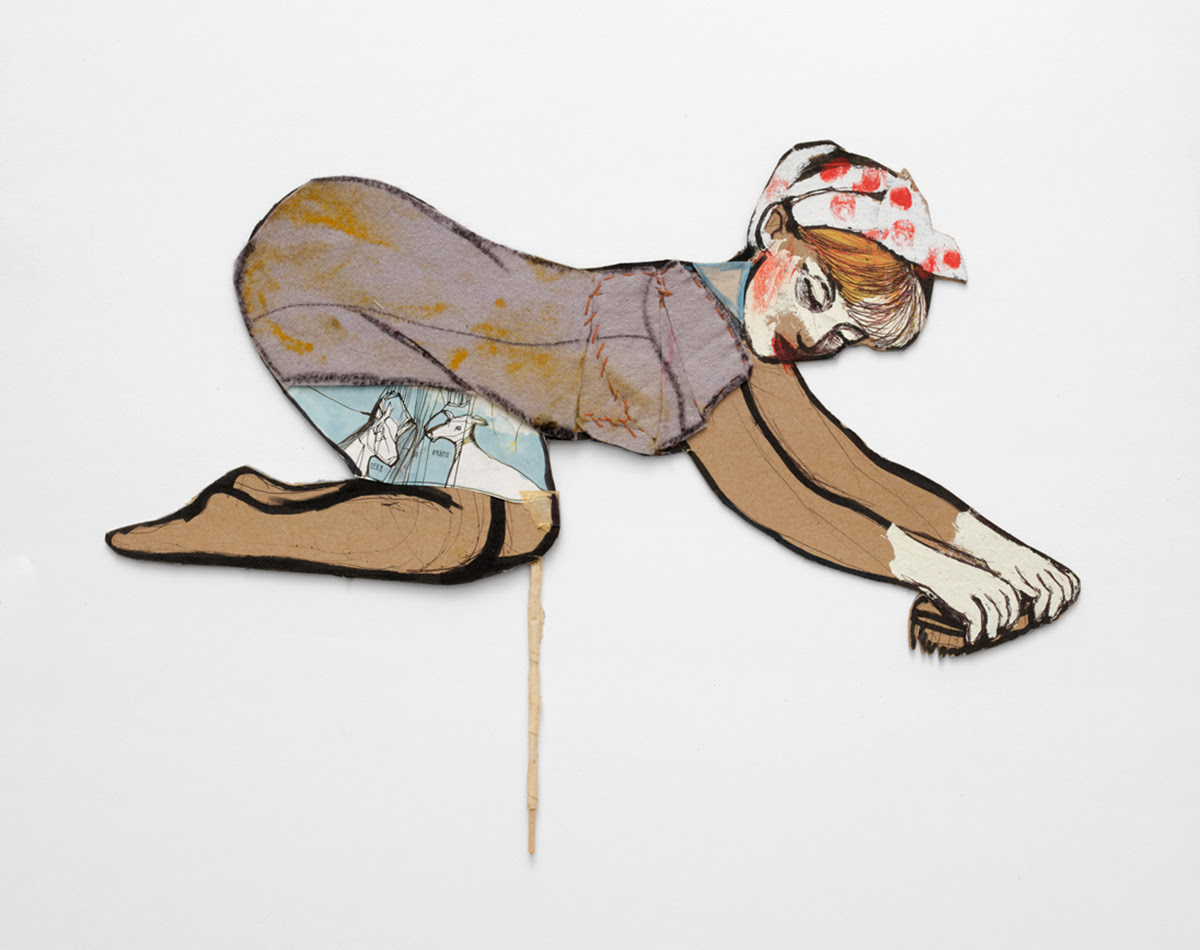
He starts by cutting out photos from magazines. He classifies them and piles them up against a mirror. Then he chooses some which he assembles in laminated folders, a big bath of liquid where images bleed onto each other. Later he quickly paints them, with just enough shortcuts for the image to become concrete. A bride who is taken from a Daniel Schmidt film, a couple of men whose outrageous makeup and silver neck ruffs could make them the heroes from Mario Bava’s Planet of the vampires, Marianne Faithfull’s face, whilst it could still be that of many others.
He hangs them in his studio much like in an exhibition. Like the poster of a face that a teenager would hang up without knowing anything about the person. Like putting a lamp in a room imagining it’s filled with positive energy to take in. To keep oneself company. To manifest one’s desire to change. They remind me of the pleasure one feels when leaving the cinema, whilst we renegotiate the memory we made of a film. They make material life acceptable by helping to think of the present as a bygone era; and nostalgia blends naturally with one’s perception of immediate things.
Michael Powell and Emeric Pressburger’s Colonel Blimp, tells itself and certainly better than me the idea I have of the emotional intelligence of Jean-Luc Blanc’s paintings.
In 1902, two officers, one German (Anton Walbrook), and the other British (Roger Livesey), get into a battle in a glass gymnasium for the honor of their nation whilst outside, in the snow, Edith (Deborah Kerr) a woman that they met a few hours earlier, is waiting for them. The two men end up leaving safe and sound and spend a few days with her during which they form asymmetrical affections for her which will link them for the rest of their lives. Just before saying goodbye, Edith accepts to marry Walbrook. She would have preferred the affection of the colonel, but he only shows her a frank and military camaraderie. Only once back in England and alone does he realise that the memory of this meeting, as brief as it was, would never leave him. And so the regret of not having been able to see soon enough that he loved her becomes inseparable from his memory of Edith.
Twenty years go by before the two men meet again in England, in a prison camp where Anton Walbrook is retained after the defeat of the Germans. When he returns to England to escape Hitler in 1935, Edith is dead. Barbara, the colonel’s wife, is also dead. The two men have aged. The colonel admits then to his friend what he would never have been able to guess on his own. That he has never forgotten Ediths face and her first apparition in her Marie Stuart costume, her brown collar, her red hair tied in a bun, her mouth hardened by her lipstick. That all his life, he devoted it to recovering the memory of her face in the women he met. He takes him into the living room where the portrait of Barbara overlooks the fireplace, lost in the middle of some hunting trophies. Walbrook then discovers what we already know. She is entirely similar to Edith since she is also personified by Deborah Kerr. Walbrook points out to the colonel that he saw Edith grow old when he married a woman twenty years his junior to keep the image intact, unaltered, of the young girl who had kissed him before leaving the military hospital. The two men are separated and Blimp offers his friend the services of his chauffeur. The car moves in the dark. Walbrook and the young officer speak without being able to observe each other. When she finally turns towards him, the red glow of the traffic light at which they stop makes appear in backlighting, and for the third time, the red and juvenile face of Deborah Kerr. He thinks it’s a mirage and asks her name. “Angela.” “That’s a lovely name. It comes from angel, doesn’t it? “ “Yes. But I think it stinks. My friends call me Johnny.”
—Baptiste Pinteaux
*****
Sur le rebord de la fenêtre de son atelier, la main d’un zombie tient entre ses doigts des fleurs. Ça lui va bien, lui qui emprunte volontiers des détails de films de série B pour les greffer à ses souvenirs quand il me les raconte. Comme celui de cette maison dans l’arrière-pays niçois où des dizaines de télévisions sont entreposées. Chaque dimanche soir, il les allume pour regarder le même film. J’imagine les murs d’un chalet de montagne, les branches des arbres qui cognent aux vitres, des couloirs sombres tapissés de moquette usée, le grésillement et la lumière bleue d’un vieux téléviseur, un garçon en pyjama, les yeux fermés, les deux mains plaquées sur l’écran. Le village n’est pas construit sur un cimetière, mais les morts doivent avoir une bonne raison de se venger. En 1926, ils ont dévalé la colline pour raser le village.
Il commence par découper des photographies dans des magazines. Il les classe et les empile face à un miroir. Puis il en choisit certaines qu’il assemble dans des classeurs plastifiés, un grand bain liquide où les images déteignent les unes sur les autres. Plus tard, il les peint rapidement, avec juste assez de raccourcis pour que l’image devienne consistante. Une mariée sortie d’un film de Daniel Schmidt ; un couple d’hommes dont le maquillage outrancier et les collerettes argentées pourraient en faire les héros de La Planète des vampires de Mario Bava ; le visage de Marianne Faithfull quand il pouvait encore être celui de beaucoup d’autres.
Il les accroche dans son atelier comme dans une exposition. Comme le poster d’un visage qu’un adolescent suspendrait sans rien savoir de lui. Comme on met une lampe dans une pièce en imaginant qu’elle est chargée d’une énergie bonne à prendre. Pour se tenir compagnie. Pour manifester son désir de changer. Ils me rappellent le plaisir éprouvé en sortant d’un cinéma, lorsqu’on renégocie en plein jour le souvenir que l’on s’est fait d’un film. Ils rendent la vie matérielle acceptable en aidant à penser le présent comme une époque révolue ; et la nostalgie se fond naturellement avec la perception qu’on se fait des choses immédiates.
Colonel Blimp, de Michael Powell et Emeric Pressburger, raconte de lui-même et certainement mieux que moi l’idée que je me fais de l’intelligence sentimentale des tableaux de Jean-Luc Blanc. En 1902, deux officiers, l’un allemand (Anton Walbrook), l’autre britannique (Roger Livesey), se battent en duel dans un gymnase en verre pour l’honneur de leur nation quand dehors, sous la neige, les attend dans une calèche Edith (Deborah Kerr), une femme qu’ils ont rencontrée quelques heures plus tôt. Les deux hommes s’en sortent sains et saufs et passent avec elle quelques jours durant lesquels se cristallisent les affections asymétriques qui les lieront pour le reste de leurs vies. Sur le point de se dire adieux, Edith accepte d’épouser Walbrook. Elle aurait préféré l’affection du colonel, mais il ne lui témoigne alors qu’une camaraderie franche et militaire. Il lui faudra se retrouver seul en Angleterre pour comprendre que jamais le souvenir de cette rencontre, aussi brève a-t-elle été, ne le quittera plus jamais ; et pour que devienne indissociable de son souvenir d’Edith le regret de ne pas avoir su voir assez tôt qu’il l’aimait.
Vingt années passent avant que les deux hommes se retrouvent en Angleterre, dans un camp de prisonniers où Anton Walbrook est retenu après la défaite des Allemands. Quand il retourne en Angleterre pour fuir Hitler en 1935, Edith est morte. Barbara, la femme du colonel, est morte aussi. Les deux hommes ont vieilli. Le colonel avoue alors à son ami ce qu’il n’a jamais su deviner seul. Qu’il n’a jamais oublié le visage d’Edith et sa première apparition dans son costume de Marie Stuart, son col lavallière, ses cheveux roux attachés en chignon, sa bouche durcie par le rouge à lèvres. Que toute sa vie, il l’a consacrée à retrouver le souvenir de son visage chez les femmes qu’il rencontrait. Il l’emmène dans le salon où le portrait de Barbara surplombe la cheminée, perdu au milieu de ses trophées de chasse. Walbrook découvre alors ce que nous savions déjà. Elle est en tout point similaire à Edith puisqu’elle est aussi incarnée par Deborah Kerr. Walbrook fait remarquer au colonel qu’il a vu vieillir Edith quand lui a épousé une femme de vingt ans sa cadette pour conserver l’image intacte, inaltérée, de la jeune fille qui l’avait embrassé avant de quitter l’hôpital militaire. Les deux hommes se séparent et Blimp propose à son ami les services de son chauffeur. La voiture roule dans l’obscurité. Walbrook et le jeune officier discutent sans pouvoir s’observer. Quand elle se retourne enfin vers lui, la lumière rouge du feu auquel ils se sont arrêtés fait apparaître en contre- jour et pour la troisième fois le visage roux et juvénile de Deborah Kerr. Il pense à un mirage et lui demande son nom. « Angela. » « That’s a lovely name. It comes from angel, doesn’t it? » « Yes. But I think it stinks. My friends call me Johnny. »
—Baptiste Pinteaux