Ended Nov 4
Camille Hoffman
Rockabye My Bedrock Bones
Sep 21 – Nov 4, 2018
More from Camille Hoffman on Gallop
False Flag proudly presents Camille Hoffman’s first solo New York gallery show — Rockabye My Bedrock Bones.
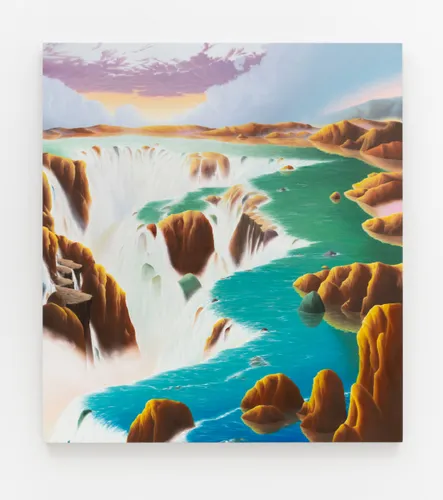
Beachcombers, a 1956 painting by Hoffman’s late grandmother, hangs at the show’s heart — in acknowledgement of its role as the exhibition’s catalyst. As Hoffman puts it: “I developed this installation thinking about both my body and my landscapes as vessels of creative inheritance.” With her grandmother, Shoshannah (1921-1998), as lodestar, Hoffman reconfigures the gallery into a site of personal archaeology, expanding her landscape work in a matrilineal excavation. This conceptual approach is most strikingly applied to the previously all-white gallery walls: painted “the colors of my skin throughout the seasons and under varying degrees of light and pressure, to match the sand in Shoshannah’s painting and the papers, plastics, paints of my landscapes.” These paintings cover over 3,000 square feet of wall-space in a striated palette of browns, olives, and peaches. Enfolded in an infinite, fleshy ground, “the space wears you,” as Hoffman says. Her topographical paintings read as birthmarks, extending and punctuating the tones and textures of the walls. While honest, the work is never obvious: running across the gallery floor, Hoffman forms her “dunes” from the actual tarps used in painting the walls. Detritus is not simply relocated, nor is the show a literal facsimile: there are no props, no gimmicks.
For Hoffman, “this show is an exploration of my landscape work as a form of creative and biological unearthing—an interior reinvention and reconfiguration of past ruins.” In a 1956 issue of Art in America, Shoshannah stated: "Painting, to me, is an extension of living, and interwoven into the life process, not a thing apart from it." Just as her grandmother—born Susannah S. Siporin in 1921—refashioned fragments of her given name to forge an identity of her own, adopting Shoshannah in 1943—Hoffman repurposes the physical substance of her life to similar effect. “Disposable things take on different meaning when one separates an object from its market value,” Hoffman explains. “How do I create value? Personal value, economic value—how do I support myself? I have to be resourceful. Everything matters.” By “laying claim to the space,” Hoffman forms a new economy: one in which material is measured by its inherent physical properties—a particular color, transparency, texture, visual effect or structure—rather than its transactional worth. The overlooked becomes valuable; the seemingly discardable earns respect. Hoffman’s bracingly honest approach reflects a fundamental aim of her practice: the reclamation of agency through confrontation and acknowledgement of her everyday experience.
Grounded in accumulation, personal narrative, and historical critique, Hoffman describes her practice as “a ceremony of reconfiguration and critical reflection on the themes of diaspora, domesticity, and disposability.” Composing her work with material collected from her daily life, Hoffman’s media range from medical records, credit card offers, calendars, plastic bags, tablecloths, found photos, maps, to paint. Hoffman draws on her family’s creative legacy, along with traditional painting techniques from her academic training, employing resonant visual and historical references: Philippine weaving, Jewish folk traditions, and influential American landscape paintings of the 19th century. Recontextualizing these figurative, nostalgic, and abstract cultural fragments, Hoffman forms layered, richly-textured geographies, charting new territory that is at once surreal and familiar.
Camille Hoffman (b. 1987, Chicago, IL) earned an MFA from Yale University (2015), a BFA from California College of the Arts (2009), and was a recipient of the Carol Schlosberg Memorial Prize for excellence in painting from Yale University, a National Endowment for the Arts scholarship, a Benjamin A. Gilman International Scholarship for research in Spain, and the Van Lier Fellowship from the Museum of Arts and Design (MAD). She has exhibited throughout the United States and Europe: Pieceable Kingdom at the Museum of Arts and Design, New York, NY (2018), Lincoln Center, New York, NY (2017), Times Square, New York, NY (2017), Yale University Art Gallery, New Haven, CT (2015), Nuit Blanche arts festival, Paris, France (2015), and Espai Cultural Biblioteca Azorín, Valencia, Spain (2008), among others. Hoffman has been an artist-in-residence in numerous programs, including Wave Hill in the Bronx (2017), QueenSpace in Long Island City (2016-17), and the Museum of Arts and Design, New York (2017). She has worked for over a decade as an arts educator and community organizer in Phoenix, the San Francisco Bay Area, New Haven, Brooklyn, and Queens. Hoffman currently lives and works in New York.