Ended
Three Exhibitions
May 18 – Aug 12, 2023
James Gortner
Meri Karapetyan
Eiko Nishida
—
James Gortner: Terra Incognita
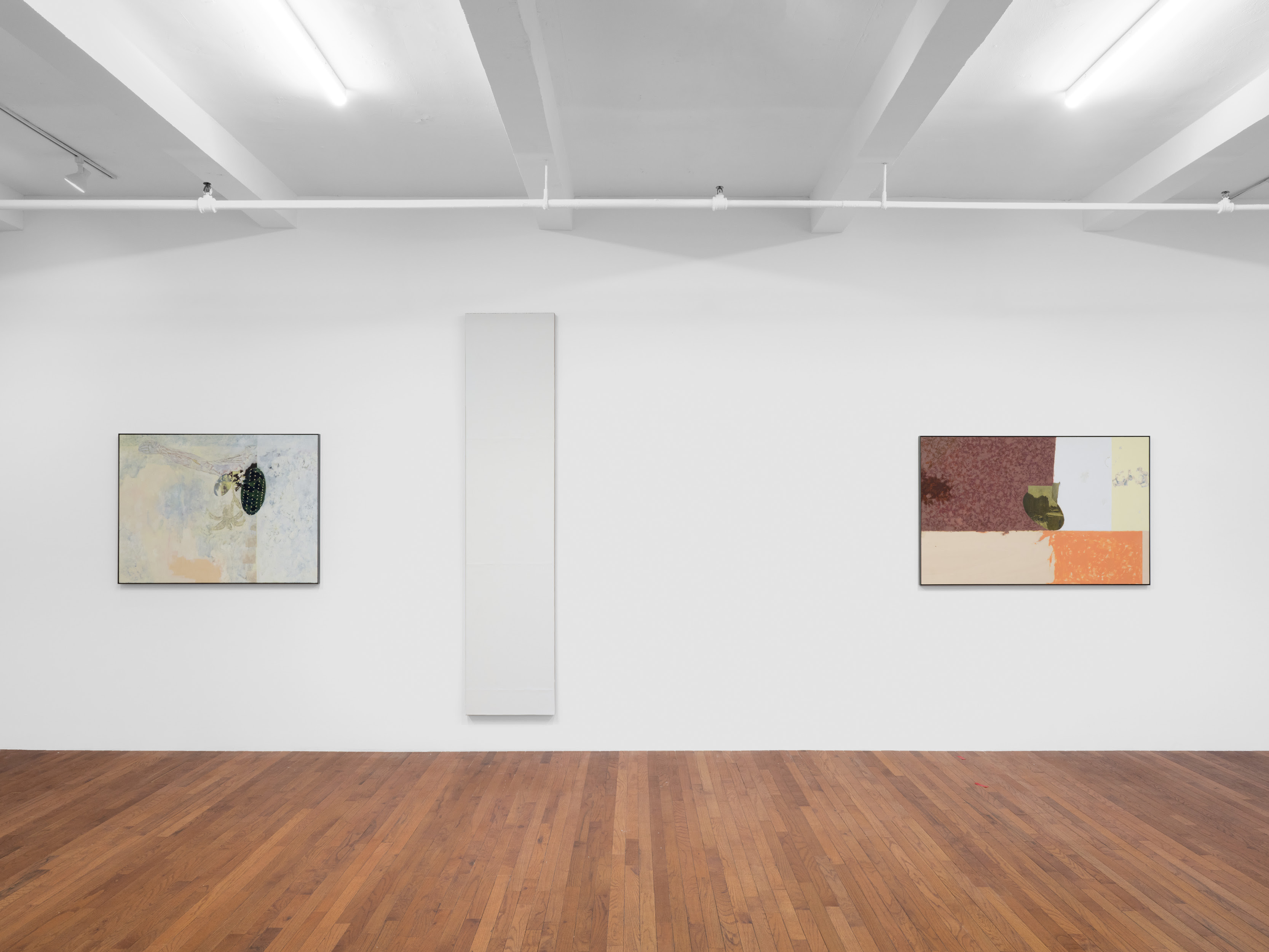
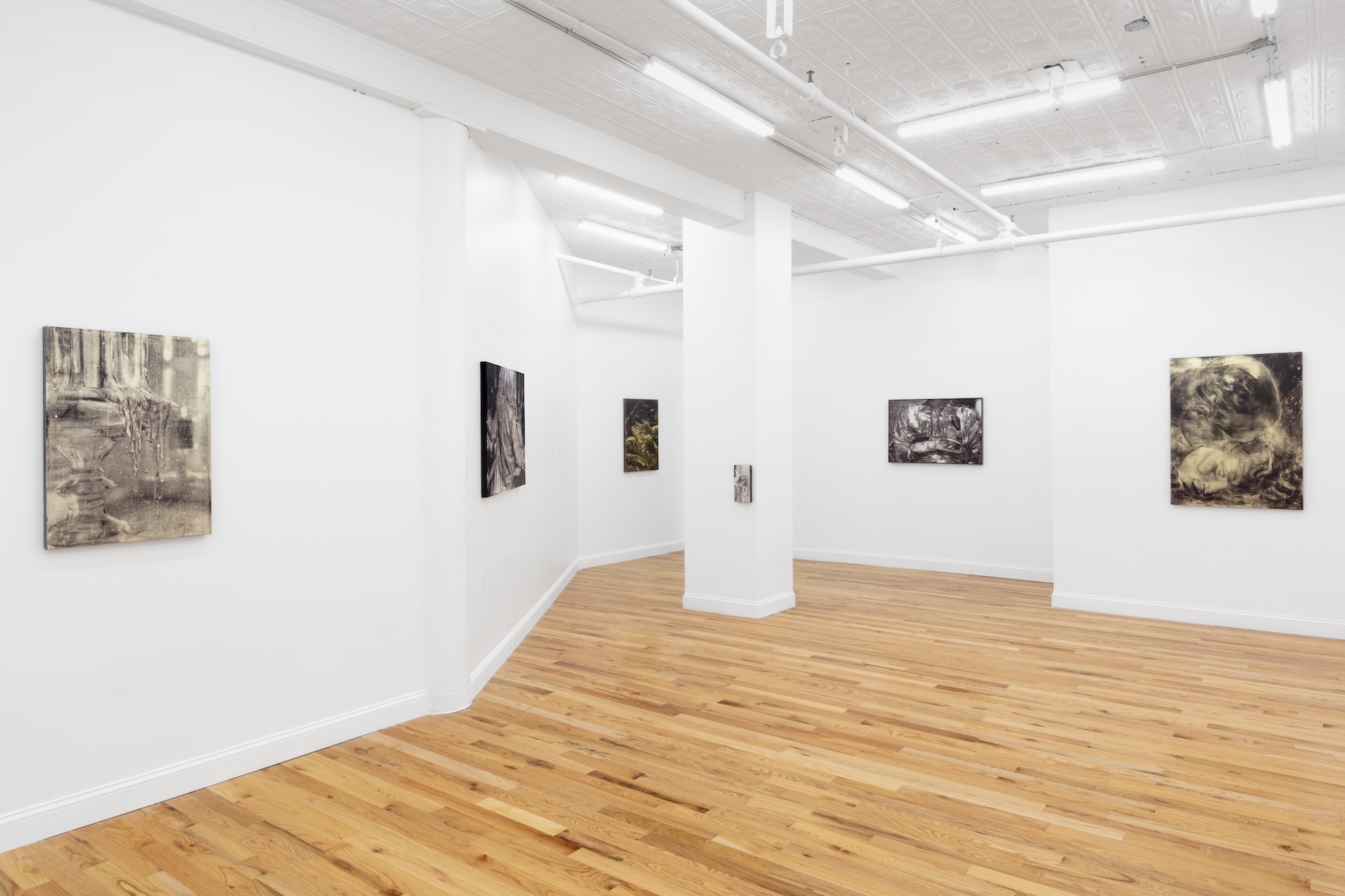
Atamian Hovsepian Curatorial Practice is pleased to present Terra Incognita, an exhibition of twelve paintings by James Gortner.
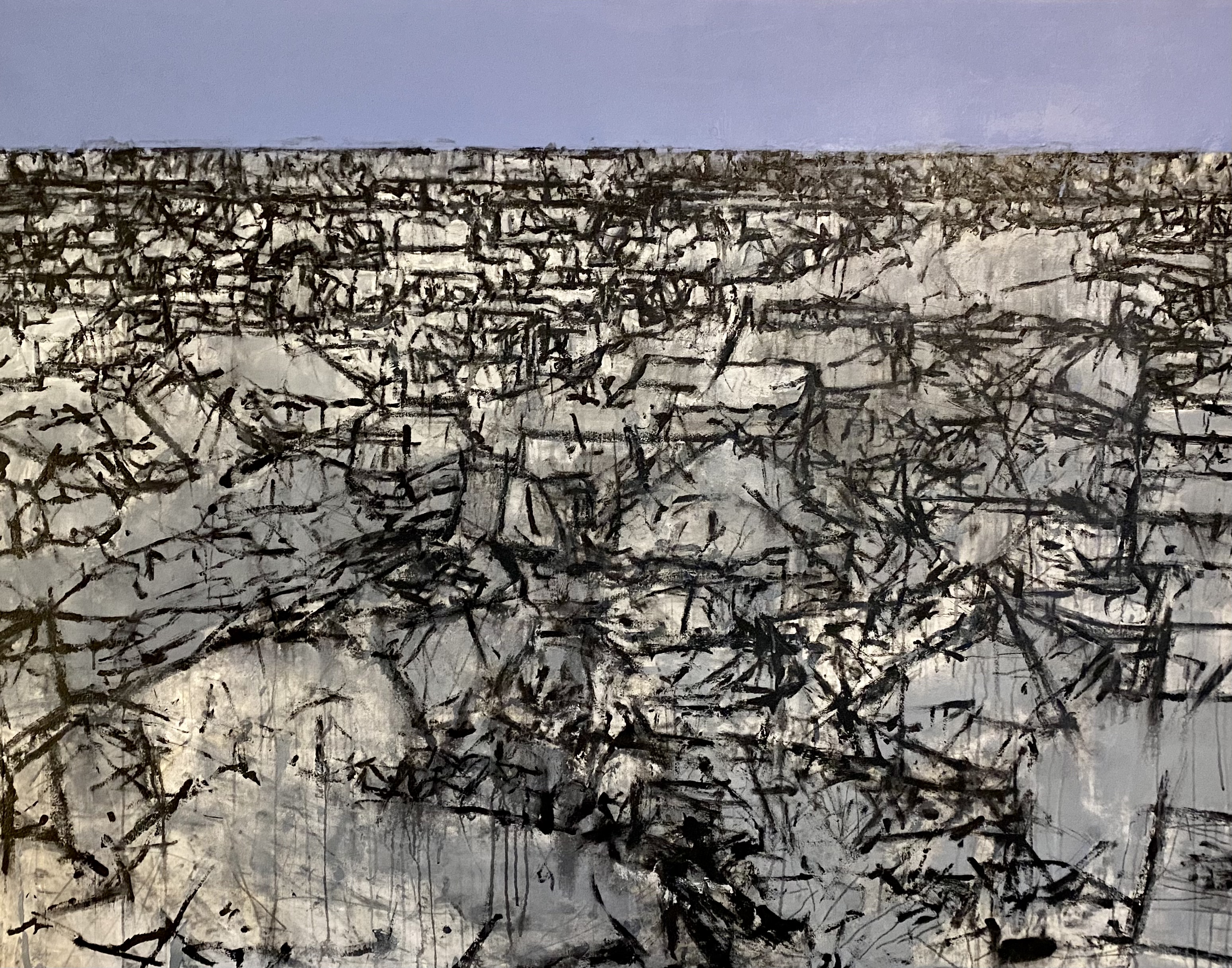
Each of Gortner's works, created from reclaimed paint, embodies a range of artistic expression, including abstract and conceptual art. His work challenges conventional notions of permanence and self-determination and draws inspiration from existing myths, dreams, conflicts, and moods. Gortner’s use of reclaimed paint along with his inventive painting techniques, place him squarely in the camp of environmental futurism. By imagining a radically different relationship to the Earth, Gortner and other like-minded artists affirm that their work possesses meaning above and beyond purely aesthetic considerations.
The paintings currently on view belong to an ongoing series that reflect Gortner's personal journey. When Gortner was forced to leave his studio in 2016 and could no longer create there, he decided that he would take the studio with him. He reversed onto his canvas everything from the topmost drywall, flooring paint, wood veneer, footprints, loose brush bristles, down to the trace gouges in the floor. In the process he kept a record of his history in the space while tearing away its last remaining elements. Having taken the working process outside the studio and into the world, this invention born of personal disruption has become a gift that Gortner revisits in his practice to this day. Out of chaos and destruction, came transformation.
In Terra Incognita, Gortner's works take on a heroic scope, reminding us of Rorschach tests and seemingly random water stains on which we can project our own stories. They also form rudimentary maps of uncharted lands and unfamiliar contents - each a terra incognita, like our own subconscious. The paintings are both playful and intellectually engaging, reflecting on the strength of tradition over time and life's undercurrent of constant restructuring.
James Gortner received his B.A. from Hawaii Pacific University and his MFA from Columbia University. Gortner’s work has been exhibited at The Fisher Landau Center for The Arts (New York), Mana Contemporary (New Jersey), San Bernardino County Museum (California), RW Norton Art Gallery (Louisiana), The LeRoy Neiman Gallery (New York), Lyons Wier Gallery (New York), Fernando Luis Alvarez Gallery (Connecticut), and Dittrich & Schlichtum Gallery (Berlin). His work has been featured in print in New American Paintings (North East Edition), New American Art Collector Magazine, Men’s Journal, and the Berliner, among other publications. His artwork is included in the collections of the Eileen S. Kaminsky Family Foundation, Jimenez-Colon Collection, and the Wooster Collective as well as the private collections of President Jiang Zemin of China and actress Reese Witherspoon, among others. James Gortner lives in New York.
—
Meri Karapetyan: հայհայ
Atamian Hovsepian Curatorial Practice is pleased to present recent works by Meri Karapetyan. This is the artists’ first exhibition in New York City.
Georges Didi-Huberman writes that the artist is an inventor of places, that he walks on the edge of borders, crosses them, shapes them, gives flesh to improbable, impossible, and unthinkable spaces. Karapetyan turns to any material, medium, space, and time, trying to commit to the process of border crossing, deconstruction, redefinition, and re-quotation. Karapetyan notes: “It seems that each type of border blends so naturally with what surrounds it that I am no longer able to completely separate these processes, overcome or understand the differences.” It is here that the work of border disarmament and deconstruction finds its expression in art. Indeed, the work of art itself can fulfill this mission because it is not subject to any limits or definitions – it is independent of all existing borders and barriers.
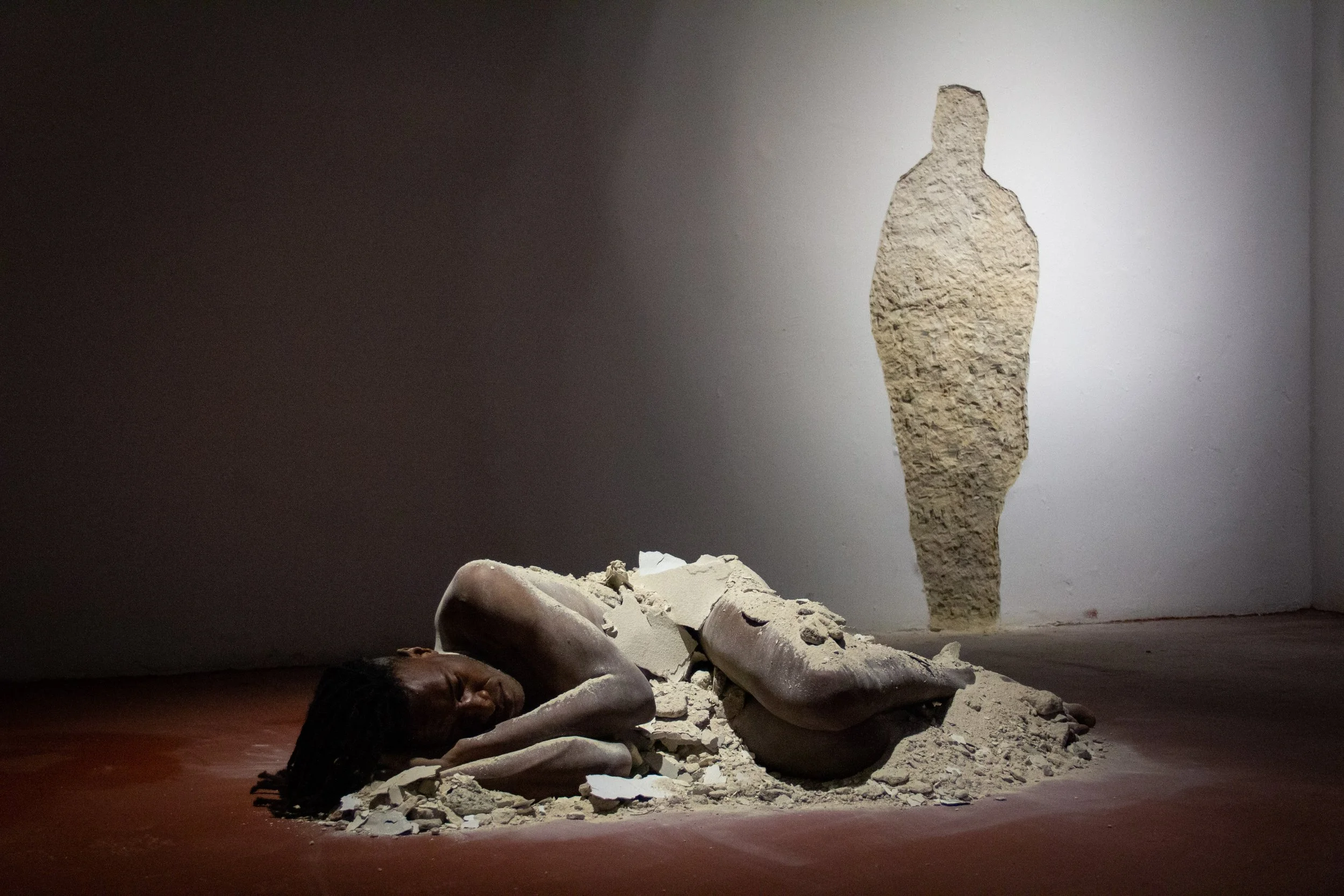
The site-specific installations presented are Mari Karapetyn’s latest works, titled “հայհայ” series. Karapetyan multiplies the word “հայ” or “Armenian,” bending it in two different directions, into the shape of barbed wire, which in turn questions the many manifestations of the border. Using the word “Armenian” as a sign, she raises several semiotic, cultural, and identity-related issues. Using a fine copper wire and some rolled gauze to print the word “հայ,” she frees the word from sentence and context, weaving a web, connecting hundreds of “հայ”s, thus erecting a barrier. The latter is passable and fragile, touchable, and interactive, and the shadows of the metal letters once again create an imitation of a barrier, as if they both exist and do not exist…
Unlike the “Copper Mesh,” the “Wall” is made of medical gauze, produced in Armenia. By transporting the bins from Armenia to Paris, and then from Paris to New York, the artist plays with the ideas of mobility and non-stability of the border, which is mutable and displaceable.
The half-demolished bandage wall, its lettering printed with a stamp, speaks simultaneously of pain and healing, of a wall that can also be passed (to cross, to pass), of barbed wire and an Armenian cruciform knot. By creating a “space within a space” and using the installation to create a border, Karapetyan explores ideas about borders and their function within physical and conceptual spaces. For Karapetyan, site-specific installations are not only a way of engaging with space but also a way of exploring the relationship between physical and conceptual boundaries.
Meri Karapetyan is a graduate of Yerevan State Academy of Fine Arts, she is currently pursuing her MFA at the University of Sorbonne in Paris. Her current series “Recollected Borders” problematizes the notion of the border itself. Karapetyan “conjugates” the border as if it were a verb, examining the border from a wide variety of angles ranging from the physical to the psychological and metaphysical. She thus deconstructs the notion of borders –from everyday borders that we experience in almost every aspect of our daily lives to the borders between states and nations: “What else, if not the artwork itself, is meant to deconstruct the notion of the border? Isn’t art the only way to “disarm” that notion…(and) eventually take up the primary role of the border defining the undefinable.” As she mentions in her artist’s statement in a nod to Richard Serra, her artwork “speaks the languages of space.” Karapetyan’s brilliant appropriation of barbed wire in Blossomed Barbed Wire–wherein delicate black flowers take the place of the barbs themselves–are also a nod to her native Armenia’s troubled geopolitical situation.
—
Eiko Nishida: Present Moment
Atamian Hovsepian Curatorial Practice is pleased to present Present Moment, a one-day experience with an audience-engaged installation by Eiko Nishida. The performance features a special guest speaker, Reverend Cheryl Ikemiya from the New York Buddhist Church, who leads everyone on a participatory experience–Walking Meditation. The work completes itself with the audience’s participation, and it invites you to wonder about interdependence and perception in a unique space for being and meditation.
In Buddhism, a mandala is used to focus attention on practitioners and create a sacred space. This mandala comprises circular patterns of lotus petals, which signify the flower that rises through the mud to bloom. It can resonate with all the events we experience as audiences scatter petal-shaped papers in order to complete the work. Although Nishida has been a Buddhist since she was little, this aspect of her life was so innate that she did not recognize it as such. Being present at the moment is one of the core teachings of Buddhism. Nishida uses mundane but intimate material, newspapers, to make a mandala that embodies an accumulation of continuous being.
The work represents not only summed-up time but also an event and information that poses the question: What is the meaning of being at this particular, precious moment? You may imagine a myriad of time fragments from the past in the form of the numerous pages of the newspapers themselves, but the moment that you see and experience the artwork, it becomes very much a part of the present.
Reverend Cheryl Ikemiya will be conducting a participatory audience experience, namely the Walking Meditation around Nishida’s mandala work. Following this, she will share a short story from the Dharma teachings, and then audience members will share their thoughts as of today—at that precise moment in space and time. Everyone is welcome.
Eiko Nishida is a site-specific installation artist and a social practitioner. Her installations are activated along with stakeholders in the venues where she works; they are often audience-engaged work. Nishida holds a Master's degree in Fine Arts from Hunter College, CUNY, in New York (2023) and a Bachelor's in Chemistry from Shimane University in Shimane, Japan (1998). Her work has been shown internationally, including Singapore Art Book Fair (2014, Singapore), Gallery idm (2013, South Korea), and Aichi Expo (2005, Japan), and featured by several publications globally, including Hyperallergic (2023, U.S.), Afterglobe, (2014, Singapore), EFX Art & Design (2004, Sweden), among many others.