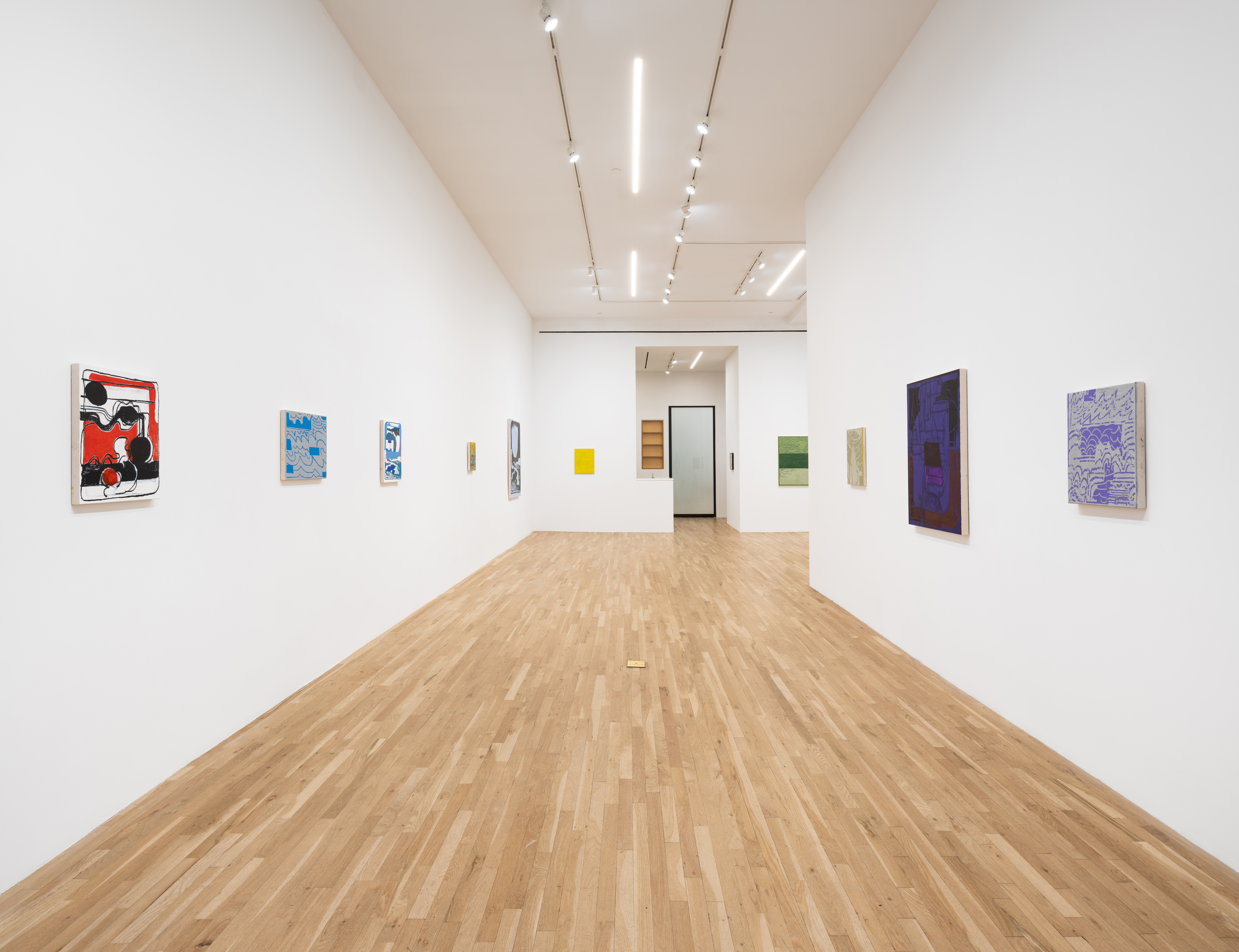
Ended Jun 19
Devin Troy Strother
Smoking and Painting
May 22 – Jun 19, 2021
More from Devin Troy Strother on Gallop
Smoking and painting are two addictions that I’ve maintained for the last thirty years or so. I’ve been drawing since I can remember, but five years old is about when I started painting. Smoking came later.
Sometime around the beginning of 2019, I began to make major changes in my work. There were three aspects of my paintings I was seeking to deviate from, not abandon in any way, but to subvert these qualities of my work that I had been accustomed to using when approaching how to make an image.
The first major change was to make what I call “just a painting.” That is, an image that didn’t utilize my signature cutouts—pieces of watercolor paper painted and cut into the shapes of various figures, animals, and other objects that occupy the work’s surface. Using some of the foundational techniques I learned in art school, I started working from a “master painting.” Not an Old Master painting in the traditional sense, but instead chose Philip Guston's painting Talking from 1979. Beyond its literal depiction of smoking and painting, the work contained everything I wanted to explore, and felt especially topical when coupled with his recent “canceling” for his depiction of hooded Klansmen. But besides that, I wanted to work on hands, as they are the hardest part of the body to render and were becoming a central theme in a lot of the paintings coming out of my studio at the time. Using the hand as a vehicle for my two addictions (smoking joints and swishing around a paint brush) I adopted Guston’s composition, substituting his pale, pinkish hand with my own.
With regard to the sculptures in the show, I want to share an origin story that will provide some context for their creation. My mother, Josephine Coleman, with her six sisters and three brothers, moved from Lake Charles, Louisiana, to Los Angeles—first to Watts, and then to Compton. She would eventually move out to the suburbs with my father, where I was born. My mother loves Christmas, and she collects all sorts of Christmas-themed ceramics to decorate her home. The problem was, there weren’t very many black figurines available, outside of some Jim Crow-era themed shit or a happy negro on a plantation. There were almost never any black Santas. So, my mother took matters into her own hands. She would buy up white Santas, angels, and carolers and turn them black using a jar of enamel paint. I’ve always thought about how this was my first brush with painting, and how it has had a major impact on my thinking and art practice. The sculptures in this show are shrines to my mother, the first real artist I ever encountered.
The second, and directly related, trope I wanted to discuss is my use of blackface. This motif has been, and will likely continue to be, central to my work’s content. In particular, it is my intention as a black person to employ at my discretion such a heavily loaded image. It has been a useful tool to examine the representation of blacks in America as it pertains to entertainment—first in this country and, eventually, across the globe. However, my approach to the use of blackface in painting is ever-evolving. As the more recent uprisings have underscored, the quest for the betterment of black lives is an ongoing fight, and I continue to grapple with the complexity of depiction.
My personal position is still not totally clear, and I don’t think it’ll ever be. Nor do I want to assume a final stance on how I talk about my work, and how my work functions under current conditions. So, I have begun a process of distancing myself from the world of the golliwog and the visual aspects of the minstrel. That said, this distancing is really just abstracting further by substituting the “black” of the black face with raw linen. With certain raw linens, usually the heavier, cheaper weaves are a lot darker than your more expensive varieties. When adding rabbit skin glue as a ground it will slightly darken the linen even more, leaving me with a rich beautiful brown that is perfect for skin tone. The second abstraction came from removing all the color in the face and putting it into the figure's hair, creating a rainbow afro of sorts. Being that this is an ongoing investigation into how I see the figures functioning in a pictorial space, I have no commitment to one or the other approach to depicting “black people.” I’m not even really sure what that means in this day and age.
The third trope has to do with a shift in the language used in my titles. Along with what I've called “the great awakening of the whites”, I have come to realize that a change in my approach was necessary, but not because I feel it is wrong for me to use language as I see fit. I think it’s an artist's job and duty to be sensitive and to acknowledge how culture is moving and to take a considered position. As such, I have tempered my interest in shocking or catching the viewer off guard by using language and imagery that we were not accustomed to seeing in exhibition spaces.
The use of the word “nigga” has shifted, but the shift in language has also led to a shift in imagery. For some black people the word “nigga” is used as a term of familiarity, and in certain ways a word of embracement—something we say to each other as a term of endearment. There are not many words that I can think of that compare, but there is another word that works in the same manner of showing familiarity with the unacquainted. Using the word “cat” has long been used in black circles since the early twentieth century and peaking during the jazz era. The word has never really left, and it spans more circles than just African Americans, but its roots stem from us trying to find a common name for the familiarly unacquainted. For instance, I was working on a drawing of four people of different races sitting at a bar, and the title was going to be Four Niggas at a Bar. Then I thought, “You know what would be even better? Four Cats at a Bar. And you know what is even more funny? To just literally paint four cartoony looking cats at a bar. With afros.”
—Devin Troy Strother, Los Angeles, 2021