
Exhibition · Entrance
Tom Friedman
There's No Such Thing as Art
Sep 10 – Oct 10
About the show
Entrance is pleased to present There's No Such Thing as Art, an exhibition by American conceptual artist Tom Friedman featuring new paintings and sculptures on both the gallery ground and lower level. At the root of Friedman’s practice is a sustained focus on labor and the messy, imperfect nature of humanity, often translated through quotidian materials and gestures that operate on both micro and macro scales. Through their transformation, these ordinary elements become vehicles for contemplating the vastness of being in all its forms— culture, science, nature, humanity, and religion— and therefore invite the viewer into a process of self-discovery.
“Instincts are not there when we are born. They accumulate over the years, becoming a thick veil of assumptions that make it impossible to see clearly”
—Tom Friedman
In Friedman’s work, objects defy presumption and instead require a curious, engaged audience. Take the edge of infinity, 2026, for example: at first appearing to be the verso of a canvas, the work reveals itself upon closer inspection as a meticulously executed trompe-l’oeil painting that— with its “face” turned from the viewer— seems to reject its own classification as capital-A art. Similarly, why is there something and not nothing?, 2026, is a photo-realistic painting depicting a detailed field of footprints across a silty, sand-like landscape. In its grandeur, the image begins to evoke the iconic photographs of mankind’s first steps on the moon, while simultaneously conjuring the nostalgia of a public beach filled with numerous unknown bodies. Friedman’s practice frequently operates between these extremes of the grandiose and the mundane, allowing the familiar to become strange and the insignificant to become monumental.
Friedman is known for his meticulously fabricated sculptures, installations, and highly conceptual minimalist aesthetics. Among his seminal works are 1000 Hours of Staring, 1992-97 (Museum of Modern Art permanent collection), a single nondescript 32 ½” x 32 ½” piece of paper which, as the title describes, Friedman stared at for a cumulative 1,000 hours; and Untitled (A Curse), 1992, in which Friedman hired a witch to formally curse an 11 inch spherical space 11 inches above a pedestal. These works are, for all intents and purposes, invisible. Like much of Friedman’s practice, the smallest and nearly imperceptible details invite us to question not only what art is (or whether it exists at all), but also the nature of our own existence. Among Friedman’s other best known works are a self portrait carved on an aspirin, a life-size recreation of the artist made from construction paper represented as a body violently torn apart, and a pencil completely shaved by a pencil sharpener into one long continuous spiral. Observation, obsession, classification, seriality, and circular logic tend to drive Friedman’s work, often leaving the viewer unsure of what they’re looking at or how it could have been created. As Roberta Smith said, “The artist Tom Friedman tends to blow our minds and then move on, rarely repeating himself” (New York Times, July, 2014).
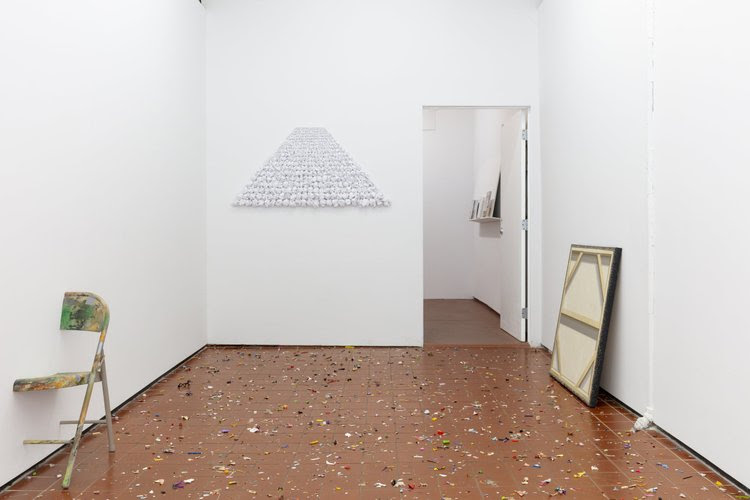
On view in There's No Such Thing as Art are multiple works which center around Friedman’s studio itself as a site of artistic production, including the works kit and kaboodle, 2026, a wall work produced from debris sourced from Friedman’s studio, which appears to continue infinitely outside of the world of the canvas; presenting artist’s detritus, 1990-2026, a collection of the artist’s detritus collected over a 36-year span strewn out across the gallery floor; and i do not exist, 2026, half of a mass produced metal chair marked by 4 decades of use in Friedman’s studio. Together, these works collapse the distinction between the site of making and the work itself, transforming the remnants of life and artistic labor into objects of contemplation. Speaking of this practice, Friedman writes “I have been selectively saving for over 30 years the packages of things I’ve consumed, things from around my home and studio, swept up piles of stuff from cleaning my studio, left-over ingredients from previous artworks, consumer roadkill [...] This stuff is then broken down and used from its fragmented identifiable form all the way to dust”, Friedman begins with an approach rooted in what appears as precious sentimentality for the most inconspicuous materials, though by the end of his process, these source materials have been transformed into objects that resist their original designation, asking us to reconsider the distinctions between waste and artifact, object and artwork.
Two newly printed books by Tom Friedman, there’s no such thing as culture and Saving Tom Friedman (with text by Stefan Haus), are available through Entrance on the occasion of Friedman’s exhibitions. There's No Such Thing as Art runs concurrently with if I ran the circus at Entrance / Red Hook, an exhibition featuring Tom Friedman’s recent and previously unseen work, primarily focused on his outdoor and large scale sculpture practice, including a number of Friedman’s acclaimed crushed aluminum foil sculptures.
Tom Friedman (b. 1965, Saint Louis, MO; lives and works in Leverett, MA) is a conceptual artist known for his meticulously disparate works, including sculpture, painting, drawing, video, and installation. Friedman investigates the concepts of perception, logic, and the cosmology of being. Since the early 1990s, Friedman has utilized and invented a multitude of processes unique to each artwork. His work engages the full spectrum between maximalist and minimalist aesthetics, and anti-aesthetics, recalling the Dadaists, Futurists, Arte Povera, and Pop Art. Friedman says he is not a professional artist, and he’s not really an artist, more a philosopher. His work tends toward the darkly humorous, and his often-sarcastic use of materials has distinguished his practice over the last 30 years. Made from a wide variety of unconventional materials, such as Styrofoam, aluminum foil, toilet paper, bubble gum, soap and hair, Friedman’s work plays on the unpredictable. Throughout his career, Friedman has developed a body of outdoor and public sculptures. Most of these are cast from maquettes rendered out of aluminum roasting pans.
About Entrance
New York art space verified from current gallery listings or gallery website.
More about Entrance →