
Ended
Noel W. Anderson
It Belongs in a Museum
Sep 8 – Oct 28, 2023
"In effect, under conditions of captivity, the offspring of the female does not “belong” to the Mother, nor is s/he “related” to the “owner,” though the latter “possesses” it, and in the African-American instance, often fathered it, and, as often, without whatever benefit of patrimony."
—Hortense J. Spillers
JDJ is thrilled to present Noel W. Anderson’s third solo exhibition with the gallery, It Belongs in a Museum. This exhibition runs concurrently with Anderson’s first solo institutional exhibition in New York City, Black Exhaustion, at the Shirley Fiterman Art Center.
Linked together conceptually, the two shows — essentially one exhibition taking place across two spaces — explore the socially constructed formation of Black male identity through American media.
The exhibitions mark the first time Anderson’s work has been seen en masse in New York City in a decade. Taken together, they expand on Anderson’s exploration of the history and creation of images, especially as they relate to the construction of Black identity, Black labor and performativity, and issues of racialized success.
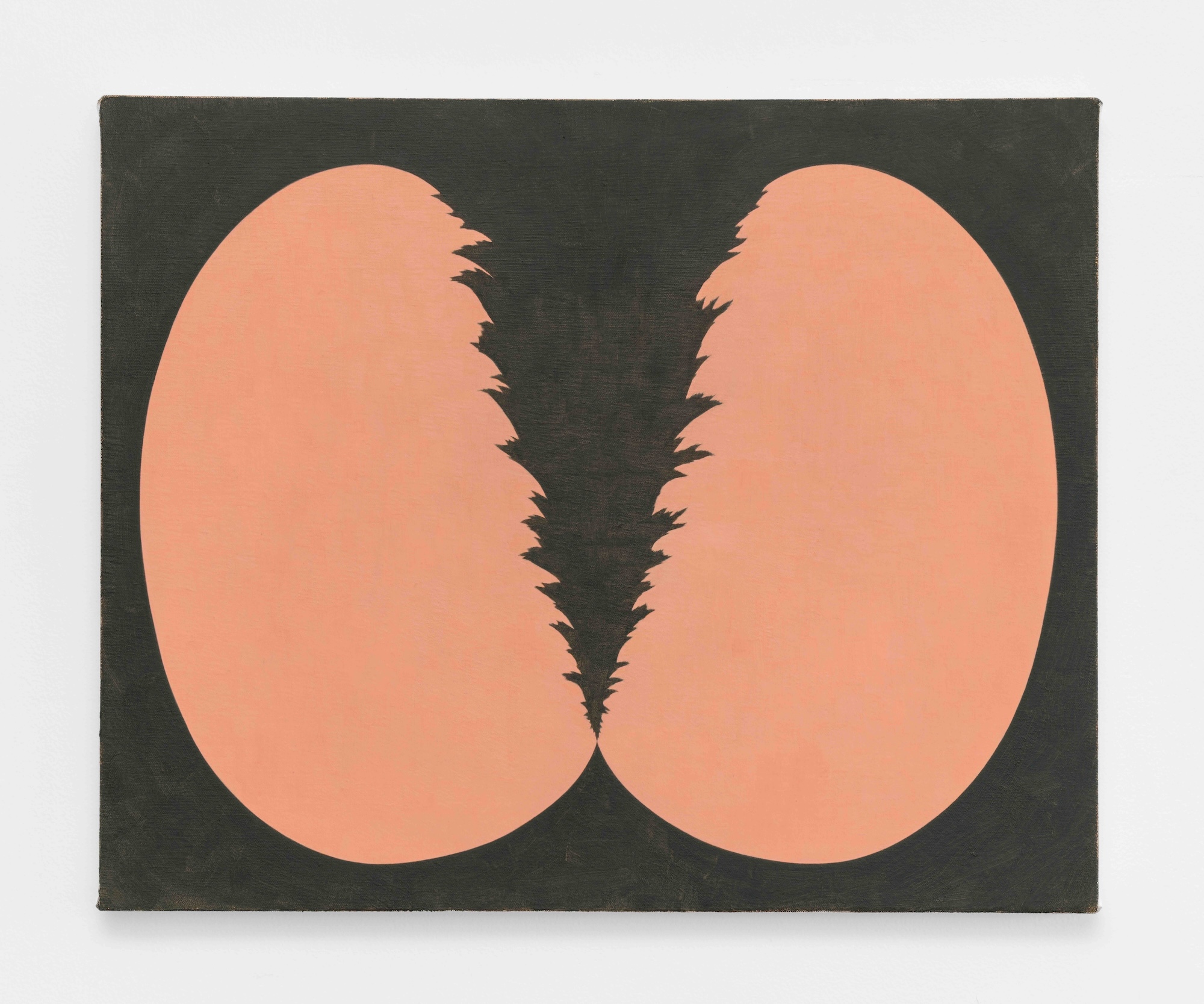
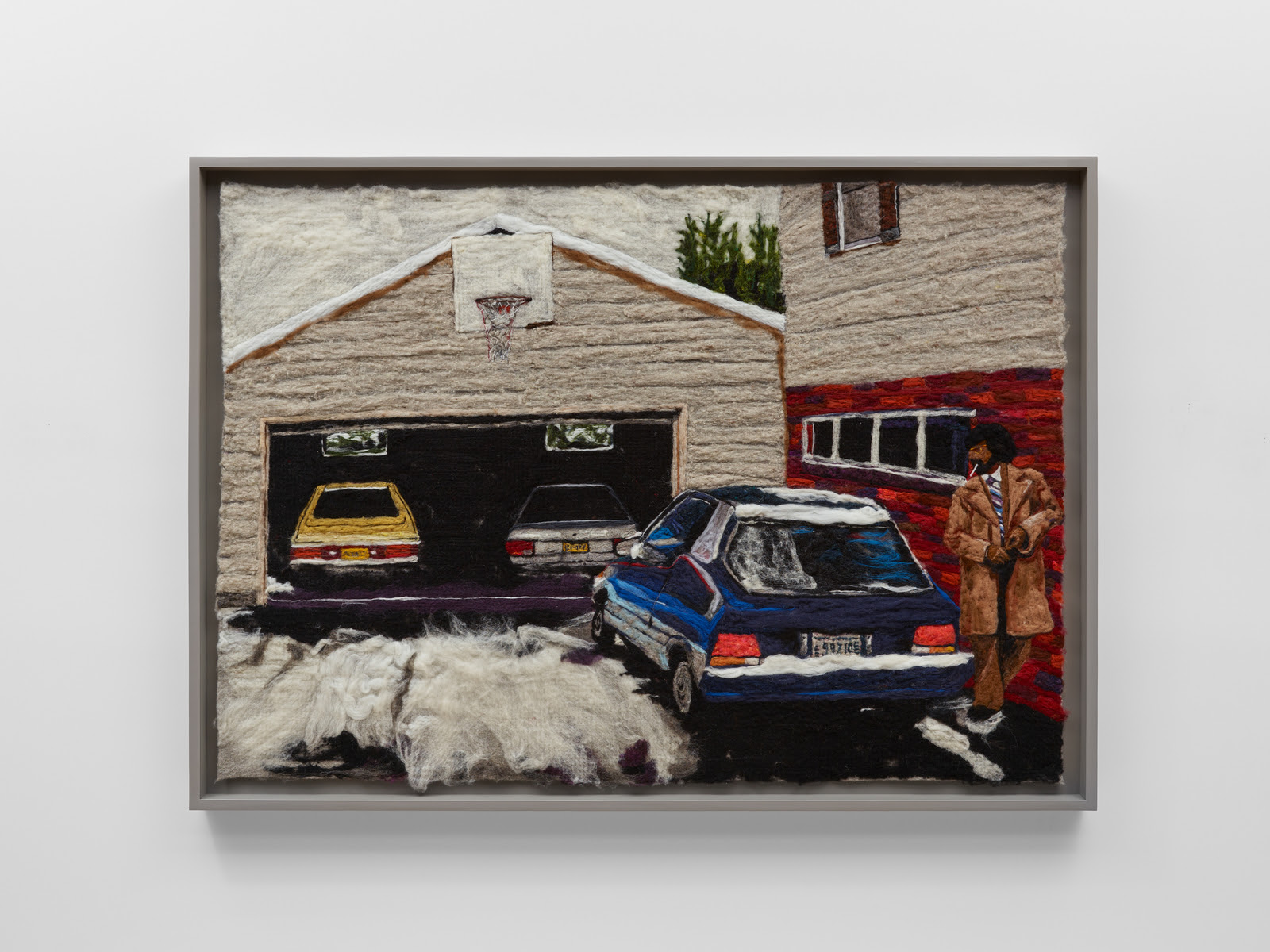
On the occasion of the exhibitions, JDJ and the Shirley Fiterman Art Center have co-published a limited edition publication which takes the form of an experimental coloring book, which includes an essay by Anderson that reflects on this new body of work. Anderson’s process starts with found images, appropriated from various archives and media outlets, that he digitally manipulates through mirroring, inverting, cropping or other forms of distortion before it is reproduced as a cotton jacquard tapestry. The resulting textile is then altered by distressing, dyeing, staining, and physically picking it apart thread by thread. In new works on view, Anderson repeatedly picks and brushes the surface, transforming it into a fur-like texture.
Anderson’s interest in textiles as a medium began with his frequent trips to the Metropolitan Museum of Art, where he was captivated by Medieval tapestries, realizing their essential role as an origin and intersection point between image reproduction, the grid structure of weaving, and digital technology (the pixels that comprise the printed image, the warp and weft of fabric, and the binary code of computer processing). Another formative reference point for Anderson comes from the rabbit-eared antenna on the television in his childhood home in Louisville, Kentucky. In moving the antenna, he could manipulate images on the screen—destabilizing and distorting them, and calling their reality into question.
Visual and intellectual references that span centuries and cultures inform Anderson’s work: from sculptures made by the African Dogon peoples in the 14th-17th centuries, to art historical references ranging from Georges Seurat to Frank Stella to David Hammons, to Black American sports and music figures, to the writings of poets and theorists such as Édouard Glissant and Fred Moten.
The literal blurring of the images with the foundations on which they are formed parallels the ways in which representations of Black male figures are warped in contemporary culture and media. The formal shift from clarity into abstraction in Anderson’s work conceptually mirrors the process by which stereotypes and archetypes overtake individuality. These works ask us to question our own relationships to issues of race and gender and to the distorted depiction of Black masculinity in American culture.
It Belongs in a Museum
Does “it” belong in a museum? What is the “it,” that’s being provided a belonging? What does the museum’s spectral vestibules (haunted halls) got to do with possession? Ain’t there a diffèrance between belonging and possession? Whose possession? Dis’ possession.
Motivated by these concerns, “It” belongs in a museum, continues my use of woven cotton tapestries as vehicles to engage with the material and conceptual legacies of colonialism and empire. As with the use of cotton, here the image of the museum indexes these roots and sites/sights an archetypical metonym for the institution of White Supremacy. In the image’s shadow, this body of work reflects on institutions such as the museum and athletics, to poetically address the absurdity of White Supremacy’s institutionally (en)titled “right/rite to possession” — assuming as its birthright the ownership of the Black body (body is meant broadly); our body belongs to ‘em. As the modalities of this/dis’ possession (dis’possession) are focused and broad, the museum as a marker of possession, and athletics as a field to observe the consequences of a populist assumption of the “right/rite to ownership,” “It” belongs in a museum poetically stitches an understanding of the function of the image of possession in foreclosing the expansive possibilities for black subjectivities and blackness.
The epigraph of critic and Black Feminist scholar, Hortense J. Spillers, citing French anthropologist, Claude Meillassoux, provisionally roots this exploration into the foundational role dis’possession plays in contemporary valuations of the indexes and representations of black subjectivities. Establishing a legacy of contemporary Black selfhood and citizenry in American slavery, Spillers highlights the condition of the enslaved as one of dispossession. Yes, master owned slave, but the traces of the right to citizenship buried in this racial economy are constitutionally sutured to the delusion of a biological “right/rite to possess”; a naturalized ritual. In this work I aim to resurrect and play with the specter of Black dis’possession — White citizenry. Realized in the form of the white sports fan, “It” belongs in a museum, observes the racialized witness as a participant in the consumptive economy of Black performance and performativity. In the diptych In the cave, who’s you’re daddy?, the viewer is given a pair of images sourced from a Harlem Globetrotter’s coloring book. The left textile in the pair weaves a comic drawing of a member of the internationally recognized athletic comedic group tossing a ball while exclaiming, “Now you see it...” Its right positioned partner shows two smoke clouds where the figure used to be, accompanied by a speech bubble remarking, “Now you don’t.” Using the diptych format to reference the origin of the image — a coloring book — the reader is forced to interpret this foundational representation with and against overlapping hand silhouettes in a range of blues. At closer inspection, these stenciled and dyed hand patterns look as if they are simultaneously woven with, and hovering over, the image as textile. This “hand-work” is meant to mimic the Paleolithic handprints found in painted caves in such places as Spain and southern France. Framing the experience of the racialized witness with the stereotype of inferiority signified by the primitive and marked by Paleolithic art untwines the myth of the civilized witness, the respectable citizen. This move ironically upsets then reweaves ideas of racial exceptionalism, suggesting that the diffèrance between “fan” and “fanatic” is as tenuous as the thread between “right” and “rite” (“write” relates to text-tile; or “human" and “animal” for that matter. This movement discloses the collective ritualized consumption of blackness. The repetitious insistence on the always already availability of the black body (body is meant broadly) is primitive and destructive.
“It” belongs in a museum, marks a field in which the ritually repetitious insistence as to the always already availability of the black body (body is meant broadly) is “primitive” and destructive. Using weaving, humor, beauty, and a heightened attunement to materiality this exhibition hopes to deploy the image of a racialized witness to deconstruct a series of binary distinctions — white/black, superior/inferior, culture/primitive, human/animal, right/rite, fan/fanatic, white sexual desire/Black maternity. In addition, dis’ image’s shadow is mobilized to conversely destroy the image of destruction that is America’s heritage. Said another way: The work is to right a rite that is always already wrong.
—Noel W. Anderson
Noel W. Anderson (born in Louisville, KY) received an MFA from Indiana University in Printmaking, and an MFA from Yale University in Sculpture. He is also Area Head of Printmaking in NYU's Steinhardt Department of Art and Art Professions. Anderson has been awarded the NYFA artist fellowship grant, the prestigious Jerome Camargo Prize, and the paper-making residency at Dieu Donné. Anderson's most recent institutional solo show, Erasure's Edge, was on view at KMAC Contemporary Art Museum (Louisville, KY). He also exhibited in the 12th Berlin Biennale. His work is included in the permanent collections of the International Center of Photography (New York, NY), The Studio Museum (Harlem, NY), and the Hunter Museum of American Art (Chattanooga, TN).