

Exhibition · Post Times
Michael Assiff
USA Flowers
Sep 9 – Oct 18
3 images · swipe
About the show
Post Times is pleased to present USA Flowers, an exhibition of new paintings and a video by Michael Assiff.
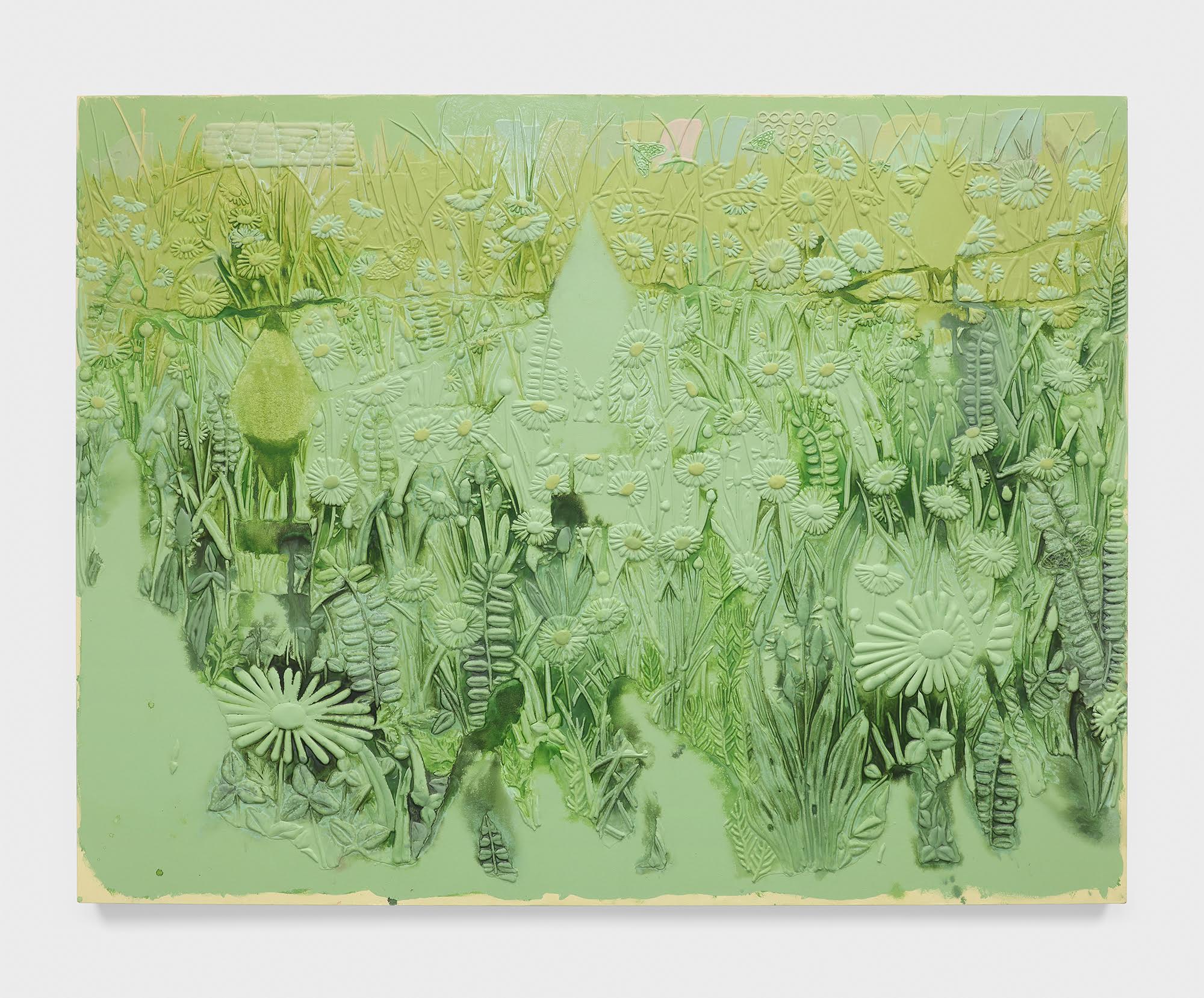
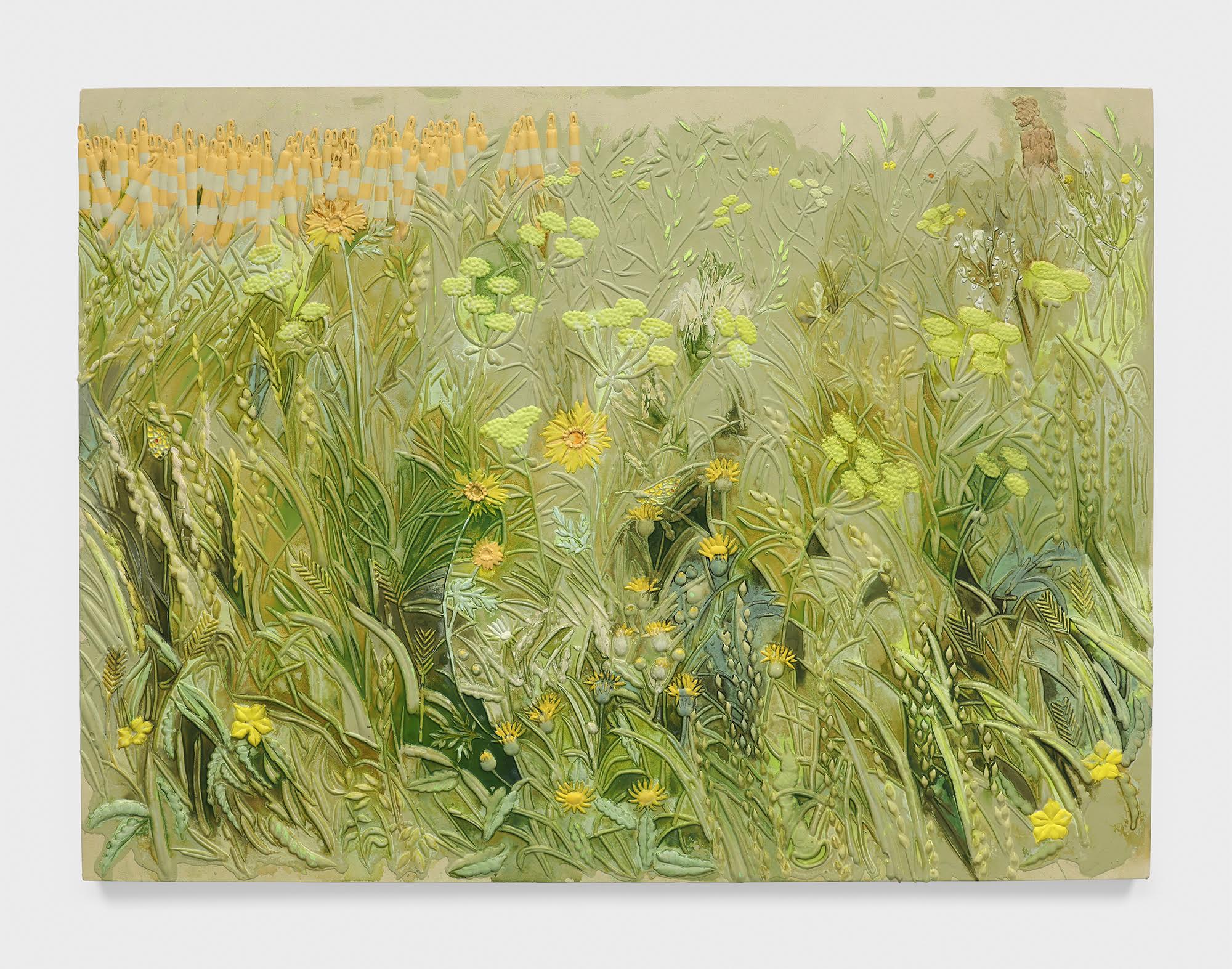
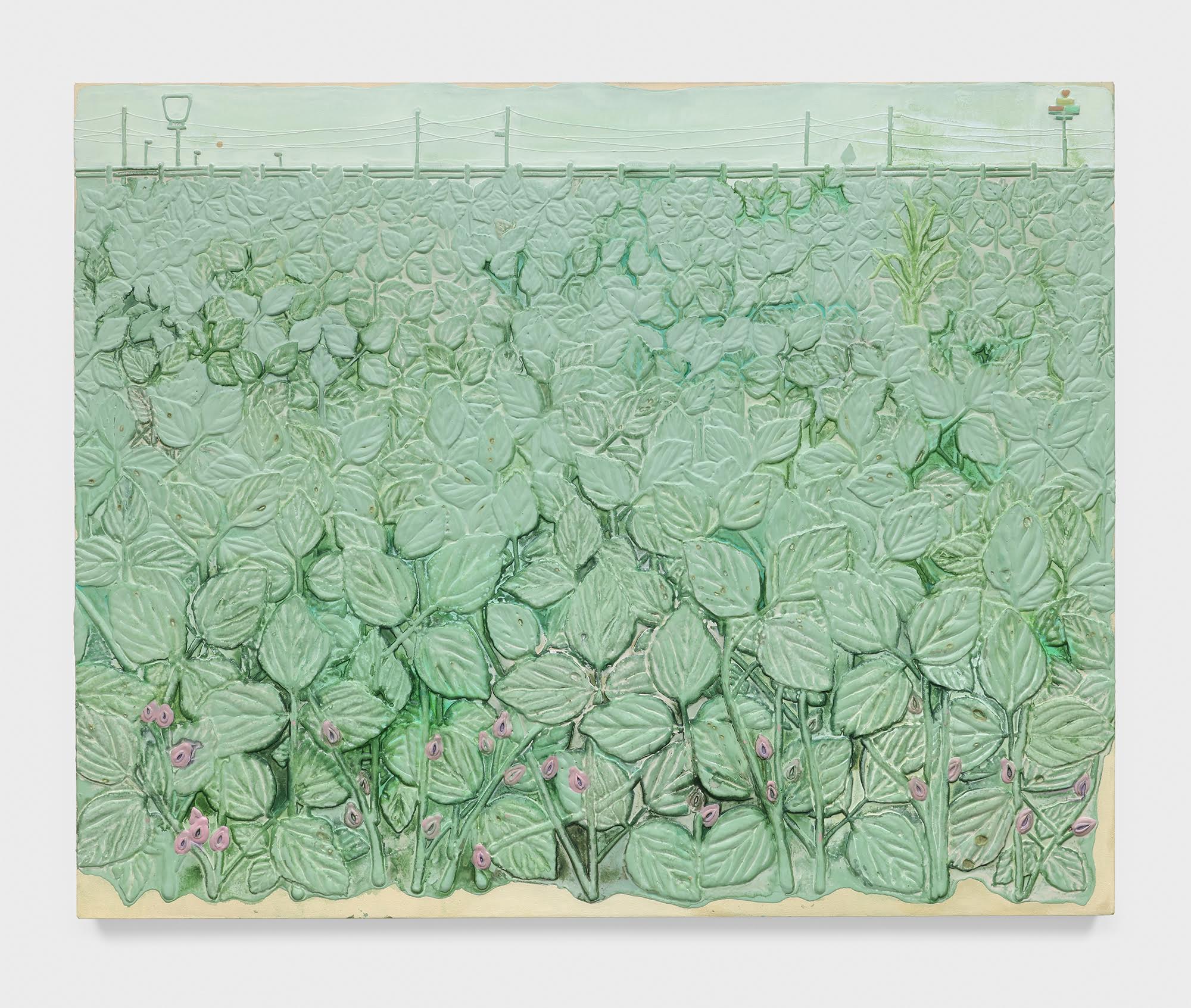
The exhibition continues Assiff’s investigation of the American landscape and the increasingly indistinct boundary between natural and industrial environments. The paintings depict weeds, agricultural fields, insects, highways, drainage systems, industrial sites, and other infrastructure associated with the movement of goods across the United States.
Assiff developed the works through a series of cross-country trips with his friend Ramblin, a long-haul flatbed trucker. Traveling in the cab of Ramblin’s semi, Assiff photographs and draws plants and their surroundings at truck stops, loading docks, gas stations, agricultural fields, and along highways. The routes of commercial freight determine the geography of the project, extending Assiff’s earlier study of New York City weeds into a provisional botany of American supply chains.
Assiff constructs each painting in low relief from extruded plastic. Working over a drawing on canvas, he applies the plastic through cake-decorating tips, pours paint over the resulting relief, sands the surface, and paints individual elements back into the composition. In the new paintings, Assiff introduces an additional process he calls a “spill,” spraying the surface with water and diluted house-paint dyes. The resulting stains evoke weathering, runoff, and chemical contamination while partially obscuring the relief image beneath.
Assiff has been developing this relief process for over a decade. He began using plastic in response to the longevity of ancient stone reliefs. Plastic offered another form of permanence: a material designed for disposability that can persist in the environment for centuries. Its use establishes a direct relationship between the paintings’ material construction and their subjects: plastic tableaus of petrocapitalist realism.
The fluorescent oranges, yellows, and greens throughout the exhibition derive partly from high-visibility workwear. Assiff relates these colors, used to distinguish workers within industrial environments, to the visible and ultraviolet coloration flowers use to attract insects. Such correspondences between biological and industrial systems describe an American landscape in which nature and infrastructure no longer appear as separate subjects.
The paintings engage a history of American landscape painting concerned with the transformation of the land through agriculture and industry. Assiff has looked particularly to Alexandre Hogue, whose solid, volumetric paintings of the Dust Bowl departed from the pastoral imagery prevalent in much American Regionalist painting of the period. Hogue depicted modern agricultural machinery alongside the erosion and drought it helped produce. Assiff’s paintings address a contemporary landscape shaped by a different forces: interstate highways, industrial agriculture, petrochemical production, warehouses, pipelines, and freight.
A video work presented on the gallery’s lower level extends the exhibition beyond the paintings. The video, Long-Haul Flowers, follows Assiff’s trucker-subject, Ramblin, through the central corridors of the United States. The video colors in the interstate ecologies with sonic overlays of guided meditation, self-help, faith healing and entrepreneurial motivational speeches. The video explores input and output loops of content generation. Ramblin is seen both watching and making YouTube content from inside his truck’s cab, creating fitness videos and critical gender commentary from the perspective of a trans man in the trucking industry. Long-Haul Flowers operates within the circadian rhythm of Ramblin's lifeworld: from early morning fog to loading steel outside in the heat of midday, driving through midday rainstorms to strapping tons of pipe to a flatbed trailer late into the night, a late afternoon workout in a Walmart parking lot to a midnight grilling of steak in a Walmart parking lot. Found sound is mixed with the analog synthesizer music of Matthew Bryan. Bryan's soundscapes evoke early new age music while the oscillators of his synthesizers create rumbling bass drones that mimic the semi-truck’s diesel engine. Presented as a continuous loop, the video becomes both a record of Assiff’s travels and a portrait of Ramblin, whose work and life provide the structure through which Assiff encounters the American landscape.
Michael Assiff (b. 1983, St. Petersburg, FL) lives and works in Queens, New York. He received his BFA from the Rhode Island School of Design. He has presented solo exhibitions at Ashes/Ashes, New York; Valentin, Paris; Galería Mascota, Mexico City; KDR305, Miami; Shoot the Lobster, New York; Good Weather, Arkansas, and others. He has been included in group exhibitions at Matthew Brown, Salon 94, Magenta Plains, Night Gallery, Jack Barrett, Charles Moffett, Marinaro, Jack Hanley, Arsenal Contemporary, and others. His work has been written about in The New York Times, Mousse Magazine, Vice, and other publications.