
Ended
There Were Gardens
Apr 3 – May 10, 2026
Dara Birnbaum, Gina Folly, Collin Leitch, Chris Marker, Jeff Preiss, Julia Scher, Jason Simon, Mira M. Yang
There Were Gardens brings together eight artists working across moving-image and media whose entangled artistic and curatorial genealogies endure as a site for critical inquiry.
The exhibition has many forking paths, but it stems from a conversation I had with artist Jason Simon last summer regarding the 20th anniversary of his curated exhibition, Having Been Described in Words, at Orchard.[1] That exhibition centered on the artistic relationships of Bill Horrigan, a curator at the Wexner Art Center, Columbus, Ohio, who championed film, video, and media art, bringing it further into institutional contexts; Horrigan passed away last year. At the center of Simon’s exhibition were works in a variety of media by the artists Horrigan collaborated with curatorially, alongside Xerox’ed copies of Horrigan’s writing on these artists. The web established in Having Been Described in Words represented the intellectual plurality emblematic of Horrigan’s vision. Jason Simon, Chris Marker, and Julia Scher, included here, are just a few of the artists directly connected to Horrigan’s legacy. This thread leads to a broader network of relationships that defined the gallery of Orchard, which reverberate through the shared ethos of the artists included in There Were Gardens, and my personal relationships to them as the curator of this exhibition. Rather than merely pay homage to the legacies of Horrigan, Simon, or Orchard, this exhibition examines how their residual effects, and the relationships they generate, continue to persevere.
One of Horrigan’s closest artistic correspondences was with Chris Marker. Marker’s influential series of films, books, travelogues, photographs, and CD-Roms attempted to capture the humanity of a world out of sorts, rummaging political histories alongside his own experiences and memories. Before his more well known films such as La Jetée and Sans Soleil, one activity of Marker’s were his travelogue books, known as the Petite Planetès; the series was highlighted in Simon’s exhibition at Orchard. In 1957 a delegation of French intellectuals, writers, and journalists were invited by the Communist government of North Korea to experience the culture of the country post-war. The results were captured in a book called Coréennes, not itself a part of the Petite Planetès series, but certainly related. The book featured photographs and textual fragments on the then-recent war, poetic reflections on North Koreans, and Marker’s perspective as an outsider in this new world. There Were Gardens includes a small selection of these photographs. Marker preferred to present his analog pictures as digital reproductions, remixed decades later through the ‘jujucraft’ of Photoshop and other digital applications. These ‘superliminal’ images, as he called them, reasserted the “Revenge of the Eye,” wherein the image takes control from the grip of its past authorial imposition.
Marker’s photographs are exhibited alongside a new work made in direct response to his Coréennes series by Mira M. Yang. Yang, a German-Korean artist, rephotographed slides of the original Coréennes prints held in his estate in the Cinematheque Française in Paris. Marker’s subjects are Choi Seung-Hee and her daughter Ahn Seung-Hee; Choi Seunge-Hee was the first woman dancer of colonial Korea to travel to America and Europe, bringing a modern mix of Western and traditional Korean styles of dance. Yang’s appropriations of Marker’s images were taken using an archival magnifying lens, wherein the images lost their definition, a counterpoint to Marker’s ‘superliminal’ images. These interpretations of Marker’s photographs are shown as slides on two Kodak carousel projectors, creating a slow-motion reanimation of Choi Seung-Hee and Ahn Seung-Hee, as captured by Marker. The projections of the dancers’ are like the phantasmagoric spirits realized by magic lanterns in the 18th and 19th century. Yang’s work reverberates across eras and viewpoints, superimposing Marker, Seung-Hee, and themselves, timeskipping across various avenues of memory and history.
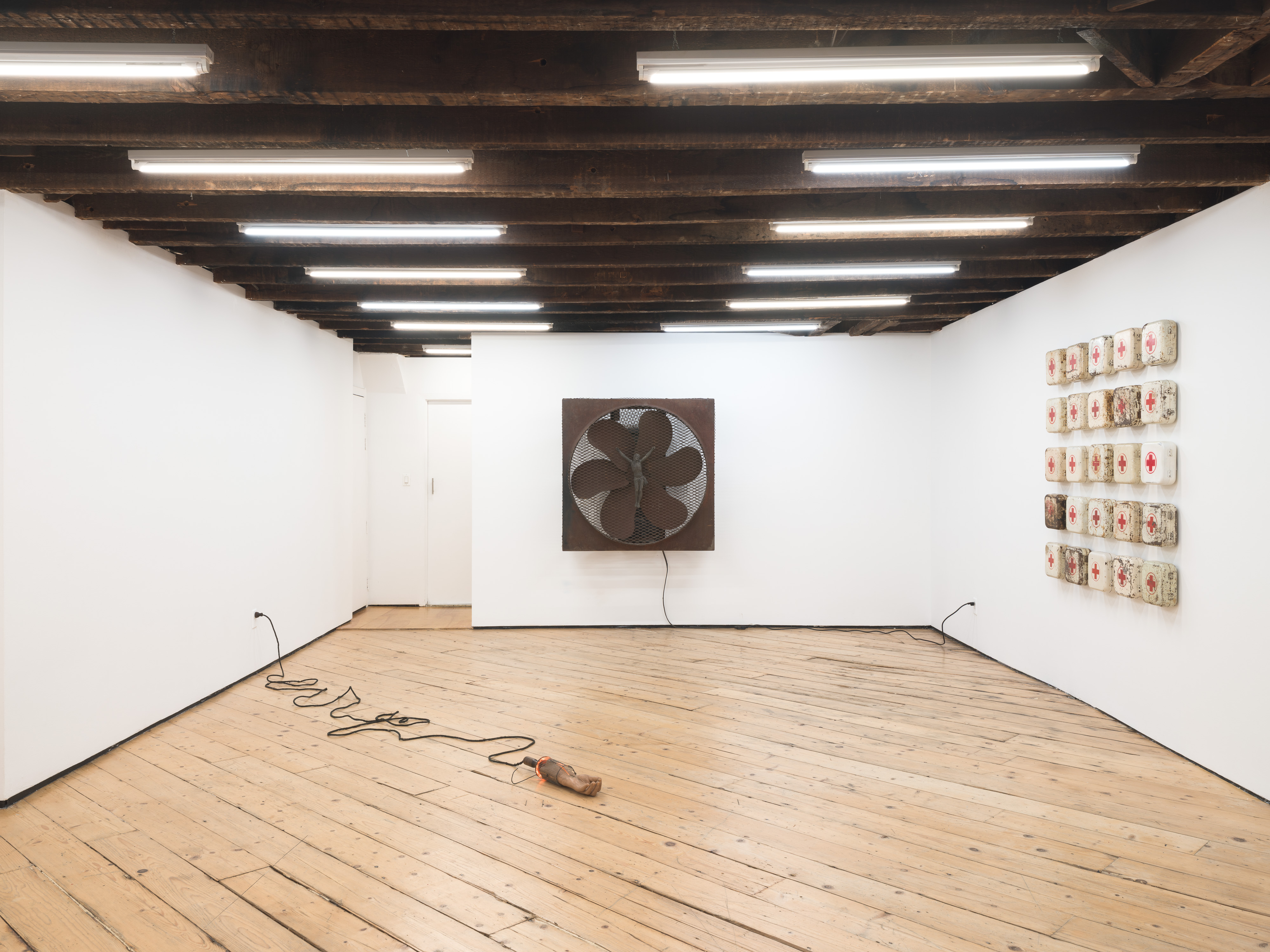
Though not deliberate, Gina Folly's subjects rhyme with Marker's own feline preoccupations. For Marker, the cat figures prominently in his oeuvre; beings with mysterious presence and power, auspicious and charged with political potential. Folly’s photographs of cats are taken among Turkish-Greek ruins, wherein the cats stand in as tourist curiosities, centuries old guardians, and cheeky symbols of the contemporary viral image. Throughout her work, Folly often laments on the obsolescence and metamorphosis of the photographic medium, with these pictures embodying that impending change with humor and quiet irony. These animals watch over the exhibition in parallel to Julia Scher's Glückshaube, originally exhibited in Simon's Orchard show on Horrigan. Scher’s marble security caps are their own ruins of a culture sadistically bound to self-surveilling ideology. Marker’s ‘Revenge of the Eye’ could be applied here with flipped meaning, wherein
Scher’s weaponised CCTV installations and her own enterprise, ‘Security by Julia, ’ exposed the psychosexual stakes of bodies under watch. Scher and Dara Birnbaum, though rarely positioned together, find an overlap in There Were Gardens. Where Scher is interested in the violence implicit in endless streams of techno-capitalism, Birnbaum's practice embodies what she called "talking back to the media, " turning mass-media content back in on itself. Her videos appropriating television stuttered, looped and germinated through galleries and social spaces of New York City and globally from the 1970s onward. Perhaps more central than the images she spliced were its effects on the audiences who captively watched her work. Birnbaum's contribution to the exhibition is Liberty: A Dozen or So Views (1976), in which she interviews tourists on the Staten Island Ferry, asking them classificatory questions, not dissimilar to the questions immigrants would be asked upon entering Ellis Island. Birnbaum then hands each interviewee her video camera to film the Statue of Liberty in America’s Bicentennial year. "Their vision was expanded, " she said, "and they could see [the Statue of Liberty] in a new way. " Birnbaum’s Liberty is a transitional work in her practice, displaying at once the calculated demeanor of her political motivations amongst the people, while hinting at the offhanding of her own subjective mode of expression: appropriation over self-production. Liberty also includes a portrait of the artist, as the camera is turned on her in the final frames; here, a fitting tribute to Birnbaum who passed away last year.
Jeff Preiss's Temple (2006), originally displayed in Moyra Davey's curated exhibition Reality/Play at Orchard, is a sculpture featuring two viewing apparatuses sized for children. Inside, upon further inspection, are two monitors with mirrors facing outwards, creating a rudimentary three-dimensional image. Similar to Yang’s projected apparitions, the sculpture references proto-cinematic devices of the 19th century like the stereoscope, and serves as a symbol for the way moving image is a receptacle for memory. In this presentation, Preiss pairs the original footage, a super 8mm film of his son watching a movie, with a clip of Birnbaum giving a collaborative lecture with former assistants at Orchard in 2008: two viewing experiences brought back to life in the flicker of a reflection. Ten years later in 2018, I would meet Birnbaum and begin working for her, becoming another in a long line of assistants. Time magnifies and shrinks in the blink of an eye.
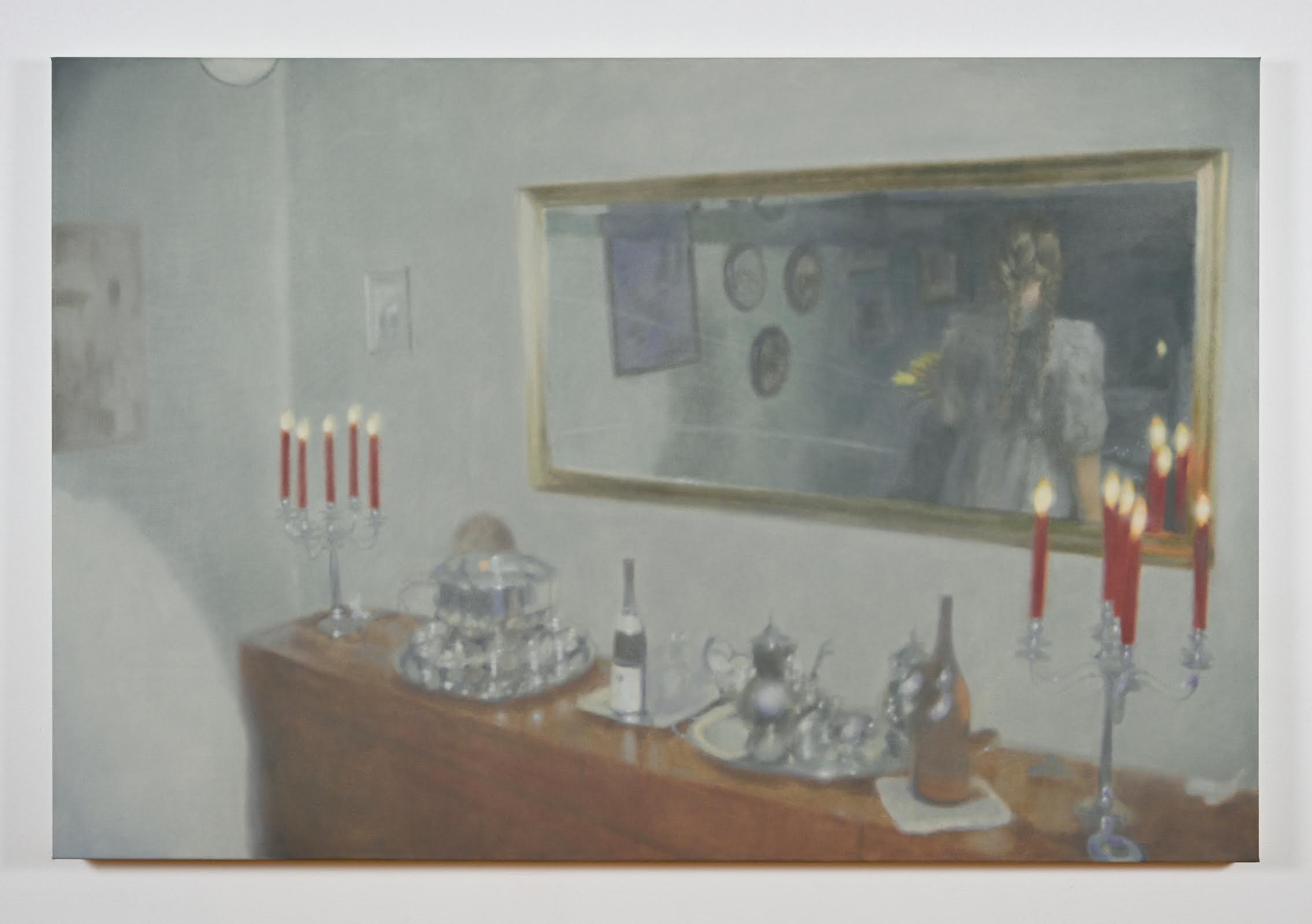
Jason Simon's photographs from Spirits, shown at Pat Hearn Gallery in 1996, were made as a sly nod to quitting smoking. To photograph smoke is to photograph the ineffable, a spirit resistant to the shutter. What once marked a moment in Simon's own biography is reframed here as an investigation of the image as memoriam. This is Simon’s second collaboration with King’s Leap, following his solo exhibition with the gallery in 2019, The Red Books, organized by myself and Collin Leitch, who reappears in There Were Gardens. The subject of The Red Books was the incomplete effort of the American Film Institute to create an encyclopedia of every film screened in the United States from cinema’s birth. There is a line to be drawn between Simon’s attempt to photograph an ineffable, near-uncapturable subject and the collection and display of an impossible archive for a history of film slipping away. Images haunt this show, but a haunting is always a good trick. The ghosts may dissipate, but only to further permeate these rooms with their presence.
Leitch's wooden sculpture is a contradictory, but natural adaptation of the permeations suggested through Simon’s work. Beginning as a digital 3D model, Leitch’s sculpture is milled from a solid block of wood using a computer-controlled router. Its undulating, organic surface slopes toward a precisely cut fold travelling the length of the piece, which serves to reinforce its machined origin. While taking the form of sculpture, Leitch’s influences are from the canon of Structural film, which foreground the material demystification of the filmic process and apparatus. Visualizing the syntax of computer-aided fabrication, and making gestures which may cast it as a form of image production, his work places at its center misdirection around the common understanding of these tools’ function and the mode of reception that might engender. Inherent to each of the artists in this show is the fleeting nature of media, that its traces imply the passing of time, knowingly bound to their respective apparatus. The changes of these technologies result in changes in the application, format, and medium of a given artist in their time. What can be seen in Leitch’s work, then, is a grappling of the nostalgic and artificial traces latent in media: he insists that the moving-image progresses, despite what has been lost.
1 - Orchard was a collaboratively-run gallery in New York which operated from 2005 to 2008. The twelve partners included artists, filmmakers, art historians, critics and curators, and focused on historical, critical and politically charged exhibitions. Its members included Rhea Anastas, Moyra Davey, Andrea Fraser, Nicolás Guagnini, Gareth James, Christian Philipp Müller, Jeff Preiss, R.H. Quaytman, Karin Schneider, Jason Simon, John Yancey Jr., and an anonymous member.