
Ended
Upside Down Zebra
Jun 28 – Sep 1, 2025
To book a free timed-entry ticket, please visit: tinyurl.com/uy6a5wrv
Darren Bader, Donald Baechler, Brian Belott, Katherine Bernhardt, Joe Bradley, Jenny Brosinski, Matt Dillon, Carroll Dunham, Rosabel Ferber, Gerasimos Floratos, Petrit Halilaj, Isla Hansen, Gerald Jackson, Jamian Juliano-Villani, Misaki Kawai, Christopher Knowles, Jonathan Lasker, Sivan Lavie, Eric N. Mack, Chris Martin, Eddie Martinez, RJ Messineo, Bascha Mon, Robert Nava, Andrea Pearlman, Walter Price, Marria Pratts, Anna De Los Reyes, Kes Richardson, Ugo Rondinone, Leomi Sadler, Michelle Segre, Daisy Sheff, Alake Shilling, Ross Simonini, Josh Smith, Keith Sonnier, Richard Tuttle, Terry Winters, Christopher Wool
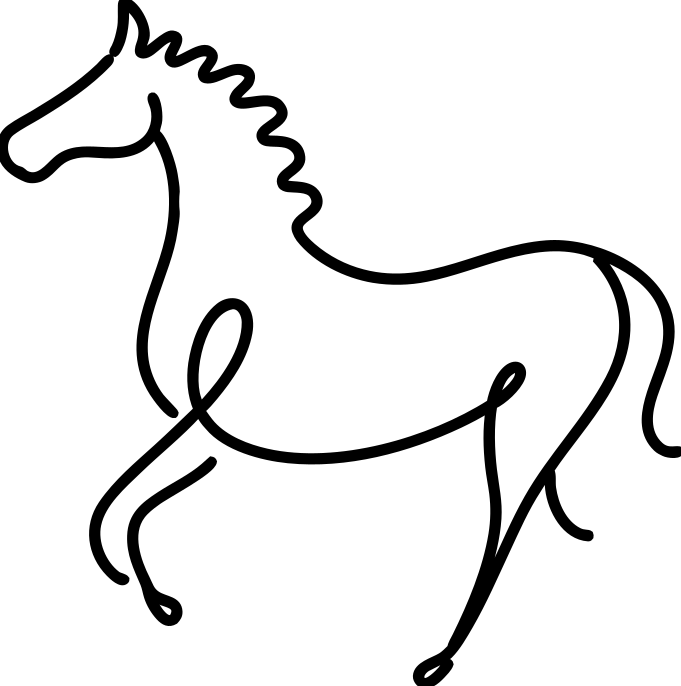
The Watermill Center is pleased to present Upside Down Zebra, an exhibition exploring the artistic value of children's imagination, its inherent role in cognitive development, and its profound influence on contemporary art. Curated by artist Brian Belott and Watermill curator Noah Khoshbin, in collaboration with early childhood specialist Jennifer DiGioia, the exhibition features works from the Rhoda Kellogg International Child Art Collection alongside responses from contemporary artists, opening a dialogue between past and present. At a moment when self-expression in early education is more vital than ever, Upside Down Zebra serves as a timely tribute to the unbounded creativity of childhood.
Through Belott and Khoshbin's vision, Kellogg's legacy is brought into the present, offering a radical reexamination of artistic value and human cognition that prioritizes collaboration, spontaneity, and the untamed joy of creation. A pioneering early childhood scholar, Rhoda Kellogg (1898–1987), was a theorist, educator, and advocate for the arts. Over six decades, she amassed an archive of more than two million drawings by children aged two to eight from over 30 countries. Her research identified universal patterns in early artistic development, revealing the fundamental role of visual language in human cognition. Kellogg developed classification systems charting the evolution of children's drawings from instinctual scribbles to structured forms, positioning children's mark-making as an innate form of communication. Rhoda also designed and established a school tailored to her research specifications, which served as a laboratory for her work. The Phoebe A. Hearst Preschool in San Francisco remains in operation today and is open to visitors. Despite her groundbreaking work, Kellogg continues to be an overlooked figure in art and education—a narrative Upside Down Zebra seeks to redress.
"Upside Down Zebra," Noah Khoshbin explains, "finds its home at The Watermill Center as the works resonate with the Center's own art collection. Our collection is inspired by the groundbreaking work of anthropologist Edmund Snow Carpenter and art historian Carl Schuster, who challenged the notion of cultural singularity by revealing universal visual motifs across time and geography — a shared human instinct. The children's artworks presented are not just charming artifacts, they are proof of something deeper — that before we speak, before we write, we draw. And when we do, we enter the universal, the ubiquitous visual language of childhood. The contemporary artists invited to participate in this exhibition share this understanding. Their contributions bridge the connection between the ‘now' and the ‘eternal' for our audience."
Spanning six indoor galleries, Upside Down Zebra features approximately 400 pieces of children's artwork from the Rhoda Kellogg International Child Art Collection, presented alongside works by over 35 contemporary artists who directly engage with Kellogg's archive. Through a wide range of approaches, these artists explore themes of unfiltered spontaneity, echoing ideas found in Kellogg's research and collection. By curating historical pieces in dialogue with present-day responses, Upside Down Zebra highlights the enduring role of artistic play - celebrating the drip, smear, scribble, and open gesture as fundamental forms of creative expression across generations.
Two major outdoor installations will be unveiled during The Watermill Center's annual Summer Benefit: Abetare (2024) by Petrit Halilaj, originally commissioned for The Metropolitan Museum of Art's Roof Garden Commission, and Sunrise. East (2005) by Ugo Rondinone. Installed across The Watermill Center's grounds, both works will be accessible to the public and remain on view through spring 2026. This long-term exhibition reflects the Center's ongoing commitment to presenting visionary contemporary art in dialogue with its unique natural setting.
Petrit Halilaj's Abetare (2024) transforms children's desk scribbles from Balkan schools into expansive metal sculptures, capturing the whimsical essence of youthful imagination. Drawing from his own experiences during the Kosovo War, Halilaj's work intertwines personal and collective memories, highlighting the resilience and dreams of children affected by conflict. The installation invites viewers to reflect on the enduring power of creativity amidst adversity.
Ugo Rondinone's Sunrise. East (2005) is a series of twelve monumental bronze sculptures, each representing a month of the year and finished in silver auto paint. Standing two meters tall, the heads feature exaggerated facial expressions—ranging from whimsical to unsettling that draw on visual languages such as ritual masks, comic art, and emoticons. Together, the works reflect on the cyclical passage of time and the broad spectrum of human emotion.
Public programming includes artist performances at The Watermill Center's annual summer benefit on July 26. A series of talks, workshops, and interactive activities designed for audiences of all ages will occur throughout the exhibition's run, furthering its mission to elevate and explore the significance of children's art.
Upside Down Zebra is supported by Cadogan Tate, Phillips, Duggal, Paul J Herman, The Herget Family Charitable Foundation, Phoebe Hearst Elementary School Foundation, and the Suffolk County Department of Economic Development.
Founded in 1992 by avant-garde visionary Robert Wilson, The Watermill Center is an interdisciplinary laboratory for the arts and humanities situated on ten acres of Shinnecock ancestral territory on Long Island's East End. With an emphasis on creativity and collaboration, The Center offers year-round artist residencies and education programs, providing a global community with the time, space, and freedom to create and inspire. To date, The Center has hosted over 250 residencies featuring 1500 multidisciplinary artists from more than 90 countries.
The Watermill Center's rural campus combines multifunctional studios with ten acres of grounds and gardens, housing a carefully curated art collection, expansive research library, and archives illustrating the life and work of Artistic Director, Robert Wilson. The Center's facilities enable Artists-in-Residence to integrate resources from the humanities and research from the sciences into contemporary artistic practice.
Through year-round public programs, The Watermill Center facilitates unique insight into the creative process of a rotating roster of national and international artists.