
Exhibition · Feuer/Mesler
Matthew Chambers
(My) LA Paintings
Sep 11 – Oct 23
4 images · swipe
About the show
September 8, 2016
To whom it may concern:
First off, thank you so much for taking the time to read this and looking at my exhibition. In the long run, I find anytime we engage with art, the world slows down a little bit and we get the opportunity to ask ourselves some questions.
I’ve spent the last 5 years making the decisions that became these paintings and Mesler/Feuer has extended their support, trust, and resources so we can look at them today.
There have been some big changes in my work in the last few years. I had a studio fire that destroyed my materials, archive, and countless paintings. So when I moved to the studio where I made these works, I started from scratch. I didn’t want to remake old work. I was in an empty warehouse with anxiety from running out of a burning building, the fire investigation, and the ensuing lawsuit. I needed to find structure and I needed to work. As far as I could see, the only value in showing paintings that I made for myself was to prove that I was painting. I was working only thinking of the value of work, and I have always worked under the notion that “art” is intention and responsibility. My intention was never to make a painting; it was to paint. This allowed me to divorce “art” from “art-making”.
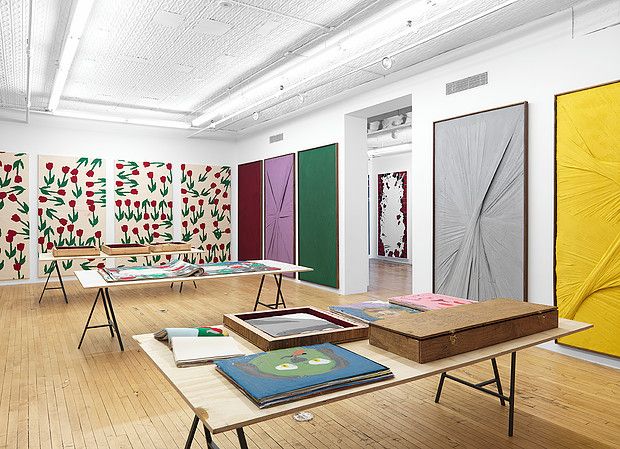
The books in the exhibition are my “art-making”. My practice is structured so I can work freely, chasing curiosity and joy as I paint. They exist showing the proof that I’m painting, and that not everything needs to be exalted and monetized. To look at them is to look at an act, and they cannot be acknowledged as images. Unlike a painting—of which you can see a JPEG and say, “I saw the painting”—you look at a picture of these books knowing you saw documentation rather than the object.
I extended this logic to the paintings as well. I spent the last few years shifting my materials to ones that photograph differently than they appear in front of you today. I worry that if a painting becomes an image too fast then the power of art, that power to slow things down and create empathy, is lost.
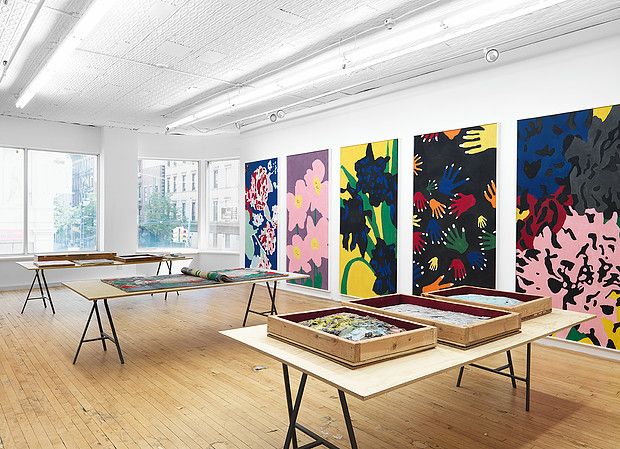
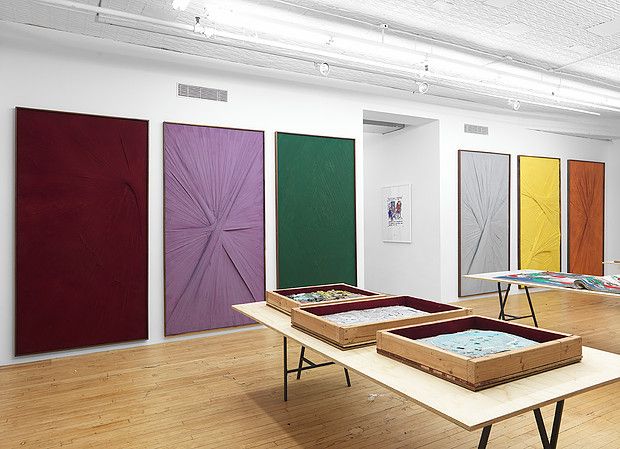
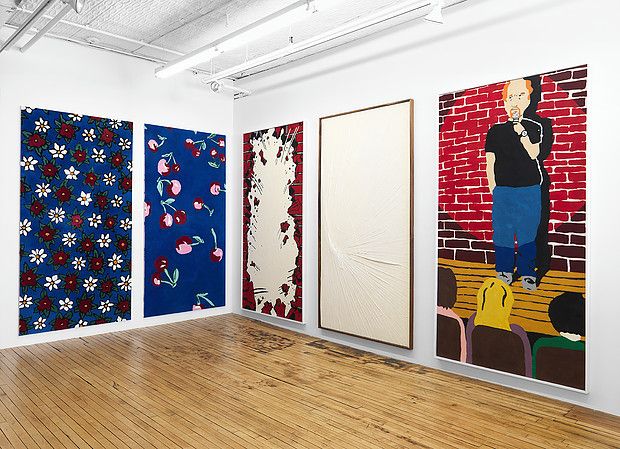
I refer to the monochrome flocked works as “jazz club” paintings; these were the first works that I conceptualized as “objects”. I’m not an artist who is precious with my work, and so the climate of approaching artworks as fetishized objects always seemed strange. I always felt that the studio should be the only fetishized object. If you’re doing it right the studio is a pure place that rewards discipline and creativity, much like the performances in front of the dark acoustic walls of a jazz club. Panels that by day tell the stories of the wonderful nights.
I made the floral paintings as a result of wondering how could I make paintings about color without all the red-tape that surrounds abstract painting. Flowers allow you to bask, there is no “I don’t get it” and I figure that if people can stand longer in front of a painting, then they’ll probably be able to tell you more about their experience. From these, the figurative flocked paintings allowed content to sneak back in. Now that one could stand in front of a painting it was time to start a dialogue with images so simple that by identifying them, one understands them and is free to include them in any conversation.
These same conversational baby steps were the genesis of the tulip paintings. The image is a silkscreen that I had made, a single action of pulling the screen made the marks, and the colors were predetermined. The paintings’ one variable is composition, determined only by the action of moving the screen around. Similarly, the painted ripped works are just about one decision: which color do I want to paint right now?
In the end, the goal is to slow things down, to understand our human experience more. The definitions of these works are evolving, and did so in the years I spent with them. I try to work with simple questions and simple answers, not to shirk responsibility, but to know exactly what I’m being responsible for. This awareness is my tool for understanding and growth. But I do, much like this show, have a lot of these very simple conversations going on at once. I always thought of my studio functioning like a Robert Altman film, overlapping conversations, just like life. But, by the this year I realized that the majority of the questions I was dealing with were being dictated by Los Angeles, a city that made me feel like art was being measured with a cultural or social yardstick and to which integrity is an extreme position. So, as of a few weeks ago I moved to the wilds of Montana to face the existential void. I’ll let you know what my new questions are next show.
Sincerely,
Matthew Chambers