
Ended
No Butterflies, No Nothing
Jun 21 – Jul 30, 2022
Mollie Conlee, Aidan Koch, Jane Margarette, Jade Forrest Marks, Brigid Moore, Leah Shirley
Leila Greiche presents No Butterflies, No Nothing.
“Won’t make the same mistake again
Tryin’ to force myself but I can’t pretend
No, I’m far from it
No, it’s not coming
No butterflies, no nothing”
—Erika de Casier
No Butterflies, No Nothing shows the transmogrification of human emotions in our post-demic reality. For some, such as myself, this season is a moment of re-emergence into the world following a prolonged state of trapped emotion. The chrysalis is the state of transition: out of a cocoon’s false sense of security, into the body of the butterfly.
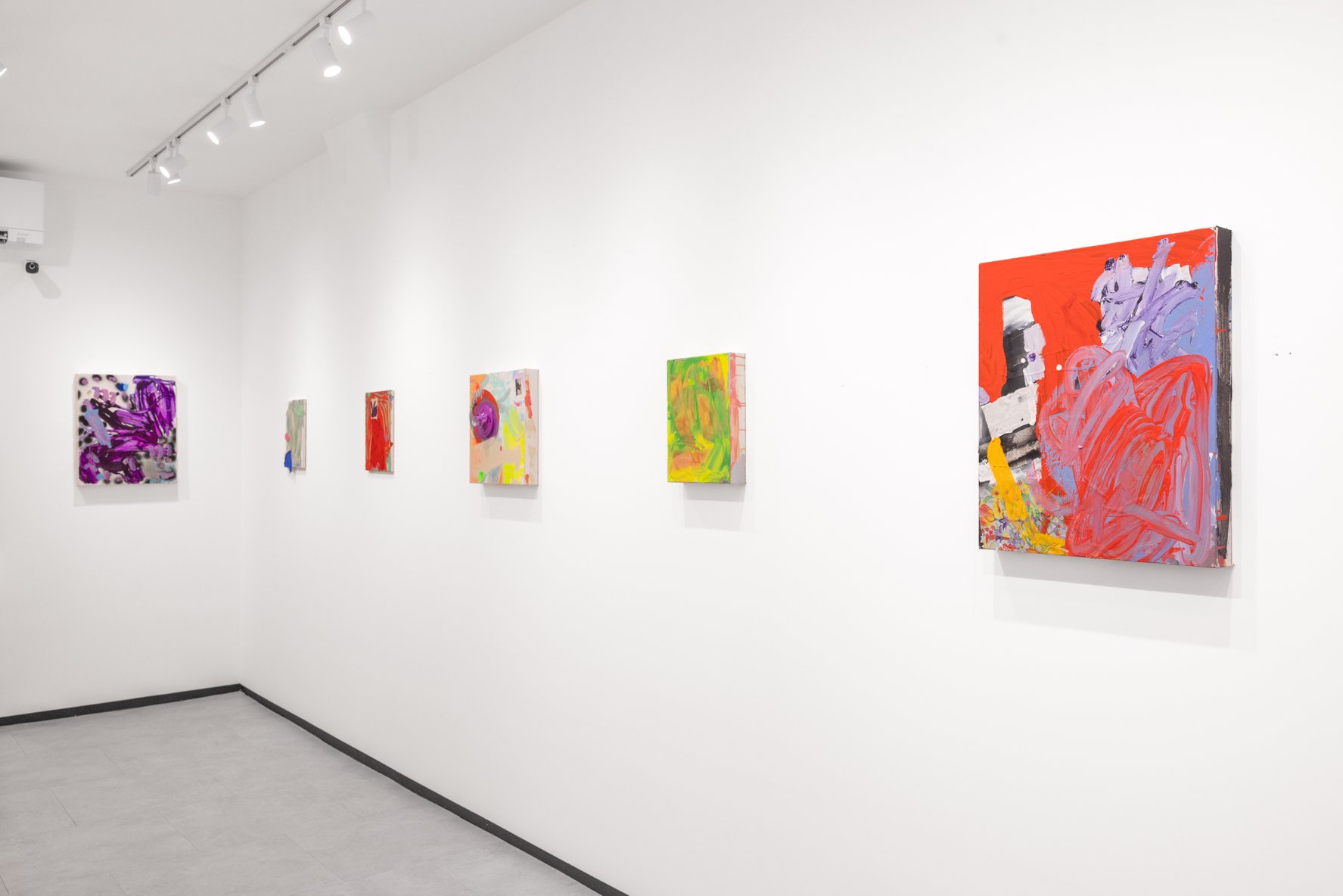
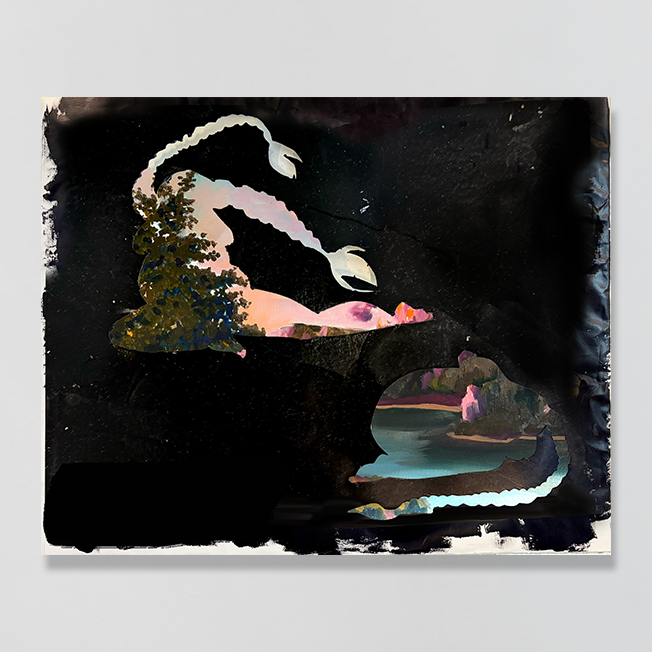
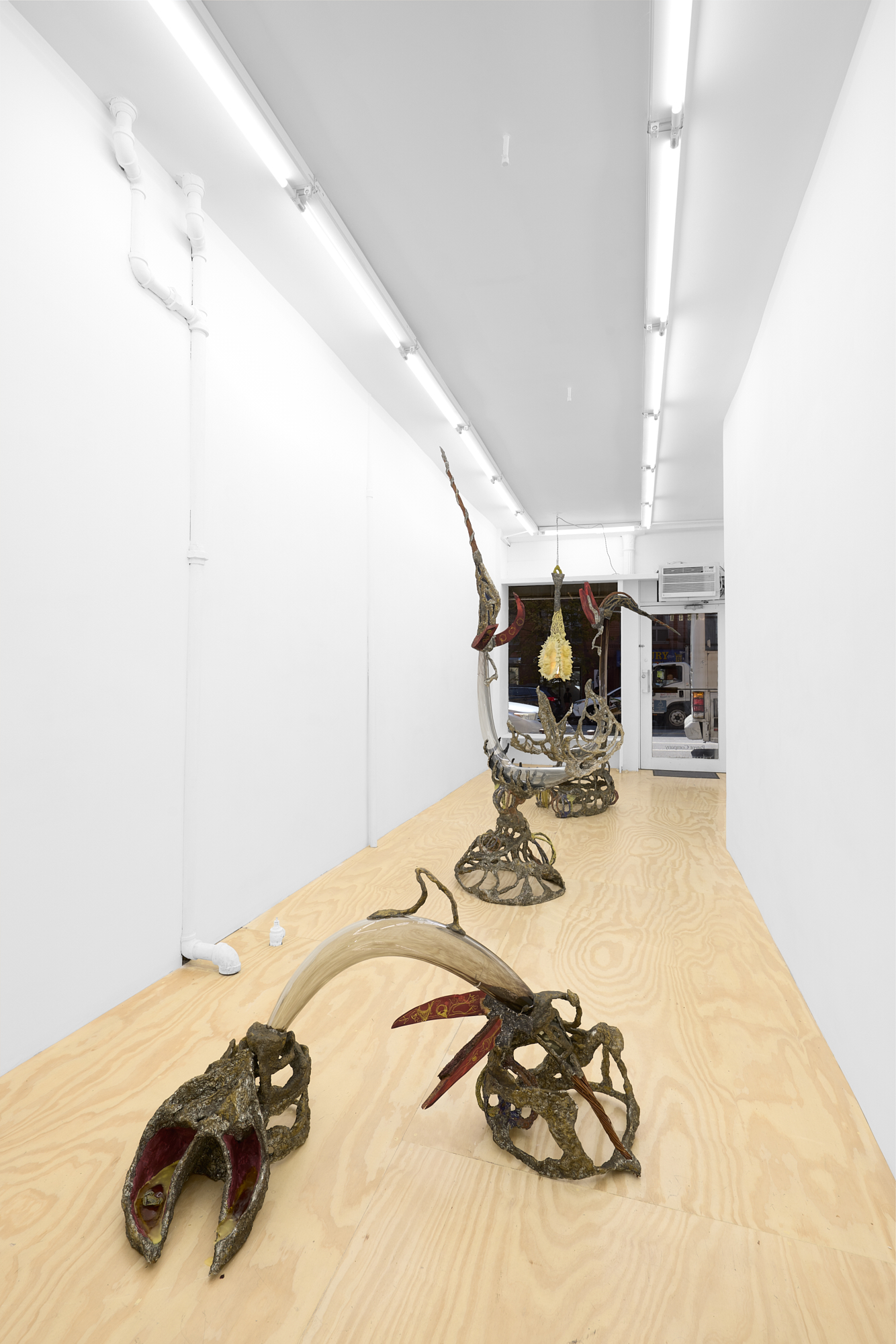
The artists included in this exhibition use the form of the butterfly through varied mediums — glass and lenticular mosaics, wood carving ceramics, essence, painting, drawing. All work shows attentive crafting. We see Marks’ floating paper outlines, Conlee’s holographic collages, Shirely’s grouting and hand-cut mosaic tile, Koch’s butterfly net with the hand carved wooden handle and Margarette’s studio-fired ceramic. The practices are process informed. One senses the piecing together of a puzzle.
Conlee’s “Blue Butterfly (wheat)” and “Butterfly 3 (Psalm 23)” are from a lenticular mosaic series which began in 2016. In these works, each panel’s reflective surface is composed of hundreds or thousands of hand-cut fabric, plastic, paper, leather, or lenticular plastic pieces, and goes through subtle shifts with the viewer’s movement. Her body of work continuously plays on the holiness of the symbol and the necessity of its undoing. The piece shifts and changes, dissolving what we think is there, asking us what it could be, or was.
Koch’s butterfly net is 5’10”, the artist’s height, and titled after the approximate number of species of butterflies in the world. The work relates the scale of one person, herself, and the vastness of biodiversity that is threatened by human action. The net is a symbol of human hubris — centuries of butterflies collected and killed for display, or, disrupted by environmental degradation. Koch relates to the beauty and desire of collection while recognizing the devastation. The drawing, “The Scent of Orange Blossoms”, includes a butterfly as pattern, ornament, symbol — incorporated into domestic spheres yet still maintaining ephemerality.
Margarette’s ceramic wall works evoke an understanding of nature and its fragile condition. The characters in her work disguise themselves as mechanical locks, tempting viewers to touch and manipulate them. Each articulated piece in the anatomy of Margarette’s haunted menagerie is hand-built, in a pastel gothic palette of eshy peaches and earthen tones. Margarette’s work takes a holistic view of the natural world, where humans, animals, and the elements are ensnared inside of time. By examining symbols of strength, protection, sensuality, and captivity, her works articulate a dichotomy between the delicate and strong, the logical and fantastical, the open and closed.
Marks states that essences are energetic imprints of objects, plants, or environments made in water. Traditionally made by rolling dewdrops off of flower petals, they don’t contain measurable constituents of their imprint. In fact, they’re heavily diluted until a spirit dose is made that can be taken internally to affect our bodies on the most subtle level. A healing on behalf of (your name) will be an environmental essence of the gallery, collecting an imprint of the space, the people, the sounds, and senses that pass through for its entire duration. Upon closing the essence will be diluted, preserved, and bottled, creating a unique memory of the show that can be revisited as internal medicine. Essences are also replicated indefinitely by further dilution, so though the “mother” essence will be 1/1, there are an infinite number of possible copies, or stock bottles, akin to the model of reproducing prints in fine art.
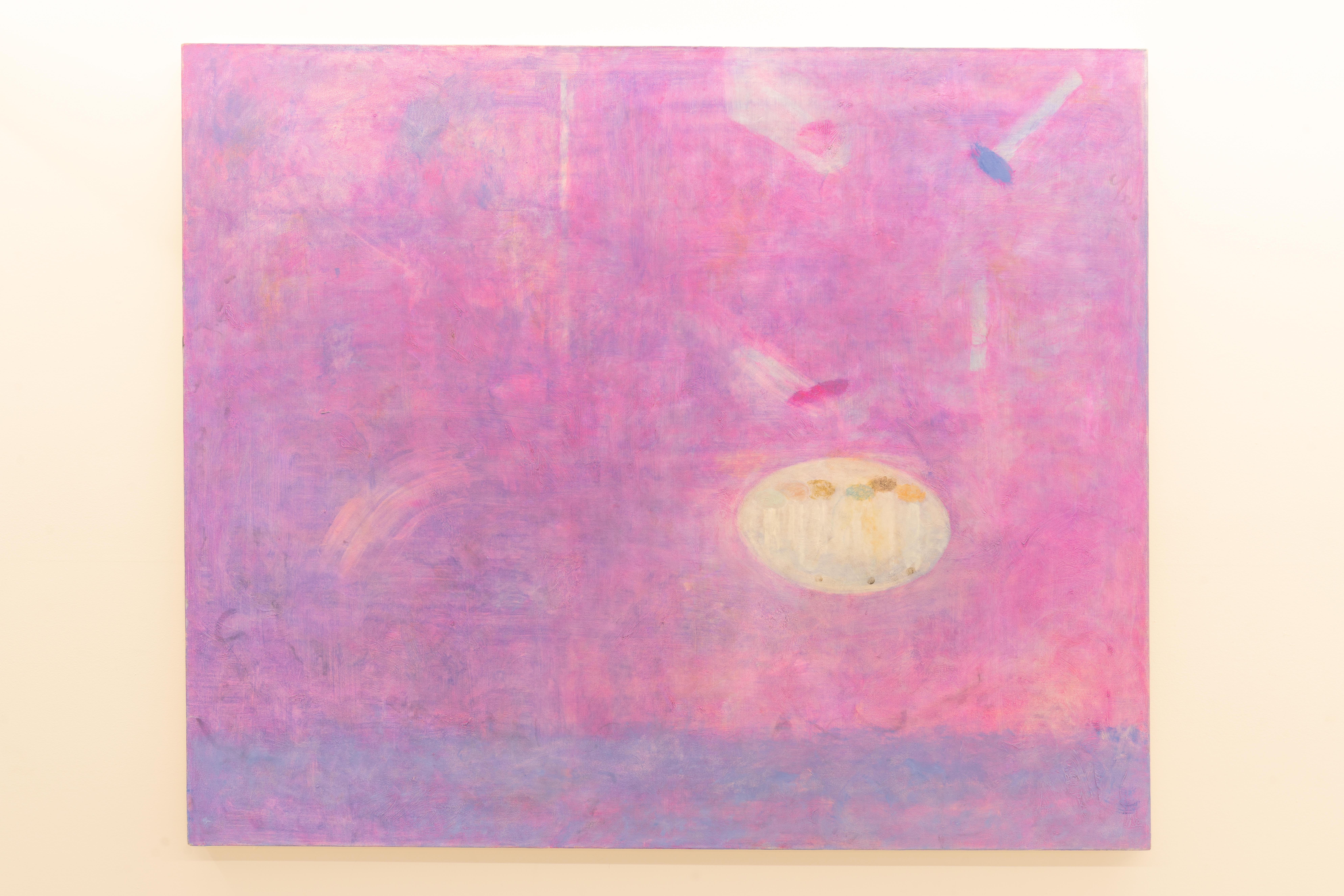
Butterflies are a motif that occurs frequently with Moore’s work. Their classical symbolic properties — maturation, reincarnation, and transformation — inspire their repeated presence. A group of butterflies is called a kaleidoscope, the namesake of one of her works in the exhibition. Moore finds herself thinking about how butterflies are seen as symbolic, fantastical forms as well as representatives of the beauty of our natural world.
Shirley’s O.U.D. (Luna Moth) shows an apotropaic guardianship by copper IUD, literalizing art as spellwork. O.U.D. (Luna Moth), is informed by cycles and change and the archetype of transformation as a potentially protective force — whatever is lost in the “death” element inherent to all cycles is necessary for every rebirth. There is a sense of protection in that shedding and loss. Feel Free (Hawk Moth) examines feeding cycles. Moths eat oleanders, poisonous plants to humans and other animals. Poison for one life can be food to another. What an extreme spectrum, how often we experience this dichotomy in our lives. Shirley began this piece in the days after a brutal break up, one that shook her to her core. She looked for a way to remind herself that the dissolving stage of the chrysalis leads to a metamorphosis. The black pearls attached to the mosaic tether the idea that there’s a potential for a beautiful outcome through hardship. A pearl is formed after an initial invasive irritation to the oyster.
The butterflies socialize and float amongst each other to pollinate the living ecosystem of this show, opening on the longest, sunniest, most fertile day of the year.
Mollie Marie Conlee (b. 1991 El Paso, TX) is a multi-disciplinary artist exploring the limits of trust and value. Her studio practice arises from the conflicting demands of material and spiritual life which peaked following the births of her children in 2014 and 2018. The themes of birth, interdependence, and maternal lineage are recurrent themes in Conlee’s work, which draws on personal and shared mythologies to record thought forms reconstructed from familiar Western iconography and literature. As a collector of memorabilia, she employs materials and techniques from the realms of domestic craft, decorative arts, children’s media, and retail ephemera to suggest the dynamics of unseen hierarchical influences. Mollie lives and works in Boulder, CO and New York, NY.
Aidan Koch’s (b. 1988 Seattle, WA) work looks at complex inter-being between humans, their non-human cohabitators, and the landscapes they are situated in through constructing narratives with drawings and objects. She’s published six graphic novels, exhibited internationally, and founded the Institute for Interspecies Art and Relations in 2017. She lives and works in Landers, California, on unceded, ancestral Serrano land with three dogs, two doves, and one other human.
Jane Margarette (b. 1985, San Diego, CA) is a Filipino-American artist living and working in Los Angeles. She received her MFA from the University of California Los Angeles (UCLA) in 2020 and her BFA from California State University Long Beach in 2016. She has recently exhibited work in solo and group exhibitions at Anat Ebgi Gallery, Los Angeles (2022); Moskowitz Bayse, Los Angeles (2022); Tiger Strikes Asteroid, Los Angeles (2021), among others. She has upcoming solo exhibitions at Gallery 1969, New York (2022) and Ruttkowski;68, Paris (2023), and group exhibitions at Galerie Wolfsen, Denmark (2022); Ruttkowski;68, Paris (2022); Sargent’s Daughters, Los Angeles (2022); and CFHILL, Stockholm (2023).
Jade Forrest Marks is an herbalist, stylist, and artist living and working in New York. Jade makes plant medicine and teaches through 69herbs, their inter-disciplinary herbalism project centered on trans and queer health and accessibility. Their work has been featured in the New York Times, Cultured Magazine, and Something Curated.
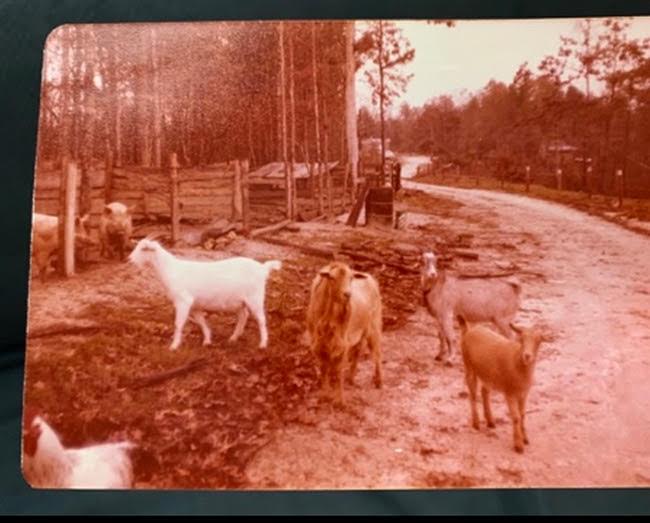
Brigid Moore (b. 1988, New York, NY). Lives and works in New York, NY. The process of painting is a vehicle for the artist to get to the bottom of her thoughts. There is a forensic quality in her process of uncovering emotional qualities and associations she has with her subjects, which often appear to be innocuous at an initial glance. Making art aids the artist in slowing down, and meditating on the uncomfortable truths of discipline and trauma behind fantasy in our everyday lives. An overarching use of nostalgia and memory in the form of fragmented images.
Leah Shirley (b. 1988 Austin, TX) She received her BFA in Photography from Columbia College Chicago and her MFA in Sculpture & Extended Media from the University of Texas, Austin. Her work traverses the intersections between her embodied research in astrology, ritual and materials. She has participated in group exhibitions at venues throughout the US including the Visual Arts Center, (Austin, TX), New Release Gallery (New York, NY), Orgy Park (Brooklyn, NY), Woman Made Gallery (Chicago, IL) as well as a solo exhibition at Genesis (Milwaukee, WI).