
Exhibition · 47 Canal
Cici Wu
Auld Lang Syne (Prelude)
Opens Oct 1 · through Nov 7
About the show
47 Canal presents its inaugural exhibition at the gallery's new Chelsea location: Auld Lang Syne (Prelude), a solo presentation of new work by New York–based artist Cici Wu (b. 1989, Beijing; raised in Hong Kong). This is Wu's third solo show with the gallery, following her previous exhibitions Lantern Strike (2021) and Upon Leaving the White Dust (2018). Rooted in her studies in cinema and experimental media, Wu's interdisciplinary practice probes the limits and ruptures of historical archives. Across sculptures, drawings, film, and installations, she attends to migratory aesthetics and to individual and collective memories that refract across space and time. Auld Lang Syne (Prelude) extends Wu's inquiries into the social, cultural, and political through the ephemeral medium of light. This new body of work suggests that the act of returning can intimately contour and shape unfinished histories and elucidate relations between past and present generations, between the material and the ephemeral.
The namesake of Wu's exhibition is taken from a song traditionally sung on New Year's Eve in the Anglophone world to mark both a conclusion and an opening. During the interwar period of the twentieth century, "Auld Lang Syne" traversed the globe: it was popularized in Korea by Western missionaries, in South Asia as a Bengali song, and in the Japanese school curriculum––still played at graduation ceremonies or to signal the end of the day. In presenting history as a continuum, Wu gestures toward its gaps by employing humble forms and delicate materials to evoke a sense of transformative potential. Here, her sculptures harness the odd temporalities between personal and collective memory to imagine a trans-imperial and intercultural narrative across the region of Northeast Asia. She links disparate periods of geopolitical turmoil in the twentieth century to our post-global, contemporary moment, taking on a new formal approach to her protocinematic objects. Some are forms that have, through repetition, become signature to her practice and growing lexicon.
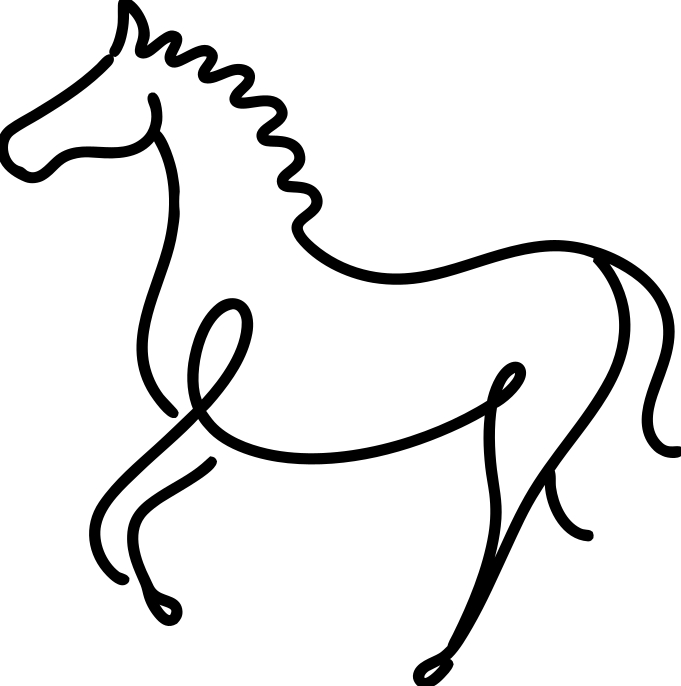
Installed in the gallery are eleven discrete lantern sculptures that take on various forms. Two door-shaped lanterns, positioned ajar, suggest both entrance and exit. This universal symbol is juxtaposed with more specific forms from folklore like the Buddhist goddess Kuan-yin, and Princess Bari, a Korean goddess who guides souls of the deceased into the afterlife. There are also further references to earthly travel in the airplane, horse, and train, which recur in Wu's practice as early as 2017. They link modern modes of international transportation to cinematic history and the transference of stories and myths.
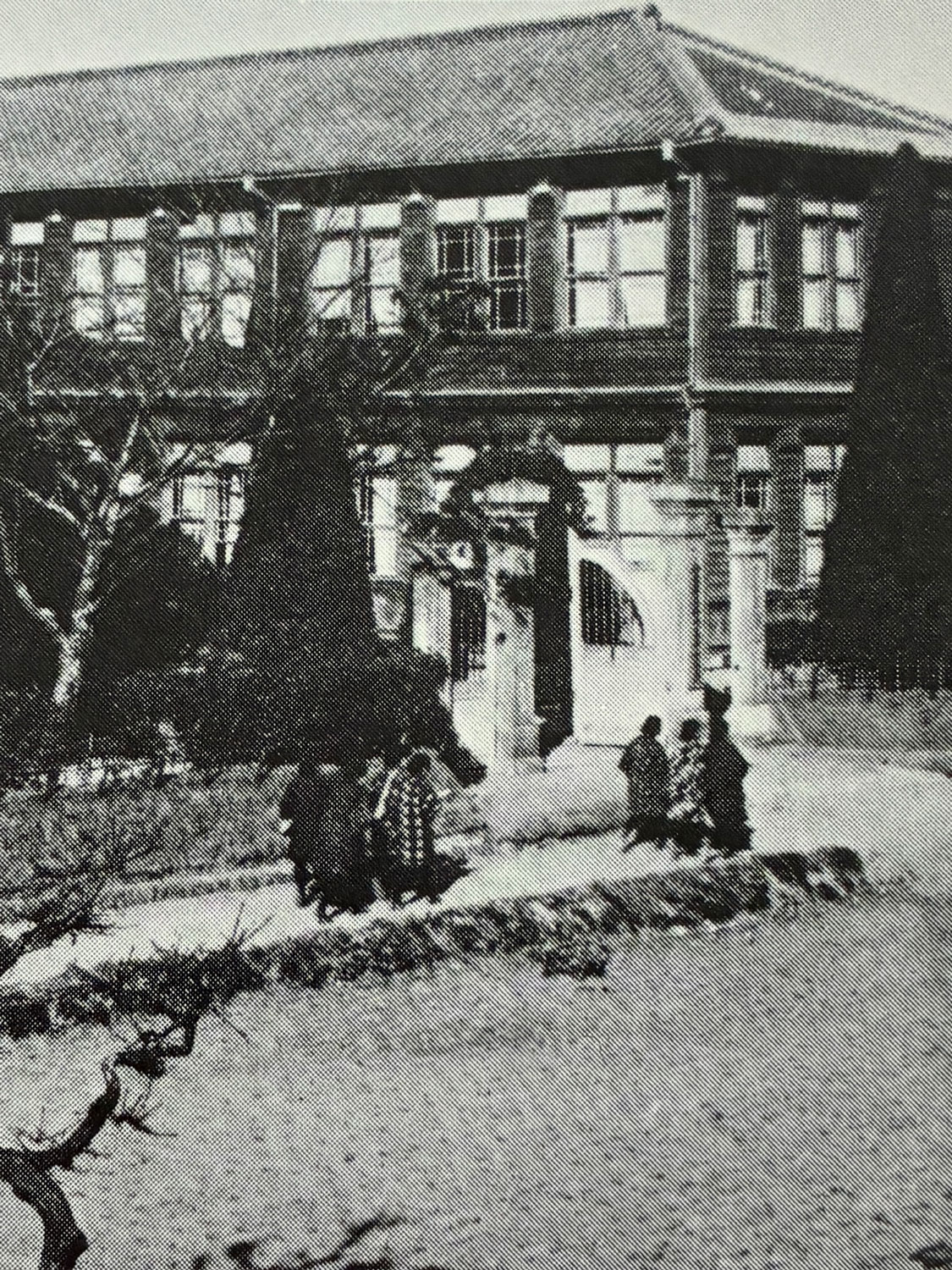
An intimately scaled schoolhouse sits within the installation, which the artist modeled after an archival image taken in 1913 of an all-girls' high school in Shizuoka, Japan. During this interwar period, exchange students from China attended schools like this one in Japan to study Japanese and English languages. Wu focuses on this period of the early twentieth century to build on a layered, temporal framework that moves beyond accepted notions of geography and spatial migration.
Each sculpture in Auld Lang Syne (Prelude) has been programmed to perform a section of the eponymous song through strobing lights. The sequence of the works corresponds to the order of the lyrics, and the frequencies of the lights change based on the song's five keys, animating the rhythm of the exhibition's kinetic, cinematic glow. At the end of the sequence is a replica of a 16-mm projector and looper. Wu constructs a length of the "film" from rice paper, which resembles celluloid stock in its texture. Reiterating the loop of "Auld Lang Syne" in the gallery space, the projection's cycle, too, suggests a form that connects beginning and end, as well as life and death.
Here, Wu takes an architectural approach to these protocinematic objects. Taut bamboo armatures and willow branches, local to North America and new for the artist, serve as the armatures for her illuminated sculptures. She employs mulberry paper as ligatures and skins that diffuses the glowing light within her lanterns, some of which are applied with ochre mineral pigment—bestowing a warm radiance. The sheer paper's delicacy belies its tensile resilience; its translucency captures and releases dancing shadows and dust.
Auld Lang Syne (Prelude) follows Wu's most recent multichannel installation at MoMA PS1's Greater New York 2026 which was initially commissioned by Palais de Tokyo for their exhibition Echo Delay Reverb in 2025. This installation, Upon Leaving the White Dust (go go she and not come back said go and don't come back) (2025), marked her return to a previous installation from 2018, which was recently exhibited at Berkeley Art Museum as part of Multiple Offerings, a major historical survey of the late Korean American artist Theresa Hak Kyung Cha (1951–1982). Wu's longstanding engagement with Cha's legacy and archive has in turn informed her artistic methodology into other significant projects such as her site-specific installation Lanterns from the Unreturned (2025), commissioned by Rockbund Art Museum, Shanghai. For Lanterns from the Unreturned, Wu researched the untold history of the museum's Art Deco-era building, which was previously used as a repository for books confiscated during the Cultural Revolution.
This will be 47 Canal's first exhibition at the gallery's new home in Chelsea, which it will share with Max Levai. Both galleries will run their respective programs across two distinct exhibition spaces located on the newly renovated ground floor of 529 Arts at West 20th Street.