Ended Oct 22
Daniel Boccato
Ghost Of
Sep 14 – Oct 22, 2023
More from Daniel Boccato on Gallop
This exhibition makes me think of the bear from the 2018 film Annihilation, which speaks in the voice of the woman it has eaten. In each of the works presented here, the viewer is subjected to something like osmosis; selectively permeable membranes through which artworks extend past their borders. Margins claim to be permeable barriers, a buffer, a delimiting zone necessary to avoid contamination between differently categorized spaces. This logic is founded in anxiety, a neurotic desire to first divide and then to protect the division. There is a fixation on boundaries, margins, and the complexities of their lack, their manufacture, their positioning, their dissolution– whether topologically, materially, or conceptually.
We see this idea very literally in Night Mode, where the artist has installed a green LED pharmacy sign prevalent in many European cities, and programmed it to turn on at sundown, expanding any margin between the sculpture and the architecture surrounding it as the entire gallery is bathed in green light. However the margins that most interest me are those that feel like contested borders or demilitarized zones– mutable margins.
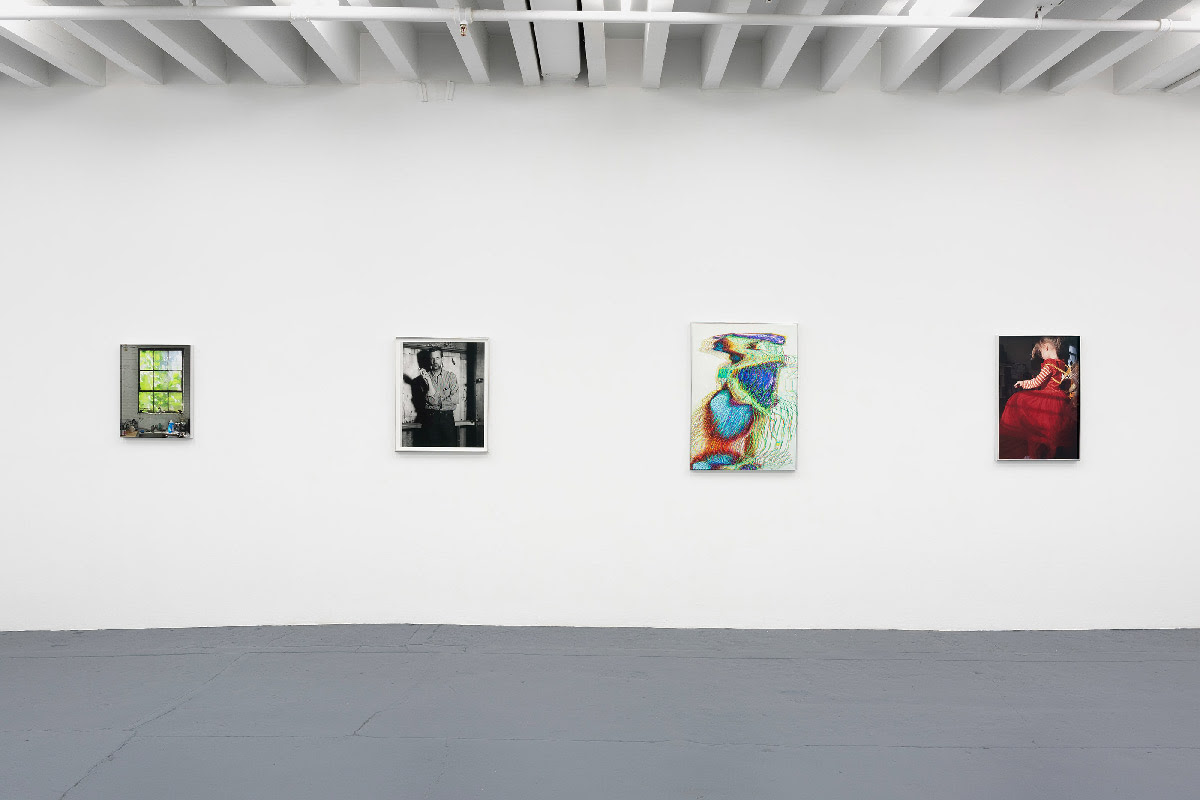
This type of mutable margin is most concretely represented by the fraudulent edges that the artist has given to its ghosts. As is often the case, it is difficult to put my accusations of fraud into words. The “edges” of the ghost works first give the impression of thick hides violently torn from some singular plane of perfect gloss; the surface of an unknown brute substrate having been perfectly polished and finished. The artist has fabricated an unrefined “edge” to these glossy planes, a border where the perfect surface ends and we see its rough substrate. On closer inspection however, it becomes evident that this substrate is in fact illusory and non-existent, what we first read as “edge” proves only to be a continuation of surface, a counterfeit perimeter where the perfect plane deforms itself into a new role.
I figured that Boccato’s ghosts were called such because they announce their deadness in the same breath as they present their vivacious glamor– their perfect image. This analysis of gloss is nothing new, there is of course the decades-old discourse of the postmodern interplay of a superficial perfection only possible through its structural supports of trauma, violence, and/or Freudian horror. In these ghost works however, what we are dealing with is something different, not just surface without substrate, but a situation where the fetishized surface, the continuous plane, imitates its substrate; a glossy exterior which mimics its brute interior. This dynamic is echoed in their titles, always a “ghost of” and never just a ghost on its own. Not unlike the nature of fiberglass itself, a shapeshifting material which has exteriority as its only intrinsic quality. A mutable replicatory surface which can never be only itself. That interiority might be constituted by nothing but its exteriority seems to me an apthomology of the social conditions in which we live at present– things are not what they seem, they are hysterically so.
The true edge of these works is not what is presented to us. The true edge– that is the work’s “perimeter” that we might begin to peel back in order to reveal some latent truth or hidden essence– exists not in the work itself, but rather behind it, in the margin between the undulating planes and the wall, where we see the melodramatic materiality of fiberglass.Once caught in this flickering margin between “interior” and “exterior,” “real” and “illusory,” the other works in this exhibition begin to fall into place. It would be cheap to propose that because lions have eyes, the concrete lions perched on quotidian objects might remind us that we too are objects in this world; as if we could ever forget such a fact in a city so overpopulated with them. However, the artist’s continued persistence on placing concrete lions on top of other objects has begun to convince me that these works should be read less like a poem and more like a manifesto. In the frame of this exhibition there seems to be a hierarchy of inanimate objects where figuration reigns supreme.
Here, material and categorical divisions reveal themselves to be fraudulent, it becomes possible to consider these borders between sculpture and pedestal; or surface and substrate; or figure and non-figure as permeable and arbitrary. This position is one fixated on physical materiality and categorization. In sculpture space just as in social space there are divisions and then there are margins which control and protect the divisions.
—Ryan Cullen
Daniel Boccato (b. 1991, Campinas, BR) received a BFA from Cooper Union in 2014 and has held solo exhibitions at Berthold Pott, Cologne, DE (2022, 2019); Formatocomodo, Madrid, ES (2021, 2016); Galeria Mascota, Mexico City, MX (2020); The Journal Gallery, New York, NY (2020, 2016); Ribot Gallery, Milan, IT (2018); Sorry We’re Closed, Brussels, BE (2017); and Kasia Michalski Gallery, Warsaw, PL (2015). Two-person exhibitions include Cannibal Valley with Loup Sarion at M+B in Los Angeles, CA (2019) and FLAT with Al Freeman at Carl Kostyal in London, UK (2018). Boccato's work has been included in group exhibitions such as Small Paintings, Venus Over Manhattan, New York, NY (2022); Ehrenfeld at Berthold Pott, Cologne, DE (2021); Friends, and Friends of Friends at the Schlossmuseum, Linz, AT (2020); Documento, Embajada, San Juan, PR (2020); Present at the Musee & Jardins Van Buuren, Brussels, BE (2018); and Pretty. Vacant.. at the Art Academy of Cincinnati, OH (2017). Boccato's solo exhibition Zone, curated by Giovanna Manzotti, opens at Galeria Krobath, Vienna, AT on September 8th, 2023. The artist lives and works in New York, NY.