
Ended
A.R. Penck
The Temple of Many Faces
Feb 26 – Apr 30, 2025
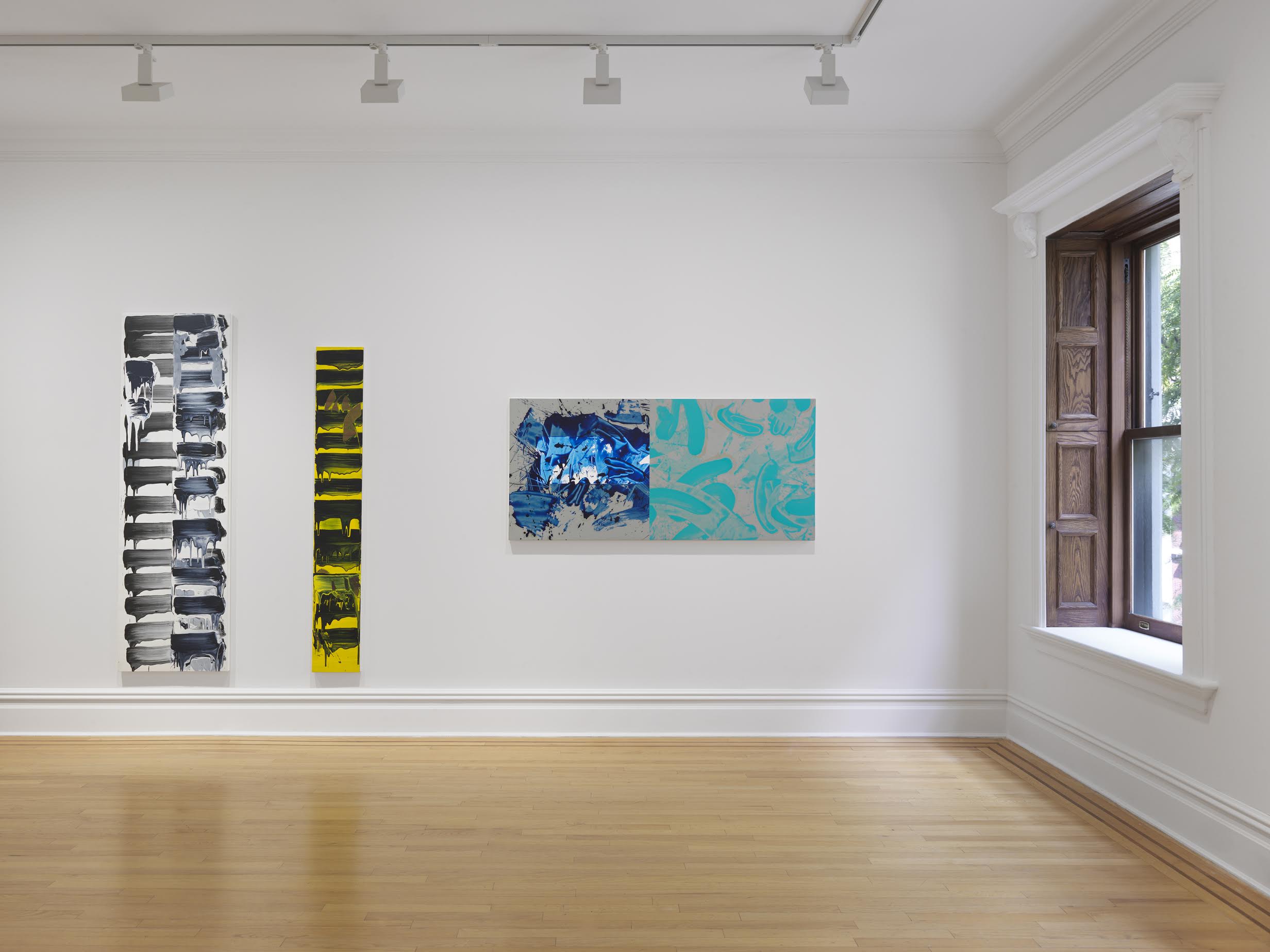
Michael Werner Gallery, New York is pleased to present The Temple of Many Faces, an exhibition of self-portraits by one of the most important artists of post-war Germany, A.R. Penck (b. 1939 in Dresden, d. 2017 in Zurich).
Self-portraiture is an integral part of A.R. Penck's artistic development during his life in the German Democratic Republic. Born Ralf Winkler, A.R. Penck shifted between pseudonyms to elude East German authorities who continually surveilled and harassed him. Unable to exist as his true self, self-portraiture is a way of affirming his individuality and identity as an artist.
Penck's work develops separately from the West, learning about the history and contemporary developments of Western art through books and reproductions. He is greatly inspired by Rembrandt, who famously painted over 100 self-portraits during his lifetime, and by Picasso, whose artistic developments can be charted through his self-portraits. Penck is also inspired by his famous post-war contemporary in the United States, Andy Warhol, who mythicizes himself, becoming the subject of his own work. Penck's work develops with the keen awareness that self-portraiture has a deep, rich history in Germany, having been invented by Albrecht Durer in 1500.
The paintings in The Temple of Many Faces are made after 1980, the year Penck emigrates to the West. Crisscrossing the Western Hemisphere and at the height of his international fame, Penck views himself as a "tourist" and visual researcher. By this time, identity is an entrenched, core topic in his work. Art critic John Yau writes: "One of the thematic threads running throughout Penck's art is identity, a concept that taps the deepest currents of his life. His highly considered response speaks to an issue his generation had to face: that of being a German artist who had to establish an identity despite having been separated from the past and much of his country. This is not to suggest that Penck is a regional artist or even simply a German artist. His identity is much broader, for his imaginative art effectively addresses alienation, solitude, and isolation, which have become integral parts of modern life."
Two decades of Penck's paintings, from 1982 to 2002, are on view in The Temple of Many Faces. The exhibition shows that the self-portrait is a natural, instinctive art form for the artist to explore and assert his identity as an autonomous East German artist of international stature and importance in the 20th century.
While in the GDR, A.R. Penck receives the help of Georg Baselitz, Jorg Immendorff, and Michael Werner, who smuggle his work westward where they cause a sensation. A.R. Penck's first solo museum exhibition occurs in 1971 at Museum Haus Lange, Krefeld. The following year he participates in Documenta 5 (he contributes major works to three subsequent presentations of Documenta). He is awarded the prestigious Will Grohmann Prize of the Academy of Arts in West Berlin in 1975. He participates in the groundbreaking exhibitions Zeitgeist (Martin-Gropius-Bau, Berlin, 1982) and New Art (Tate, London, 1983). Overall, his career spans more than five decades. Numerous solo exhibitions worldwide include Museum Ludwig, Cologne; Tate Gallery, London; Kunsthaus, Zurich; Schirn Kunsthalle, Frankfurt; Musee d'Art Moderne de la Ville de Paris; and Kunstmuseum den Haag. A.R. Penck dies in Zurich in 2017.
A full-color catalogue with text by Nils Emmerichs and an interview between Penck and himself titled Where Time is Headed accompanies the exhibition.