Ended Jan 6
Paulina Olowska
Squelchy Garden Mules and Mamunas
Nov 21, 2023 – Jan 6, 2024
More from Paulina Olowska on Gallop
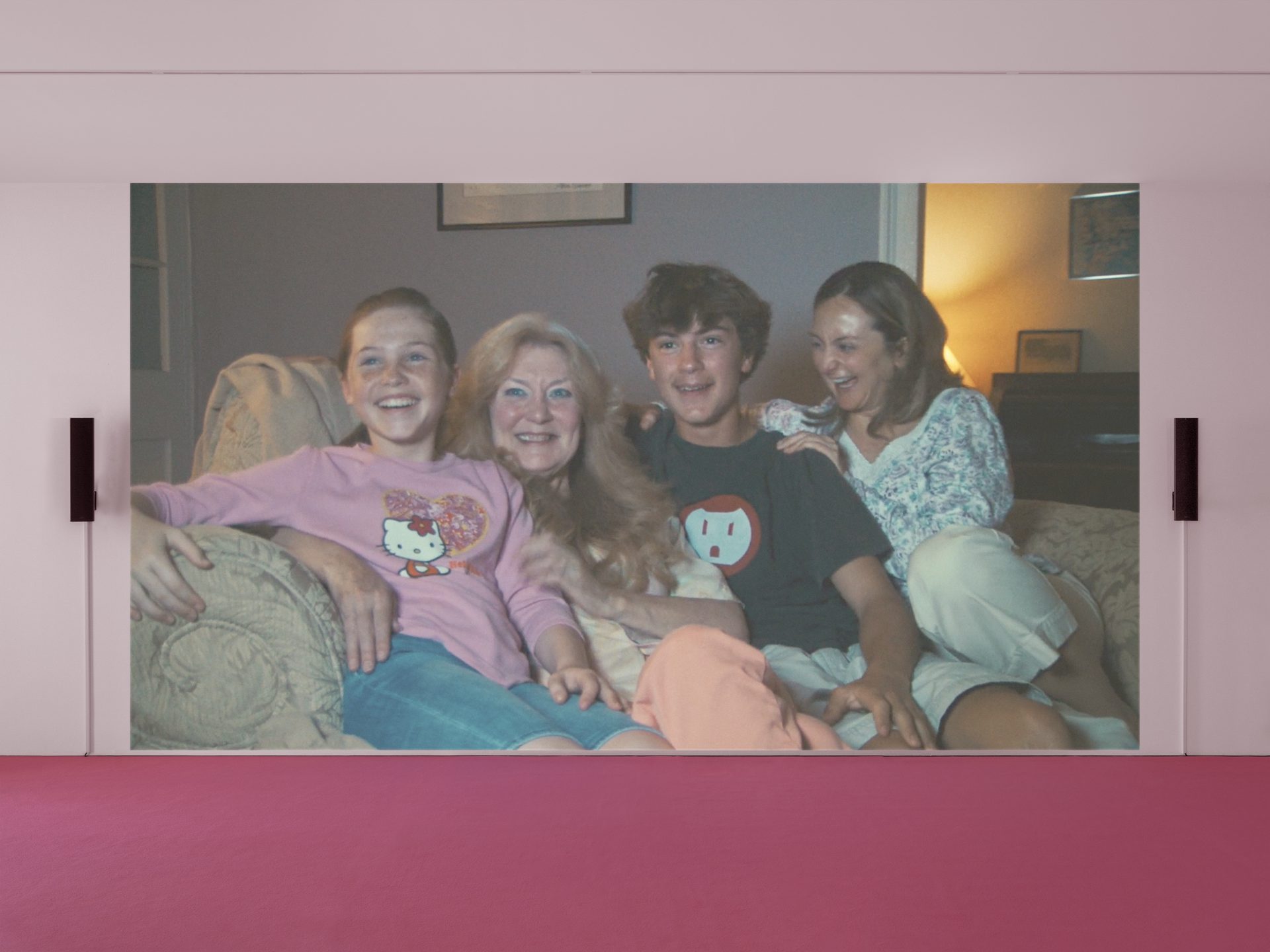
Pace is pleased to present Squelchy Garden Mules and Mamunas. Marking Paulina Olowska’s debut exhibition with Pace since joining the gallery’s programme in 2022, the artist showcases a suite of paintings, collages, film, and sound installation across the entirety of Pace’s Hanover Square gallery. Centring female perspectives and narratives, Olowska’s presentation develops her explorations into Slavic folklore, mythology, and the collective capabilities of, and our intrinsic connection to, nature.
Titled after Olowska’s eponymous video installation, first included in the artist’s 2022 exhibition at Kistefos Museum in Norway, Squelchy Garden Mules and Mamunas reimagines Slavic mythological deities and demons in new modernist lights. The Mamuna, literally translated from Polish as strangewife, is a female swamp demon closely associated with rivers, streams, and thickets. Historically characterised as menacing, Olowska portrays her Mamunas as earthly androgynous nymphs, more magical than malicious.
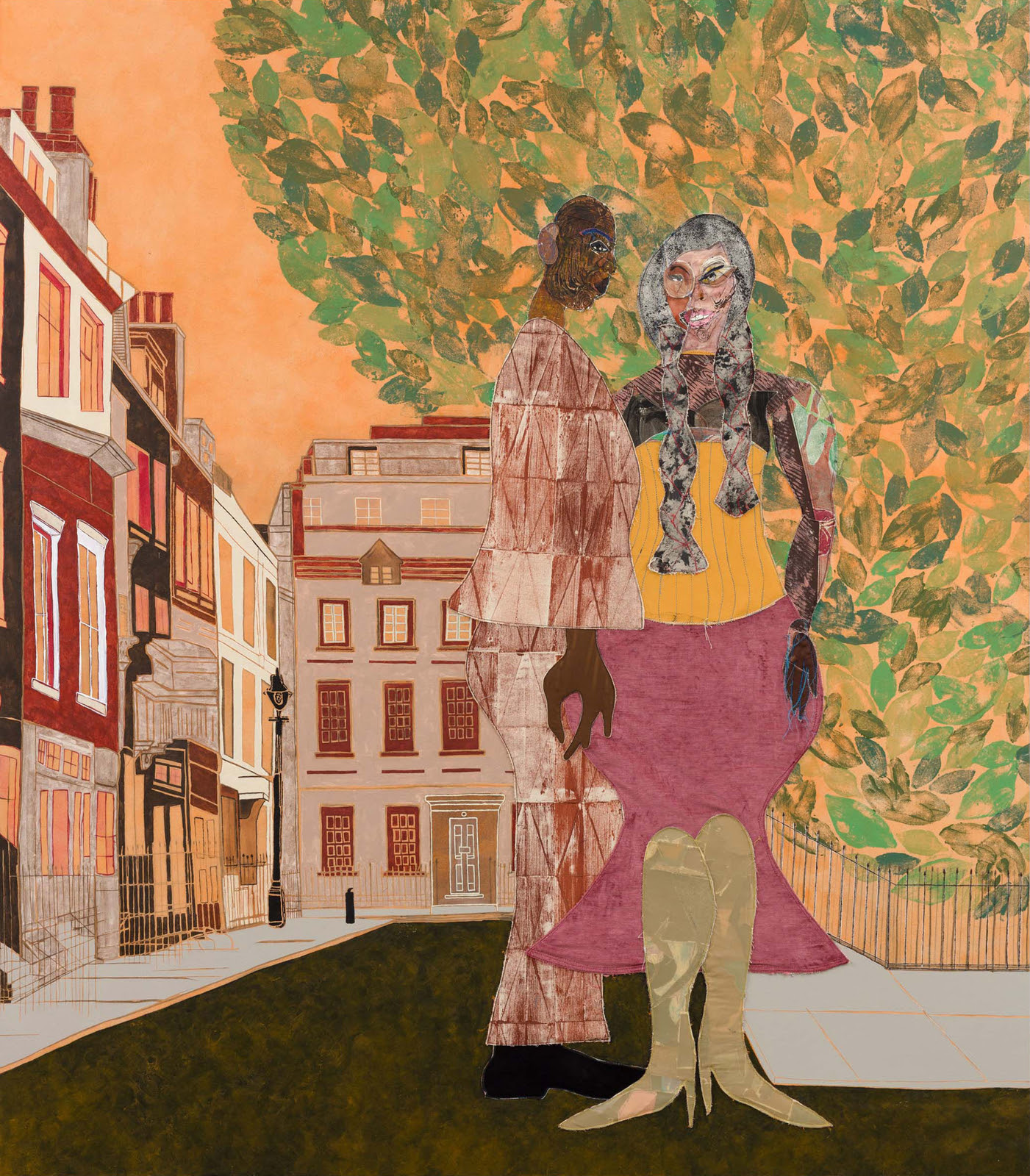
Large-scale paintings, each titled after deities from the Slavic pantheon, feature Olowska’s Mamuna-muses gathered amongst the birch and pine forests of northern Europe. By using found fashion photographs as the basis for her compositions—from sources such as Polish Vogue, and the photographers Arthur Elgort and Branislav Šimončík—the artist subverts mass media and fine art to recover female mythological figures from their two-dimensional past. In these paintings, women commune with their surroundings, with themselves, and with the viewer.
Throughout the upper two galleries of the exhibition, Mamunas peer out from video installations nestled within woodland hollows. Suggestive of gilt antique mirrors, the sculpted frames open a literal window into Olowska’s reconstructed matriarchal world. Kadenówka Bouquet(2023), the only framed painting in the exhibition, is based on an image taken at the Kadenówka in Rabka, home to Artist House Kadenowka Foundation of which Olowska is founder and president. Designed in 1930 by Adam Kaden, Kadenówka has since been home to a health spa, tailoring school, hospital accommodation, and is now run by Olowska as an artistic and cultural retreat, hosting meetings, lectures, and performances.
Further complicating notions of interior and exterior, two ornate chandeliers are featured in the show. Working in collaboration with the artist Jessica Segall as a continuation of Segall’s Nom Nom Ohm series, Olowska’s chandeliers are a material representation of her commitment to artisan craft and artistic exchange. Bedecked with ceramic and handblown glass mushrooms, pinecones, fruits, vegetables, and potatoes, the chandeliers recreate reciprocal systems and inter-species networks of communication—coined by Dr Suzanne Simard as the Wood Wide Web. Research on fungi suggests they can generate electrical signals through their mycelial webs: Olowska symbolically harnesses this energy to charge her chandeliers and illuminate the exhibition. Here, traditional signifiers of bourgeois domesticity, like Olowska’s frames, are made wild through their contact with earthly goddesses.
In the lower ground floor gallery, Olowska stages a tableau vivant featuring the costumes from her Kistefos performance. Arranged in compositional motifs mirroring those found in the artist’s paintings for the exhibition, the handmade mannequins appear corporeal in their softer lighting. The artist’s interest in animism—the belief that objects, places, and creatures all possess a distinct spiritual essence—informs the exhibition throughout.
Pace Gallery and Paulina Olowska would like to thank the Let It Go team: Sayuri Chetti; Amy Corall; Yasmin el Yassini; Rick Geene; Lou Renard, and Kamil Sznajder. Jessica Segall collaborated with Olowska on the chandeliers, with additional support from Christoph Krane. Photographs by Arthur Elgort, Kacper Kasprzyk, and Branislav Šimončík were the source for paintings in the exhibition. Additional thanks to William Flatmo, Laura Grudniewska, Dorota Kidziak, Monika Kucel, Aleksandra Lewandowska, Viktoriia Semenska, Kate Smith-Raabe, Christen Sveeas and the Hahnel Bujalski Spółka team for all their help with Squelchy Garden Mules and Mamunas.
Paulina Olowska’s (b. 1976, Gdansk, Poland) multifarious practice spans painting, collage, sculpture, video, installation, and performance. Her work is deeply engaged with the political and social histories of Eastern Europe, American consumerism and pop culture, feminism, and the aesthetics of fashion advertisements. Olowska’s figurative paintings often feature women in a wide range of environments, from offices and shops to farms and jungles, challenging art historical conventions as well as traditional notions of femininity in Eastern and Western cultures. She has had one-person exhibitions at Kunsthalle Basel; the Stedelijk Museum, Amsterdam; the Zacheta National Gallery of Art, Warsaw; and Kistefos Museum, Norway. Olowska received the prestigious Aachen Art Prize in 2014, with an associated exhibition at the Ludwig Forum for International Art, Aachen, Germany. She has also staged performances at Tate Modern, the Carnegie International and the Museum of Modern Art, New York. Olowska presented the ballet “Slavic Goddesses—A Wreath of Ceremonies” at the Kitchen, New York, in 2017 and "Slavic Goddesses and The Ushers” at the Museo del Novecento in Milan in 2018 and at the Kestner Gesellschaft in July 2023. Her work was featured in the 2017 National Gallery of Victoria Triennial in Melbourne and the 2018 Liverpool Biennial, as well as in group exhibitions at the Museum of Modern Art, Warsaw; mumok, Vienna; Hamburger Kunsthalle, Hamburg; Migros Museum Für Gegenwartskunst, Zürich; New Museum, New York; Tate Modern, London, and LACMA, Los Angeles.