Opens tomorrow
Beatriz Zamora
The Lost Works
Nov 6 – Dec 20, 2026
More from Beatriz Zamora on Gallop
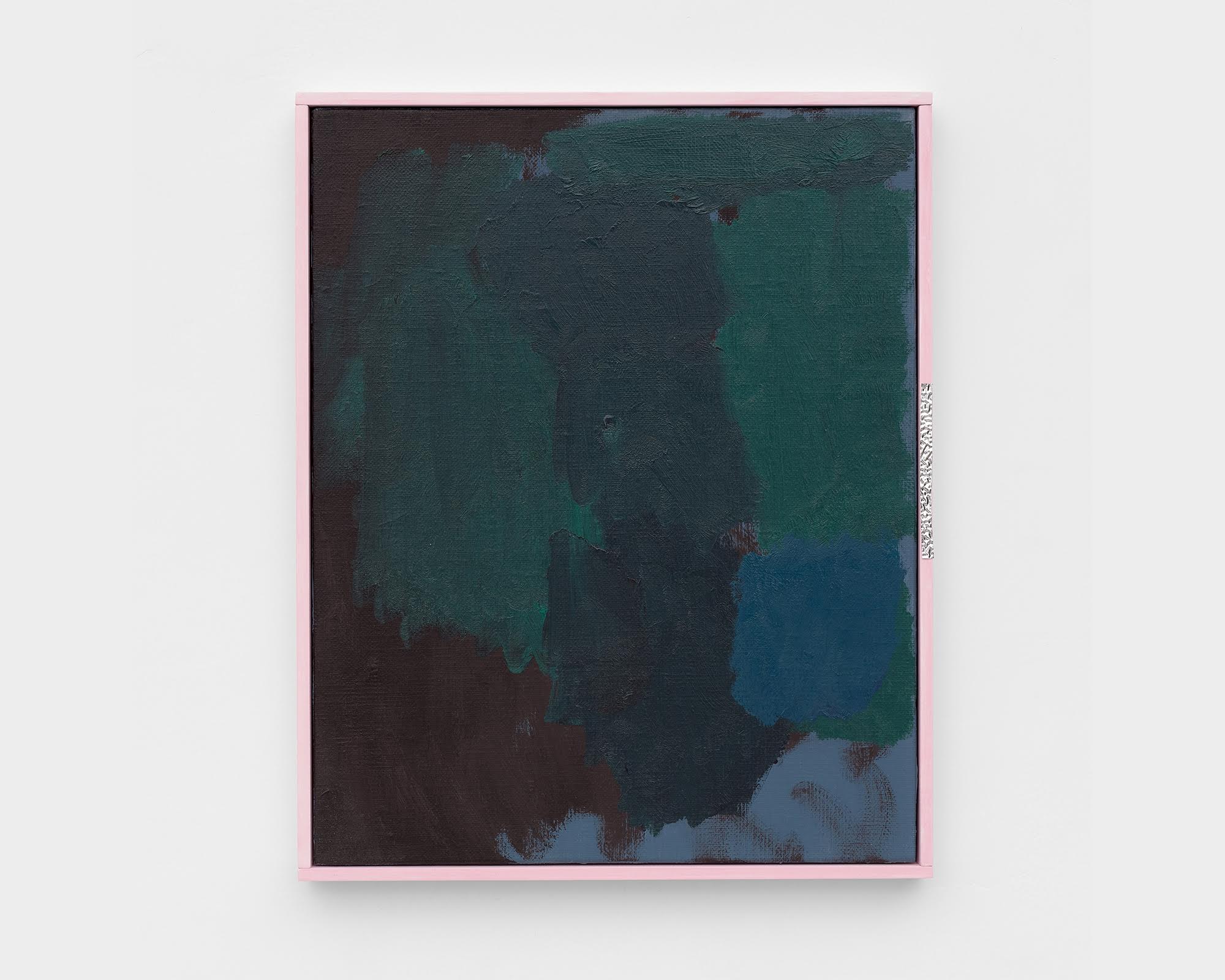
Here are ten paintings that for a long time made themselves known only as rumors. A rumor of their own existence, since they were presumed lost; the rumor of a murmur, the world’s, which reaches us only muffled (as it reaches the child growing in its mother’s womb); a rumor like the rumble of volcanoes about to roar; a rumor that carries certain anecdotes about their rare and singular author, whose life has been made of ruptures and upheavals. Beatriz Zamora painted them between 1977 and 1979, in the first years of her definitive turn to Black.
Their excavation brings us back to a threshold in her story, which she started writing with color, in a surrealist vein. In 1977, at the Palacio de Bellas Artes in Mexico City, she presented La Tierra (The Earth), a group of heavy works made of crushed marble, stubble, and grain. Earth is not a motif there but the source. Black already dominates, set against ochre, thereby echoing the opposition drawn by ancient Egypt: Kemet, the black of the silt, against Deshret, the red land of the desert. The following year, the painting prize of the Salón Nacional de Artes Plásticas, that arbiter of artistic taste, was awarded to her for a work from the El Negro series. From then on she would remain faithful to her project, never betraying the idea that drives her: that Black is inexhaustible and has nothing to do with reduction.
The history of the black monochrome is dominated by a logic of subtraction, whether one thinks of Malevich’s zero of form, Reinhardt’s last paintings, or Soulages’s explorations of light—a history that is, moreover, essentially Western and male. Zamora’s Black stands against it: it is an “absolute,” the “symbol of symbols,” and it “includes all colors, forms, and contents.”[1] Chinese painters held that ink, well handled, could contain the five colors[2]. Zamora made this conviction her own, except that she arrived at it through matter rather than the brush.
Black, in truth, imposed itself on her before painting ever did. As a child, she learned from her nanny, whom she had asked, that we die when we stop breathing. She then set out to try her hand at death: night after night, seated on a stone in the garden, she practiced apnea, until a near-death experience gave her what she still describes as a knowledge of the universe, an encounter with it. This is how Black came to her: at the edge of death, in its company—not as a confrontation with mourning, but as a revelation. Hence her intuition: no word can contain Black. She would never try to define it or pin it down, only to transmit it.
Earth is the medium, to be sure, but so is the artist—in the sense that she acts as a vehicle of transmission, faced with the need to produce “exogenous images,” external to the body, in order to render its “endogenous images,”[3] in keeping with a tradition rooted in the “symbolic exchange” between death and the image[4]. Therefore, Zamora’s Black is not a matter of style, but a cosmology including humans. We are black inside, she asserts, and the branching of our neurons mirrors the nervous structure of the cosmos. The paintings that follow from this “describe for us the origin of the Universe and of the Earth, but with us inside,”[5] as one could read of La Tierra in 1977—with all the violence that implies, witness a certain “crevice that aches from its own fissure.”[6] This Black also issues from the mother (cosmic though she may be), for Earth is “the womb and the tomb,”[7] as Zamora puts it. As an epigraph to La Tierra, she had chosen a maxim from Laozi: “Whoever knows white but holds to black possesses the measure of the world.”[8] And so we find her surveying the world to harvest the materials her paintings are made of, and thereby take its measure. The spirituality that guides her proceeds from no doctrine but from nature itself: the copal she burns and the volcanic earth she uses, the Mexican altar of the Day of the Dead, the Taoist maxim, the vocabulary and vast numbers of astrophysics—all coexist there without hierarchy. Ecology is not a cause, but a cosmology: a worldview rooted in Nature, which reveals the “eloquent pulsar of fossil light that the gaze reactivates.”[9] What she shapes is not a color but the very form of Black. She is indeed a medium in every sense of the word—less the author of Black than the place it passes through. Her paintings, she says, speak for themselves; it falls on us to learn their language.
Such a stance would bring her many hardships. In Mexico, the woman who kept her distance from politics as much as from the market ran up against an openly hostile art establishment. The Black she has practiced for five decades is the proof of her patience, she says, but also of her tenacity, for she left everything behind to devote herself to it wholly and exclusively from the mid-1970s on. The ten paintings, survivors of so long an obscurity, bear witness to this in turn: now comes the day of their delivery.
—Guillaume Blanc-Marianne
Beatriz Zamora (b. 1935 in Mexico City, Mexico; lives and works in Mexicy City) studied painting alongside muralist José Hernández Delgadillo, art history at the Instituto de Cultura Superior, A.C., and painting at L’École des Beaux-Arts in Paris, France. Since 1977, Zamora has worked only in Black, following an obsession with the sublime essence of the universe that the color represents in her personal metaphysics. Her practice is an unrelenting pursuit of absolute truth through painting, distilled to a single color that represents the origin of everything in existence, the first principle of life and the universe. Zamora works with different techniques, materials, and surfaces; she has used oils and acrylics, and also experimented with creating her own pigments, forming sands, dusts, and stones from charcoal, obsidian, oxidized metals, mineral coal, semiprecious stones, and other dark materials.
After being awarded first place in the National Painting Salon in Mexico City in 1978, on the day of the awards ceremony at the Palacio de Bellas Artes, a group of disgruntled artists took down her work, "El Negro #4" with the intent to kill Zamora by dropping it on her as she was passing through the palace staircase. The work proved too heavy, and so the group tried to destroy it instead. Following this incident, several more attempts have been made on Zamora’s life, and she left Mexico City for New York in 1980. In 1988, when she tried to renew her visa to re-enter the United States, she was denied and has remained in Mexico City since.
Zamora has had recent solo exhibitions at Museo de la Ciudad de Mexico (2025); Galeria Enrique Guerrero (2024), Salon de la Plastica Mexicana (2023), and Labor (2020), all in Mexico City. Her work is included in numerous museum collections in Mexico, including the Jumex Museum, the Tamayo Museum, the Museo de Arte Moderno (INBA), the Museo Unversitario de Arte Contemporaneo (MUAC), and others.
1 - Beatriz Zamora, quoted in Adriana Moncada, [untitled article on the exhibition Lo negro del silencio en el cosmos, Academia de San Carlos, Mexico City], undated press clipping, artist’s archive. Translation by Guillaume Blanc-Marianne (GBM).
2 - Zhang Yanyuan, Lidai minghua ji [Record of famous painters of successive dynasties], ca. 847: “When ink is wielded, the five colors are all present” (運墨而五色具). Translation by GBM.
3 - Hans Belting, An Anthropology of Images. Picture, Medium, Body, trans. Thomas Dunlap (Princeton & Oxford: Princeton University Press, 2011), 15. Translation by GBM.
4 - Ibid., 4, 87. Belting here quotes Jean Baudrillard’s notion of “symbolic exchange”.
5 - Alberto Dallal, “Beatriz Zamora: el sentido del universo,” Revista Mexicana de Cultura (Sunday supplement of El Nacional), no. 425, March 27, 1977; reprinted in La Tierra: Obras de Beatriz Zamora, exh. cat. (Mexico City: INBA, 1977). Translation by GBM.
6 - “Pintura terrible, gran arte,” unsigned article, press clipping, [1977]. Translation by GBM.
7 “Pintar la Tierra, vital necesidad de Beatriz Z.,” unsigned article, press clipping, Mexico City, 1977. Translation by GBM.
8 Quoted in Alaíde Foppa, “Los gestos de la Tierra,” press clipping, May 8, 1977. Translation by GBM.
9 - Pedro Schneider, “Beatriz Zamora. La magia de la luz fósil,” letter of recommendation to the Pollock-Krasner Foundation, Mexico City, February 2002. Translation by GBM.